



CDK2 Protein, Human (His)

Based on 1 Customer Validation
CDK2 is an important serine/threonine protein kinase that plays a critical regulatory role in the cell cycle, especially during meiosis. It phosphorylates various substrates (CTNNB1, USP37, p53/TP53, NPM1, CDK7, RB1, BRCA2, MYC, NPAT, EZH2) and coordinates centrosome duplication and initiation of DNA synthesis at the G1-S transition. CDK2 Protein, Human (His) is the recombinant human-derived CDK2 protein, expressed by E. coli , with N-6*His labeled tag.
- Species: Human
- Source: E. coli
-
Storage:Stored at -80°C for 1 year from date of receipt. It is stable at -20°C for 3 months after opening. It is recommended to freeze aliquots at -80°C for extended storage. Avoid repeated freeze-thaw cycles.


To place orders, for customer services and technical support, please contact: MedChemExpress USA
Tel: 609-228-6898 E-mail: [email protected] [email protected]


-
 Biological Activity
-
Technical Parameters
-
Product Properties
- Documentation
- Help & FAQs




Biological Activity
Description
CDK2 is an important serine/threonine protein kinase that plays a critical regulatory role in the cell cycle, especially during meiosis. It phosphorylates various substrates (CTNNB1, USP37, p53/TP53, NPM1, CDK7, RB1, BRCA2, MYC, NPAT, EZH2) and coordinates centrosome duplication and initiation of DNA synthesis at the G1-S transition. CDK2 Protein, Human (His) is the recombinant human-derived CDK2 protein, expressed by E. coli , with N-6*His labeled tag.
Background
CDK2, a serine/threonine-protein kinase, intricately regulates the cell cycle, playing an indispensable role in meiosis while being dispensable for mitosis. Operating at the nexus of cellular processes, CDK2 phosphorylates a diverse array of substrates, including CTNNB1, USP37, p53/TP53, NPM1, CDK7, RB1, BRCA2, MYC, NPAT, and EZH2. It orchestrates critical events such as centrosome duplication and DNA synthesis initiation at the G1-S transition, modulating G2 progression and finely tuning the balance between cellular proliferation, death, and DNA repair in human embryonic stem cells. Activated sequentially by cyclin E and cyclin A2, CDK2 regulates the transition from S phase to mitosis. Notably, its phosphorylation of EZH2 is implicated in maintaining H3K27me3 and epigenetic gene silencing. CDK2's involvement extends to DNA damage responses, where it regulates the G1-S phase checkpoint, phosphorylates BRCA2, and modulates homologous recombination-dependent repair. Furthermore, CDK2 participates in diverse signaling pathways, including vitamin D-mediated growth inhibition, NO-mediated signaling, and the phosphorylation of substrates such as FOXP3 and ERCC6, highlighting its multifaceted role in cellular physiology.
Verified Bioactivity
The kinase activity of this recombinant protein is testing in progress, we cannot offer a guarantee yet.
MCE Validation Data
-
Purity - SDS-PAGE
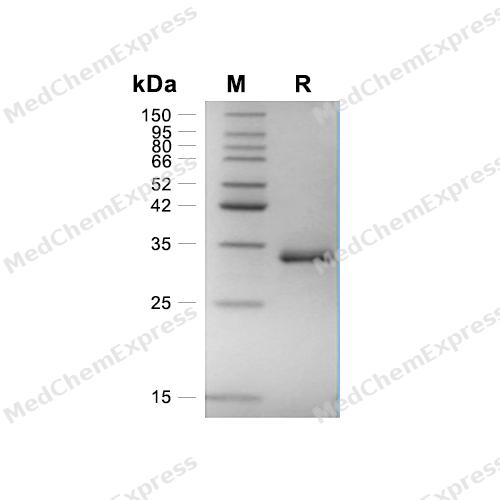
Purity - SDS-PAGE


Technical Parameters
-
Species Human
-
Source E. coli
-
Tag N-6*His
-
Accession
P24941-1 (E2-L298)
-
Molecular Construction
-
N-term
-
6*His
-
CDK2 (M1-L298)
Accession # P24941-1 -
C-term
-
-
Protein Length
Full Length
-
Synonyms
CDK2; CDKN2; Cyclin Dependent Kinase 2; Cdc2-Related Protein Kinase; Cell Division Protein Kinase 2; Cyclin-Dependent Kinase; Cyclin-Dependent Kinase 2; P33(CDK2); P33 Protein Kinase
-
AA Sequence
ENFQKVEKIGEGTYGVVYKARNKLTGEVVALKKIRLDTETEGVPSTAIREISLLKELNHPNIVKLLDVIHTENKLYLVFEFLHQDLKKFMDASALTGIPLPLIKSYLFQLLQGLAFCHSHRVLHRDLKPQNLLINTEGAIKLADFGLARAFGVPVRTYTHEVVTLWYRAPEILLGCKYYSTAVDIWSLGCIFAEMVTRRALFPGDSEIDQLFRIFRTLGTPDEVVWPGVTSMPDYKPSFPKWARQDFSKVVPPLDEDGRSLLSQMLHYDPNKRISAKAALAHPFFQDVTKPVPHLRL
-
Molecular Weight
Approximately 34 kDa, based on SDS-PAGE under reducing conditions.
-
Purity
≥ 95%, as determined by reducing SDS-PAGE.


Product Properties
Solution.
1.Supplied as a 0.22 μm filtered solution of 20 mM Tris-HCl, 200 mM NaCl, 1 mM DTT, 40% Glycerol, pH 8.0.
2.Supplied as a 0.22 μm filtered solution of 200 mM Tris, 200 mM NaCl, 1 mM DTT, 40% Glycerol, pH 8.0.
Please refer to the lot-specific COA for specific buffer information.
Note: For SPR assay, please replace the buffer. Primary amine components (e.g., Tris, imidazole) can affect protein-coupled chips.
<1 EU/μg, determined by LAL method.
Please use rapid thawing with running water to thaw the protein.
Stored at -80°C for 1 year from date of receipt. It is stable at -20°C for 3 months after opening. It is recommended to freeze aliquots at -80°C for extended storage. Avoid repeated freeze-thaw cycles.
Shipping with dry ice.


Documentation
-
Data Sheet (237 KB)
-
SDS (252 KB)
- English - EN (252 KB)
- Français - FR (252 KB)
- Deutsch - DE (252 KB)
- Norwegian - NO (252 KB)
- Español - ES (252 KB)
- Swedish - SV (252 KB)
- Italian - IT (252 KB)
- Korean - KR (252 KB)
- Portuguese - PT (252 KB)
-
Handling Instructions (2659 KB)

Calculators
Concentration (start) × Volume (start) = Concentration (final) × Volume (final)


 Powered by Bioz

