



Complement factor H/CFH Protein, Mouse (HEK293, Fc)

Based on 1 Customer Validation
Complement factor H (CFH) protein has C3b and heparin-binding activity and plays a multifaceted role in various processes such as organ development, complement activation, and vasculature development. It is present in different cellular compartments and expressed in different structures, including the adrenal gland, bone, central nervous system, humeral cartilage condensation, and metanephros. Complement factor H/CFH Protein, Mouse (HEK293, Fc) is the recombinant mouse-derived Complement factor H/CFH protein, expressed by HEK293 , with C-hFc labeled tag.
- Species: Mouse
- Source: HEK293
-
Storage:Stored at -20°C for 2 years from date of receipt. After reconstitution, it is stable at 4°C for 1 week or -20°C for longer (with carrier protein). It is recommended to freeze aliquots at -20°C or -80°C for extended storage.


To place orders, for customer services and technical support, please contact: MedChemExpress USA
Tel: 609-228-6898 E-mail: [email protected] [email protected]


-
 Biological Activity
-
Technical Parameters
-
Product Properties
- Documentation
- Help & FAQs




Biological Activity
Description
Complement factor H (CFH) protein has C3b and heparin-binding activity and plays a multifaceted role in various processes such as organ development, complement activation, and vasculature development. It is present in different cellular compartments and expressed in different structures, including the adrenal gland, bone, central nervous system, humeral cartilage condensation, and metanephros. Complement factor H/CFH Protein, Mouse (HEK293, Fc) is the recombinant mouse-derived Complement factor H/CFH protein, expressed by HEK293 , with C-hFc labeled tag.
Background
Complement Factor H (CFH) protein exhibits a multifaceted role, featuring complement component C3b binding activity and heparin binding activity. Operating upstream of various physiological processes, such as animal organ development, complement activation, and vasculature development, CFH is found in diverse cellular compartments, including axons, the external side of the plasma membrane, and neuronal cell bodies. Its expression spans across multiple structures, including the adrenal gland, bone, central nervous system, humerus cartilage condensation, and metanephros. This protein is implicated in various diseases, such as atypical hemolytic-uremic syndrome, eye diseases, lupus nephritis, and systemic lupus erythematosus, highlighting its critical involvement in health and disease. The expression pattern underscores its significant presence in tissues, particularly prominent in the liver during embryonic and adult stages, emphasizing its pivotal role in hepatic functions.
Verified Bioactivity
Measured in a cell proliferation assay using A549 cells. The ED50 for this effect is 28.04 ng/mL, corresponding to a specific activity is 3.57×10^4 units/mg.
MCE Validation Data
-
Purity - SDS-PAGE
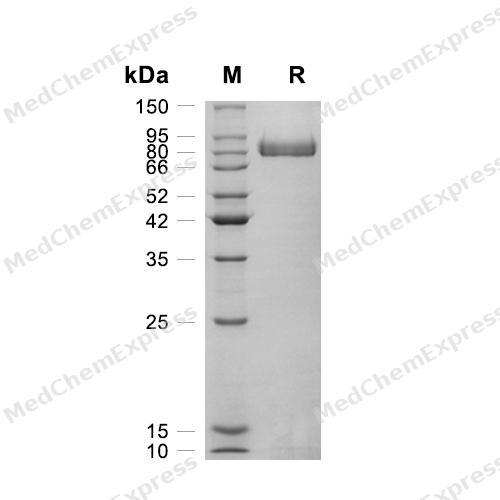
Purity - SDS-PAGE
-
Bioactivity - Cell-Based Assay
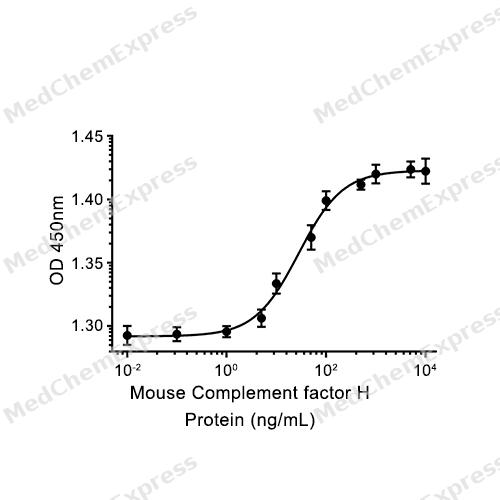
Bioactivity - Cell-Based Assay


Technical Parameters
-
Species Mouse
-
Source HEK293
-
Tag C-hFc
-
Accession
E9Q8I0/NP_034018.2 (S875-V1252)
-
Molecular Construction
-
N-term
-
CFH (S875-V1252)
Accession # E9Q8I0/NP_034018.2 -
hFc
-
C-term
-
-
Protein Length
Partial
-
Synonyms
CFH; H Factor 1 (Complement); Prev. HF1; Adrenomedullin Binding Protein; Prev. HF2; Beta-1-H-Globulin; Prev. HF; Factor H-Like 1; ARMS1; H Factor 1; ARMD4; Factor H; FHL1; AHUS1; HUS; AMBP1; Age-Related Maculopathy Susceptibility 1; CFHL3; H Factor 2 (Com
-
AA Sequence
SLPRCIEKIPCSQPPTIEHGSINLPRSSEERRDSIESSSHEHGTTFSYVCDDGFRIPEENRITCYMGKWSTPPRCVGLPCGPPPSIPLGTVSLELESYQHGEEVTYHCSTGFGIDGPAFIICEGGKWSDPPKCIKTDCDVLPTVKNAIIRGKSKKSYRTGEQVTFRCQSPYQMNGSDTVTCVNSRWIGQPVCKDNSCVDPPHVPNATIVTRTKNKYLHGDRVRYECNKPLELFGQVEVMCENGIWTEKPKCRDSTGKCGPPPPIDNGDITSLSLPVYEPLSSVEYQCQKYYLLKGKKTITCRNGKWSEPPTCLHACVIPENIMESHNIILKWRHTEKIYSHSGEDIEFGCKYGYYKARDSPPFRTKCINGTINYPTCV
-
Molecular Weight
Approximately 80-94 kDa, based on SDS-PAGE under reducing conditions, due to the glycosylation.
-
Purity
≥ 95%, as determined by reducing SDS-PAGE.


Product Properties
Lyophilized powder.
Lyophilized from a 0.22 μm filtered solution of 20 mM PB, 150 mM NaCl, pH 7.4.
<1 EU/μg, determined by LAL method.
It is not recommended to reconstitute to a concentration less than 100 μg/mL in ddH2O.
Stored at -20°C for 2 years from date of receipt. After reconstitution, it is stable at 4°C for 1 week or -20°C for longer (with carrier protein). It is recommended to freeze aliquots at -20°C or -80°C for extended storage.
Room temperature in continental US; may vary elsewhere.


Documentation
-
Data Sheet (238 KB)
-
SDS (251 KB)
- English - EN (251 KB)
- Français - FR (251 KB)
- Deutsch - DE (251 KB)
- Norwegian - NO (251 KB)
- Español - ES (251 KB)
- Swedish - SV (251 KB)
- Italian - IT (251 KB)
- Korean - KR (251 KB)
- Portuguese - PT (251 KB)
-
Handling Instructions (2659 KB)

Calculators
Concentration (start) × Volume (start) = Concentration (final) × Volume (final)


 Powered by Bioz

