



ENPP-7 Protein, Mouse (HEK293, His)

Based on 1 Customer Validation
The ENPP-7 protein acts as a choline-specific phosphodiesterase and is essential for sphingomyelin digestion, ceramide formation, and FA absorption in the gastrointestinal tract. It hydrolyzes sphingomyelin to release ceramide and phosphocholine. ENPP-7 Protein, Mouse (HEK293, His) is the recombinant mouse-derived ENPP-7 protein, expressed by HEK293 , with C-His labeled tag.
- Species: Mouse
- Source: HEK293
-
Storage:Stored at -20°C for 2 years from date of receipt. After reconstitution, it is stable at 4°C for 1 week or -20°C for longer (with carrier protein). It is recommended to freeze aliquots at -20°C or -80°C for extended storage.


To place orders, for customer services and technical support, please contact: MedChemExpress USA
Tel: 609-228-6898 E-mail: [email protected] [email protected]


-
 Biological Activity
-
Technical Parameters
-
Product Properties
- Documentation
- Help & FAQs




Biological Activity
Description
The ENPP-7 protein acts as a choline-specific phosphodiesterase and is essential for sphingomyelin digestion, ceramide formation, and FA absorption in the gastrointestinal tract. It hydrolyzes sphingomyelin to release ceramide and phosphocholine. ENPP-7 Protein, Mouse (HEK293, His) is the recombinant mouse-derived ENPP-7 protein, expressed by HEK293 , with C-His labeled tag.
Background
ENPP-7 protein functions as a choline-specific phosphodiesterase, playing a crucial role in sphingomyelin digestion, ceramide formation, and fatty acid (FA) absorption within the gastrointestinal tract. This enzyme hydrolyzes sphingomyelin, releasing ceramide and phosphocholine. Additionally, ENPP-7 exhibits phospholipase C activity, cleaving phosphocholine from palmitoyl lyso-phosphatidylcholine and platelet-activating factor (PAF), thereby inactivating PAF. Despite its enzymatic activities, ENPP-7 does not possess nucleotide pyrophosphatase activity. The protein's involvement in these processes suggests a potential role in promoting cholesterol absorption by modulating sphingomyelin levels derived from dietary or endogenous sources within the intestinal lumen.
Verified Bioactivity
Measured by its ability to hydrolyze sphingomyelin to ceramide and phosphorylcholine. The phosphorylcholine is cleaved by Recombinant Human Alkaline Phosphatase/ALPL and the phosphate is detected/measured by a Malachite Green Phosphate Detection Kit. In this experiment, 0.071 mM SPM substrate was used per well at 37°C for 30 min. The specific activity is 23492.16 pmol/min/μg.
MCE Validation Data
-
Purity - SDS-PAGE
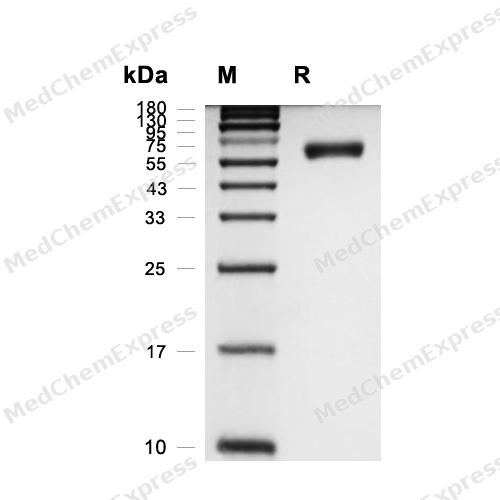
Purity - SDS-PAGE


Technical Parameters
-
Species Mouse
-
Source HEK293
-
Tag C-10*His
-
Accession
Q3TIW9 (A22-Q421)
-
Molecular Construction
-
N-term
-
ENPP-7 (A22-Q421)
Accession # Q3TIW9 -
His
-
C-term
-
-
Protein Length
Partial Extracellular Domain
-
Synonyms
ENPP7; Alkaline Sphingomyelin Phosphodiesterase; Ectonucleotide Pyrophosphatase/Phosphodiesterase 7; Intestinal Alkaline Sphingomyelinase; Alk-SMase; Alkaline Sphingomyelinase; NPP7; E-NPP 7; Ectonucleotide Pyrophosphatase/Phosphodiesterase Family Member
-
AA Sequence
APVQRQHKLLLVSFDGFRWNYDQDVDTPNLDSMAQEGVKAQYMTPAFVTMTSPCHFTLVTGKYIENHGVVHNMFYNTTSTVRLPYHATLGIQRWWDNGSIPIWITAQRQGLKTGSFFYPGGNVTYQGEAVTMSRKEGVLHNYKNETEWRGNVDTVMKWFLEEDVSLVTLYFGEPDSTGHKYGPESQERKDMVKQVDRTVGYLRDSIKRHHLSDSLNLIITSDHGMTTVNKKASDLVEFHKFSNFTFQDIQFELLDYGPIGMLIPKEGMLEKVYSVLKDAHPRLHVYKKEDFPKNFHYANNPRITPLLMYSDLGYVIHGRVNVQFNNGEHGFNNQDMDMKTIFRAVGPSFKAGLEVEPFESVHVYELMCQLLGIVPEPNDGNPGILRPMLRSGSASLLSSQ
-
Molecular Weight
Approximately 60 kDa, based on SDS-PAGE under reducing conditions, due to the glycosylation.
-
Glycosylation
Yes
-
Purity
≥ 95%, as determined by reducing SDS-PAGE.


Product Properties
Lyophilized powder.
Lyophilized from a 0.22 μm filtered solution of 20 mM Tris, 150 mM NaCl, pH 7.6.
Note: For SPR assay, please replace the buffer. Primary amine components (e.g., Tris, imidazole) can affect protein-coupled chips.
<1 EU/μg, determined by LAL method.
It is not recommended to reconstitute to a concentration less than 100 μg/mL in ddH2O. For long term storage it is recommended to add a carrier protein (0.1% BSA, 5% HSA, 10% FBS or 5% Trehalose).
Stored at -20°C for 2 years from date of receipt. After reconstitution, it is stable at 4°C for 1 week or -20°C for longer (with carrier protein). It is recommended to freeze aliquots at -20°C or -80°C for extended storage.
Room temperature in continental US; may vary elsewhere.


Documentation
-
Data Sheet (238 KB)
-
SDS (251 KB)
- English - EN (251 KB)
- Français - FR (251 KB)
- Deutsch - DE (251 KB)
- Norwegian - NO (251 KB)
- Español - ES (251 KB)
- Swedish - SV (251 KB)
- Italian - IT (251 KB)
- Korean - KR (251 KB)
- Portuguese - PT (251 KB)
-
Handling Instructions (2659 KB)

Calculators
Concentration (start) × Volume (start) = Concentration (final) × Volume (final)


 Powered by Bioz

