



EPDR1 Protein, Human (HEK293, His)

Based on 1 Customer Validation
EPDR1 (ependymin related 1) is a type II transmembrane protein and related to calcium-dependent cell adhesion. EPDR1 is closely related to pathological or developmental processes of various tumors including breast cancer (BRCA), hepatocellular carcinoma (HCC), colorectal cancer, and bladder cancer (BLCA). EPDR1 Protein, Human (HEK293, His) is the recombinant human-derived EPDR1 protein, expressed by HEK293 , with C-6*His labeled tag.
- Species: Human
- Source: HEK293
-
Storage:Stored at -20°C for 2 years from date of receipt. After reconstitution, it is stable at 4°C for 1 week or -20°C for longer (with carrier protein). It is recommended to freeze aliquots at -20°C or -80°C for extended storage.


To place orders, for customer services and technical support, please contact: MedChemExpress USA
Tel: 609-228-6898 E-mail: [email protected] [email protected]


-
 Biological Activity
-
Technical Parameters
-
Product Properties
- Documentation
- References
- Help & FAQs




Biological Activity
Description
EPDR1 (ependymin related 1) is a type II transmembrane protein and related to calcium-dependent cell adhesion. EPDR1 is closely related to pathological or developmental processes of various tumors including breast cancer (BRCA), hepatocellular carcinoma (HCC), colorectal cancer, and bladder cancer (BLCA). EPDR1 Protein, Human (HEK293, His) is the recombinant human-derived EPDR1 protein, expressed by HEK293 , with C-6*His labeled tag.
Background
Ependymin related 1 (EPDR1), also known as EPDR, UCC1, MERP1; MERP-1 is a member of mammalian ependymin-related proteins (MERPs). The protein shares a conserved critical amino acid and primary structure with piscine pendymins, which is a type II transmembrane protein and opposes cell adhesion by intracellular and extracellular mechanisms. In human colorectal cancer overexpression of EPDR1 can facilitate the viability and invasion of cancer cells and serve as a reliable prognostic marker. Moreover, EPDR1 also involved in several signaling pathways as well as PI3K/AKT pathway, Cytokine receptor interaction, and apoptosis[1][2].
MCE Validation Data
-
Purity - SDS-PAGE
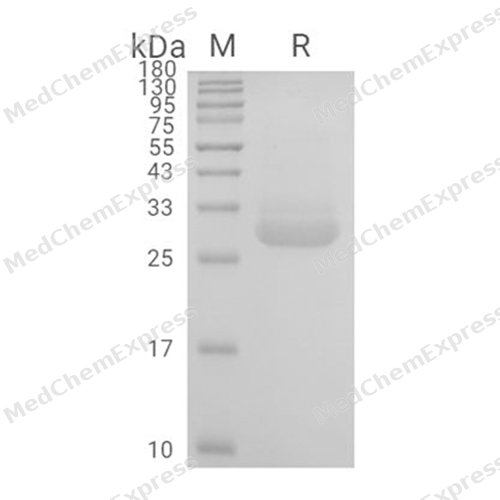
Purity - SDS-PAGE


Technical Parameters
-
Species Human
-
Source HEK293
-
Tag C-6*His
-
Accession
Q9UM22-1 (A38-S223)
-
Molecular Construction
-
N-term
-
EPDR1 (A38-S223)
Accession # Q9UM22-1 -
6*His
-
C-term
-
-
Protein Length
Full Length of Isoform-1
-
Synonyms
EPDR1; Upregulated In Colorectal Cancer Gene 1 Protein; Ependymin Related 1; Mammalian Ependymin-Related Protein 1; MERP-1; Ependymin Related Protein 1 (Zebrafish); MERP1; Mammalian Ependymin Related Protein 1; UCC1; Ependymin Related Protein 1; EPDR
-
AA Sequence
APRPCQAPQQWEGRQVMYQQSSGRNSRALLSYDGLNQRVRVLDERKALIPCKRLFEYILLYKDGVMFQIDQATKQCSKMTLTQPWDPLDIPQNSTFEDQYSIGGPQEQITVQEWSDRKSARSYETWIGIYTVKDCYPVQETFTINYSVILSTRFFDIQLGIKDPSVFTPPSTCQMAQLEKMSEDCS
-
Molecular Weight
Approximately 28 kDa & 33 kDa, based on SDS-PAGE under reducing conditions.
-
Glycosylation
Yes
-
Purity
≥ 95%, as determined by reducing SDS-PAGE.


Product Properties
Lyophilized powder
Lyophilized from a 0.22 μm filtered solution of PBS, pH 7.4.
<1 EU/μg, determined by LAL method.
It is not recommended to reconstitute to a concentration less than 100 μg/mL in ddH2O. For long term storage it is recommended to add a carrier protein (0.1% BSA, 5% HSA, 10% FBS or 5% Trehalose).
Stored at -20°C for 2 years from date of receipt. After reconstitution, it is stable at 4°C for 1 week or -20°C for longer (with carrier protein). It is recommended to freeze aliquots at -20°C or -80°C for extended storage.
Room temperature in continental US; may vary elsewhere.


Documentation
-
Data Sheet (262 KB)
-
SDS (251 KB)
- English - EN (251 KB)
- Français - FR (251 KB)
- Deutsch - DE (251 KB)
- Norwegian - NO (251 KB)
- Español - ES (251 KB)
- Swedish - SV (251 KB)
- Italian - IT (251 KB)
- Korean - KR (251 KB)
- Portuguese - PT (251 KB)
-
Handling Instructions (2659 KB)


References
[1]. Yang Y, et al. EPDR1 is related to stages and metastasize in bladder cancer and can be used as a prognostic biomarker. BMC Urol. 2021 Apr 26;21(1):71. [Content Brief]
[2]. Liang X, et al. Overexpression of EPDR1 has an antitumorigenic effect on breast cancer in vitro. Int J Clin Exp Pathol. 2020 Oct 1;13(10):2628-2636. [Content Brief]

Calculators
Concentration (start) × Volume (start) = Concentration (final) × Volume (final)


 Powered by Bioz

