



FABP3 Protein, Human (His)

Based on 1 Customer Validation
FABP3 Protein, Human (His) is a recombinant FABP3 protein with a His-flag. FABP3 Protein is expressed in the skeletal muscle, heart, brain and brown adipose tissue.
- Species: Human
- Source: E. coli
-
Storage:Stored at -20°C for 2 years from date of receipt. After reconstitution, it is stable at 4°C for 1 week or -20°C for longer (with carrier protein). It is recommended to freeze aliquots at -20°C or -80°C for extended storage.


To place orders, for customer services and technical support, please contact: MedChemExpress USA
Tel: 609-228-6898 E-mail: [email protected] [email protected]


-
 Biological Activity
-
Technical Parameters
-
Product Properties
- Documentation
- References
- Help & FAQs




Biological Activity
Description
FABP3 Protein, Human (His) is a recombinant FABP3 protein with a His-flag. FABP3 Protein is expressed in the skeletal muscle, heart, brain and brown adipose tissue[1].
Background
Fatty acid binding proteins (FABPs) are intracellular proteins and exhibit high affinity for small lipophilic ligands. FABP-3 is expressed in the skeletal muscle, heart, brain and brown adipose tissue. And its expression in skeletal muscles is elevated on consumption of a high fat diet. The gene encoding it is localized on human chromosome 1p35. FABP3 is a newly introduced plasma marker of acute myocardial infarction (AMI). FABP3 is identified as a novel selective autophagy substrate of OPTN (optineurin, a macroautophagy/autophagy receptor, is found to play a pivotal role in selective autophagy, coupling autophagy with bone metabolism). FABP3 promotes adipogenesis and inhibits osteogenesis of MSCs. Knockdown of FABP3 alleviates bone loss in optn-/ - mice and aged mice[1][2].
MCE Validation Data
-
Purity - SDS-PAGE
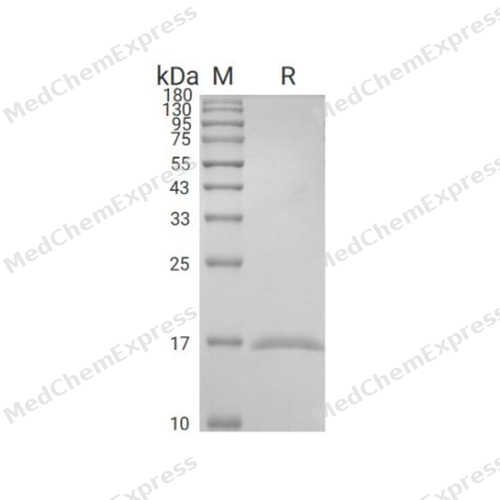
Purity - SDS-PAGE


Technical Parameters
-
Species Human
-
Source E. coli
-
Tag N-6*His
-
Accession
P05413 (V2-A133)
-
Molecular Construction
-
N-term
-
6*His
-
FABP3 (V2-A133)
Accession # P05413 -
C-term
-
-
Protein Length
Full Length
-
Synonyms
FABP3; Heart-Type Fatty Acid-Binding Protein; Prev. FABP11; Muscle Fatty Acid-Binding Protein; Prev. MDGI; Fatty Acid Binding Protein 11; H-FABP; M-FABP; Mammary-Derived Growth Inhibitor; Fatty Acid Binding Protein 3, Muscle And Heart (Mammary-Derived Gro
-
AA Sequence
VDAFLGTWKLVDSKNFDDYMKSLGVGFATRQVASMTKPTTIIEKNGDILTLKTHSTFKNTEISFKLGVEFDETTADDRKVKSIVTLDGGKLVHLQKWDGQETTLVRELIDGKLILTLTHGTAVCTRTYEKEA
-
Predicted Molecular Mass
17 kDa
-
Molecular Weight
Approximately 15 kDa, based on SDS-PAGE under reducing conditions.
-
Purity
≥ 95%, as determined by reducing SDS-PAGE.


Product Properties
Lyophilized powder
1.Lyophilized from a 0.22 μm filtered solution of PBS, pH 6.5.
2.Lyophilized from a 0.22 μm filtered solution of 20 mM PB, 5% trehalose, 5% mannitol,
0.02% Tween 80, pH 6.0.
Please refer to the lot-specific COA for specific buffer information.
<1 EU/μg, determined by LAL method.
It is not recommended to reconstitute to a concentration less than 100 μg/mL in ddH2O. For long term storage it is recommended to add a carrier protein (0.1% BSA, 5% HSA, 10% FBS or 5% Trehalose).
Stored at -20°C for 2 years from date of receipt. After reconstitution, it is stable at 4°C for 1 week or -20°C for longer (with carrier protein). It is recommended to freeze aliquots at -20°C or -80°C for extended storage.
Room temperature in continental US; may vary elsewhere.


Documentation
-
Data Sheet (262 KB)
-
SDS (251 KB)
- English - EN (251 KB)
- Français - FR (251 KB)
- Deutsch - DE (251 KB)
- Norwegian - NO (251 KB)
- Español - ES (251 KB)
- Swedish - SV (251 KB)
- Italian - IT (251 KB)
- Korean - KR (251 KB)
- Portuguese - PT (251 KB)
-
Handling Instructions (2659 KB)


References
[1]. Seung-Min Lee, et al. FABP3-mediated membrane lipid saturation alters fluidity and induces ER stress in skeletal muscle with aging. Nat Commun. 2020 Nov 9;11(1):5661. [Content Brief]
[2]. Zheng-Zhao Liu, et al. Autophagy receptor OPTN (optineurin) regulates mesenchymal stem cell fate and bone-fat balance during aging by clearing FABP3. Autophagy. 2020 Nov 4;1-17. [Content Brief]

Calculators
Concentration (start) × Volume (start) = Concentration (final) × Volume (final)


 Powered by Bioz

