



FCRN-B2M Heterodimer Protein, Human (Biotinylated, HEK293, His-Avi)

Based on 1 Customer Validation
FCGRT is an IgG Fc receptor. Fc receptor expression is up-regulated by pro-inflammatory cytokines TNF and down-regulated by IFN-γ. FCGRT plays a role in regulating IgG and serum albumin conversion. Overexpression of FCGRT is also associated with poor prognosis of tumors. FCRN-B2M Heterodimer Protein, Human (Biotinylated, HEK293, His-Avi) is a recombinant protein dimer complex containing human-derived FCRN-B2M protein, expressed by HEK293 , with C-Avi, C-6*His labeled tag.
- Species: Human
- Source: HEK293
-
Storage:Stored at -20°C for 2 years from date of receipt. After reconstitution, it is stable at 4°C for 1 week or -20°C for longer (with carrier protein). It is recommended to freeze aliquots at -20°C or -80°C for extended storage.


To place orders, for customer services and technical support, please contact: MedChemExpress USA
Tel: 609-228-6898 E-mail: [email protected] [email protected]


-
 Biological Activity
-
Technical Parameters
-
Product Properties
- Documentation
- References
- Help & FAQs




Biological Activity
Description
FCGRT is an IgG Fc receptor. Fc receptor expression is up-regulated by pro-inflammatory cytokines TNF and down-regulated by IFN-γ. FCGRT plays a role in regulating IgG and serum albumin conversion. Overexpression of FCGRT is also associated with poor prognosis of tumors. FCRN-B2M Heterodimer Protein, Human (Biotinylated, HEK293, His-Avi) is a recombinant protein dimer complex containing human-derived FCRN-B2M protein, expressed by HEK293 , with C-Avi, C-6*His labeled tag.
Background
IgG receptor FcRn large subunit p51 is an IgG Fc receptor with a molecular structure similar to MHC Class I and also binds to β-2 microglobulin. In rodents, FcRn was originally thought to be a receptor that trantranks maternal immunoglobulin G (IgG) from mother to newborn offspring via breast milk and is therefore known as a neonatal Fc receptor. FcRn has also been shown to play a role in regulating IgG and serum albumin conversion, and neonatal Fc receptor expression is up-regulated by pro-inflammatory cytokines TNF and down-regulated by IFN-γ. In the acidic endosomes of endothelial and hematopoietic cells, monomer IgG binds to FcRn, circulates IgG to the cell surface, where it is released into the circulation, regulating, in addition to IgG, homeostasis of the circulating protein albumin /ALB. The up-regulated expression of FCGRT in bladder cancer may serve as a key neutrophil gene associated with poor prognosis. FCGRT overexpression was also associated with decreased PD-L1 expression and decreased tumor mutation load (TMB) level[1][2][3][4][5][6].
Verified Bioactivity
1. Loaded Biotinylated Human FcRn Heterodimer-His-Avi on HIS1K Biosensor, can bind Anti-Human HER2 mAb (Human IgG1) with an affinity constant of 0.11 μM as determined in BLI assay.
2. Loaded Rozanolixizumab (HY-P9979) on AHC2 biosensor, can bind FCRN-B2M Protein, Human (Biotinylated, HEK293, His-Avi) with an affinity constant of 1.430E-10 M as determined in BLI assay.
MCE Validation Data
-
Bioactivity - BLI
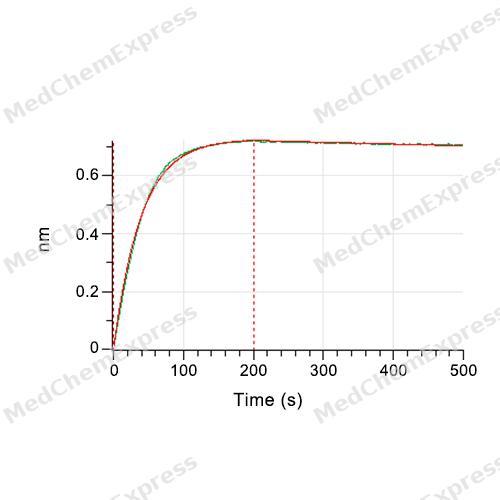
Bioactivity - BLI


Technical Parameters
-
Species Human
-
Source HEK293
-
Tag C-Avi;C-6*His
-
Molecular Construction
-
N-term
-
FCGRT (A24-S297)
Accession # AAF72596 -
6*His
-
C-term
-
N-term
-
B2M (I21-M119)
Accession # P61769 -
Avi
-
C-term
-
-
Conjugation
Biotin
-
Conjugate Method
The single lysine residue in Avitag is biotinylated through an enzymatic reaction.
-
Synonyms
FCGRT; Major Histocompatibility Complex Class I-Like Fc Receptor; Fc Gamma Receptor And Transporter; Neonatal Crystallizable Fc Receptor FcRn Splice Variant 6; Neonatal Fc Receptor; Neonatal Crystallizable Fc Receptor FcRn Splice Variant 5; FcRn; Neonatal Fragment Crystallizable Fc Receptor FcRn; IgG Fc Fragment Receptor Transporter Alpha Chain; Immunoglobulin Receptor, Intestinal, Heavy Chain; IgG Receptor FcRn Large Subunit P51; Neonatal Fc-Receptor For Ig; FcgammaRn; FCRN Alpha-Chain; Heavy Chain Of The Major Histocompatibility Complex Class I-Like Fc Receptor; FcRn Alpha Chain; Transmembrane Alpha Chain Of The Neonatal Receptor; Alpha-Chain; Fc Fragment Of IgG, Receptor, Transporter, Alpha; FCRN; Fc Fragment Of IgG Receptor And Transporter; B2M; Beta 2-Microglobulin; Beta-2-Microglobulin; Beta-2-Microglobin; Beta Chain Of MHC Class I Molecules; AMYLD6; Beta 2-Microglobulin Protein; MHC1D4; Human Nkt Tcr Alpha Chain; IMD43; Human Nkt Tcr Beta Chain
-
AA Sequence
AESHLSLLYHLTAVSSPAPGTPAFWVSGWLGPQQYLSYNSLRGEAEPCGAWVWENQVSWYWEKETTDLRIKEKLFLEAFKALGGKGPYTLQGLLGCELGPDNTSVPTAKFALNGEEFMNFDLKQGTWGGDWPEALAISQRWQQQDKAANKELTFLLFSCPHRLREHLERGRGNLEWKEPPSMRLKARPSSPGFSVLTCSAFSFYPPELQLRFLRNGLAAGTGQGDFGPNSDGSFHASSSLTVKSGDEHHYCCIVQHAGLAQPLRVELESPAKSS&IQRTPKIQVYSRHPAENGKSNFLNCYVSGFHPSDIEVDLLKNGERIEKVEHSDLSFSKDWSFYLLYYTEFTPTEKDEYACRVNHVTLSQPKIVKWDRDM
-
Predicted Molecular Mass
31.1 kDa & 13.5 kDa
-
Molecular Weight
Approximately 35 kDa & 13 kDa, based on SDS-PAGE under reducing conditions.
-
Glycosylation
Yes
-
Purity
≥ 95%, as determined by reducing SDS-PAGE.


Product Properties
Lyophilized powder.
Lyophilized from a 0.22 μm filtered solution of 20 mM PB, 6% Sucrose, 4% Mannitol, 0.05% Tween 80, pH 7.8.
<1 EU/μg, determined by LAL method.
It is not recommended to reconstitute to a concentration less than 100 μg/mL in ddH2O.
Stored at -20°C for 2 years from date of receipt. After reconstitution, it is stable at 4°C for 1 week or -20°C for longer (with carrier protein). It is recommended to freeze aliquots at -20°C or -80°C for extended storage.
Room temperature in continental US; may vary elsewhere.


Documentation
-
Data Sheet (267 KB)
-
SDS (252 KB)
- English - EN (252 KB)
- Français - FR (252 KB)
- Deutsch - DE (252 KB)
- Norwegian - NO (252 KB)
- Español - ES (252 KB)
- Swedish - SV (252 KB)
- Italian - IT (252 KB)
- Korean - KR (252 KB)
- Portuguese - PT (252 KB)
-
Handling Instructions (2659 KB)


References
[1]. imister NE, et al. Cloning and expression of the neonatal rat intestinal Fc receptor, a major histocompatibility complex class I antigen homolog. Cold Spring Harb Symp Quant Biol. 1989;54 Pt 1:571-80. [Content Brief]
[2]. Ghetie V, et al. Abnormally short serum half-lives of IgG in beta 2-microglobulin-deficient mice. Eur J Immunol. 1996 Mar;26(3):690-6. [Content Brief]
[3]. Yang R, et al. Neutrophil-related genes predict prognosis and response to immune checkpoint inhibitors in bladder cancer. Front Pharmacol. 2022 Oct 21;13:1013672. [Content Brief]
[4]. West AP Jr, et al. Crystal structure and immunoglobulin G binding properties of the human major histocompatibility complex-related Fc receptor(,). Biochemistry. 2000 Aug 15;39(32):9698-708. [Content Brief]
[5]. Pyzik M, et al FcRn regulates albumin homeostasis and susceptibility to liver injury. Proc Natl Acad Sci U S A. 2017 Apr 4;114(14):E2862-E2871. [Content Brief]
[6]. Story CM, et al. A major histocompatibility complex class I-like Fc receptor cloned from human placenta: possible role in transfer of immunoglobulin G from mother to fetus. J Exp Med. 1994 Dec 1;180(6):2377-81. [Content Brief]

Calculators
Concentration (start) × Volume (start) = Concentration (final) × Volume (final)


 Powered by Bioz

