



G6PD Protein, Human (HEK293, His)
Based on 1 Customer Validation
The G6PD protein is a rate-limiting enzyme in the oxidative pentose phosphate pathway located in the cytosol, which is crucial for the catabolism of carbohydrates in glycolysis. The primary function of G6PD is to provide reducing power in the form of NADPH and generate pentose phosphates, helping the cell resist oxidative stress and regulate metabolic rates. Additionally, the activity of G6PD is associated with cancer progression. The G6PD protein (Human, HEK293, His) is a recombinant G6PD protein expressed in HEK293 cells, with a C-terminal His tag, and consists of 514 amino acids (A2-L515) .
- Species: Human
- Source: HEK293
-
Storage:Stored at -80°C for 1 year from date of receipt. It is stable at -20°C for 3 months after opening. It is recommended to freeze aliquots at -80°C for extended storage. Avoid repeated freeze-thaw cycles.


To place orders, for customer services and technical support, please contact: MedChemExpress USA
Tel: 609-228-6898 E-mail: [email protected] [email protected]


-
 Biological Activity
-
Technical Parameters
-
Product Properties
- Documentation
- References
- Help & FAQs




Biological Activity
Description
The G6PD protein is a rate-limiting enzyme in the oxidative pentose phosphate pathway located in the cytosol, which is crucial for the catabolism of carbohydrates in glycolysis. The primary function of G6PD is to provide reducing power in the form of NADPH and generate pentose phosphates, helping the cell resist oxidative stress and regulate metabolic rates. Additionally, the activity of G6PD is associated with cancer progression. The G6PD protein (Human, HEK293, His) is a recombinant G6PD protein expressed in HEK293 cells, with a C-terminal His tag, and consists of 514 amino acids (A2-L515) [1][2][3][4][5][6][7].
Background
G6PD is the first enzyme in the pentose phosphate pathway of glucose metabolism. By regulating the pentose phosphate pathway, G6PD maintains intracellular levels of reduced glutathione, helping cells resist oxidative stress. The G6PD protein is crucial for protecting red blood cells from oxidative stress; a deficiency in this enzyme can lead to hemolysis, neonatal jaundice, and favism[1][2]. G6PD activity is closely related to oocyte development. As the oocyte completes its growth phase, the activity of G6PD significantly decreases, indicating its key role during the early stages of cell development[3]. G6PD is upregulated in various cancers and is associated with tumor development and resistance to chemotherapy. For instance, increased G6PD expression can inhibit apoptosis caused by oxidative stress in osteosarcoma (OS) tissues and cell lines (MG-63, SaoS-2, SJSA-1, G-292). G6PD also acts as an angiogenic factor, promoting angiogenesis, providing nutrients for tumor cells, and supporting tumor cell growth. Therefore, G6PD holds promise as a target for inhibiting tumor growth[4].
In Vitro
Silencing G6PD (Human) (by siRNA transfection in A2780/CDDP cells) can enhance the sensitivity of the ovarian cancer cisplatin-resistant cell line A2780/CDDP (established by low-concentration dose escalation) to cisplatin by inducing ferroptosis[5]. G6PD (Human) activity can be inhibited by extracts of Macrolepiota procera, with an IC50 value of 0.853 μg/mL. The reduction in G6PD activity can inhibit the growth of A549 lung cancer cells[6].
In Vivo
A decrease in G6PD activity can activate protein kinase C (PKC) and NF-κB in G6PD-deficient mouse models, resulting in increased renal oxidative stress and albuminuria[7].
Verified Bioactivity
Measured by its ability to dehydrogenate 1mM glucose-6-phosphate. that incubate at room temperature in kinetic mode for 5 minutes. The specific activity is >14000 pmol/min/μg.
MCE Validation Data
-
Purity - SDS-PAGE
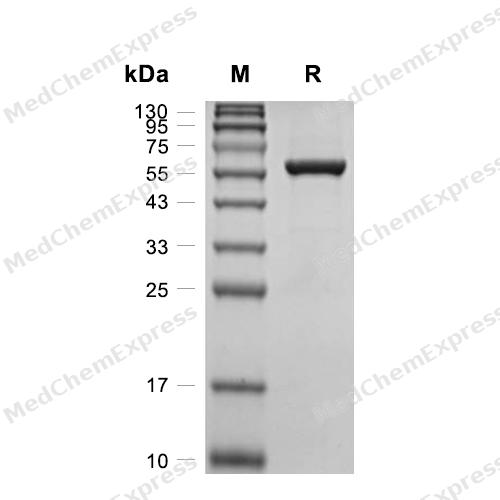
Purity - SDS-PAGE


Technical Parameters
-
Species Human
-
Source HEK293
-
Tag C-6*His
-
Accession
P11413-1 (A2-L515)
-
Molecular Construction
-
N-term
-
G6PD (A2-L515)
Accession # P11413 -
6*His
-
C-term
-
-
Protein Length
Full Length of Isoform-1
-
Synonyms
G6PD; Glucose-6-Phosphate Dehydrogenase (NADP(+)); Glucose-6-Phosphate Dehydrogenase; Epididymis Secretory Sperm Binding Protein; Glucose-6-Phosphate 1-Dehydrogenase; CNSHA1; G6PD1
-
AA Sequence
AEQVALSRTQVCGILREELFQGDAFHQSDTHIFIIMGASGDLAKKKIYPTIWWLFRDGLLPENTFIVGYARSRLTVADIRKQSEPFFKATPEEKLKLEDFFARNSYVAGQYDDAASYQRLNSHMNALHLGSQANRLFYLALPPTVYEAVTKNIHESCMSQIGWNRIIVEKPFGRDLQSSDRLSNHISSLFREDQIYRIDHYLGKEMVQNLMVLRFANRIFGPIWNRDNIACVILTFKEPFGTEGRGGYFDEFGIIRDVMQNHLLQMLCLVAMEKPASTNSDDVRDEKVKVLKCISEVQANNVVLGQYVGNPDGEGEATKGYLDDPTVPRGSTTATFAAVVLYVENERWDGVPFILRCGKALNERKAEVRLQFHDVAGDIFHQQCKRNELVIRVQPNEAVYTKMMTKKPGMFFNPEESELDLTYGNRYKNVKLPDAYERLILDVFCGSQMHFVRSDELREAWRIFTPLLHQIELEKPKPIPYIYGSRGPTEADELMKRVGFQYEGTYKWVNPHKL
-
Molecular Weight
Approximately 55-62 kDa, based on SDS-PAGE under reducing conditions.
-
Purity
≥ 95%, as determined by reducing SDS-PAGE.


Product Properties
Solution
1.Supplied as a 0.22 μm filtered solution of 20 mM citrate, 8% trehalose, 4% mannitol, 50 mM NaCl, 1 mM TCEP, 0.05% Tween 80, pH 4.0.
2.Supplied as a 0.22 μm filtered solution of PBS, pH 7.4.
Please refer to the lot-specific COA for specific buffer information.
<1 EU/μg, determined by LAL method.
Stored at -80°C for 1 year from date of receipt. It is stable at -20°C for 3 months after opening. It is recommended to freeze aliquots at -80°C for extended storage. Avoid repeated freeze-thaw cycles.
Shipping with dry ice.


Documentation
-
Data Sheet (267 KB)
-
SDS (252 KB)
- English - EN (252 KB)
- Français - FR (252 KB)
- Deutsch - DE (252 KB)
- Norwegian - NO (252 KB)
- Español - ES (252 KB)
- Swedish - SV (252 KB)
- Italian - IT (252 KB)
- Korean - KR (252 KB)
- Portuguese - PT (252 KB)
-
Handling Instructions (2659 KB)


References
[1]. Harcke SJ, et al. G6PD deficiency: An update. JAAPA. 2019 Nov;32(11):21-26. [Content Brief]
[3]. https://pubmed.ncbi.nlm.nih.gov/1242707/
[4]. An F, Chang W, Song J, Zhang J, Li Z, Gao P, Wang Y, Xiao Z, Yan C. Reprogramming of glucose metabolism: Metabolic alterations in the progression of osteosarcoma. J Bone Oncol. 2024 Jan 4;44:100521. [Content Brief]
[5]. 陈朝梅, 等. 沉默 G6PD 对卵巢癌细胞顺铂敏感性的影响及其作用机制[J]. 中国癌症防治杂志, 2022, 14(3): 274-280.
[6]. Zara R, et al. Identification of Macrolepiota procera extract as a novel G6PD inhibitor for the treatment of lung cancer. Saudi J Biol Sci. 2022 May;29(5):3372-3379. [Content Brief]
[7]. Xu Y, et al. Glucose-6-phosphate dehydrogenase-deficient mice have increased renal oxidative stress and increased albuminuria. FASEB J. 2010 Feb;24(2):609-16. [Content Brief]

Calculators
Concentration (start) × Volume (start) = Concentration (final) × Volume (final)


 Powered by Bioz

