



GABARAPL1/GEC-1 Protein, Human (His)

Based on 1 Customer Validation
GABARAPL1/GEC-1 is a multifunctional ubiquitin-like modifier that contributes to cell surface expression of kappa-type opioid receptors and contributes to autophagy, shaping autophagosome vacuoles.Unlike LC3, which is involved in phagophore elongation, the GABARAP/GATE-16 subfamily plays a crucial role in late autophagosome maturation.GABARAPL1/GEC-1 Protein, Human (His) is the recombinant human-derived GABARAPL1/GEC-1 protein, expressed by E.coli , with N-6*His labeled tag.
- Species: Human
- Source: E. coli
-
Storage:Stored at -20°C for 2 years from date of receipt. After reconstitution, it is stable at 4°C for 1 week or -20°C for longer (with carrier protein). It is recommended to freeze aliquots at -20°C or -80°C for extended storage.


To place orders, for customer services and technical support, please contact: MedChemExpress USA
Tel: 609-228-6898 E-mail: [email protected] [email protected]


-
 Biological Activity
-
Technical Parameters
-
Product Properties
- Documentation
- Help & FAQs




Biological Activity
Description
GABARAPL1/GEC-1 is a multifunctional ubiquitin-like modifier that contributes to cell surface expression of kappa-type opioid receptors and contributes to autophagy, shaping autophagosome vacuoles.Unlike LC3, which is involved in phagophore elongation, the GABARAP/GATE-16 subfamily plays a crucial role in late autophagosome maturation.GABARAPL1/GEC-1 Protein, Human (His) is the recombinant human-derived GABARAPL1/GEC-1 protein, expressed by E.coli , with N-6*His labeled tag.
Background
GABARAPL1/GEC-1, a ubiquitin-like modifier, plays a multifaceted role in cellular processes. It enhances the cell-surface expression of kappa-type opioid receptors by facilitating their anterograde intracellular trafficking. Additionally, GABARAPL1/GEC-1 contributes to autophagy, participating in the formation of autophagosomal vacuoles. While LC3s are associated with phagophore membrane elongation, the GABARAP/GATE-16 subfamily assumes a crucial role in later stages of autophagosome maturation. Furthermore, GABARAPL1/GEC-1 collaborates with the reticulophagy receptor TEX264 to remodel subdomains of the endoplasmic reticulum into autophagosomes during nutrient stress, facilitating subsequent fusion with lysosomes for endoplasmic reticulum turnover. The protein engages in a network of interactions with various partners, including ATG13, OPRK1, RB1CC1, ULK1, TP53INP1, TP53INP2, SQSTM1, ATG3, ATG7, MAP15, TECPR2, TBC1D5, MAPK15, TRIM5, MEFV, TRIM21, WDFY3, UBA5, KBTBD6, KBTBD7, RETREG1, RETREG2, RETREG3, TEX264, and IRGM, underscoring its significance in cellular homeostasis and autophagic processes.
MCE Validation Data
-
Purity - SDS-PAGE
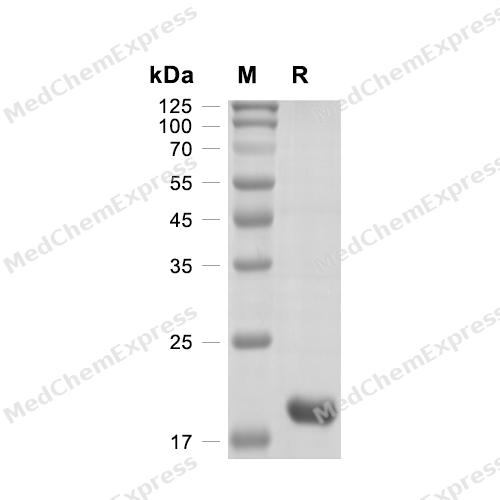
Purity - SDS-PAGE


Technical Parameters
-
Species Human
-
Source E. coli
-
Tag N-6*His
-
Accession
Q9H0R8 (M1-K117)
-
Molecular Construction
-
N-term
-
6*His
-
GABARAPL1 (M1-K117)
Accession # Q9H0R8 -
C-term
-
-
Protein Length
Full Length
-
Synonyms
GABARAPL1; Glandular Epithelial Cell Protein 1; GABA Type A Receptor Associated Protein Like 1; Early Estrogen-Regulated Protein; APG8L; GABA(A) Receptor-Associated Protein Like 1, Isoform CRA_e; ATG8L; GABA(A) Receptor-Associated Protein Like 1; ATG8B; A
-
AA Sequence
MKFQYKEDHPFEYRKKEGEKIRKKYPDRVPVIVEKAPKARVPDLDKRKYLVPSDLTVGQFYFLIRKRIHLRPEDALFFFVNNTIPPTSATMGQLYEDNHEEDYFLYVAYSDESVYGK
-
Molecular Weight
Approximately 20-24 kDa, based on SDS-PAGE under reducing conditions.
-
Purity
≥ 95%, as determined by reducing SDS-PAGE.


Product Properties
Lyophilized powder.
Lyophilized from a 0.22 μm filtered solution of 50 mM Tris-HCl, 300 mM NaCl, pH 7.4, 5% trehalose, 5% mannitol and 0.01% Tween 80.
Note: For SPR assay, please replace the buffer. Primary amine components (e.g., Tris, imidazole) can affect protein-coupled chips.
<1 EU/μg, determined by LAL method.
It is not recommended to reconstitute to a concentration less than 100 μg/mL in ddH2O.
Stored at -20°C for 2 years from date of receipt. After reconstitution, it is stable at 4°C for 1 week or -20°C for longer (with carrier protein). It is recommended to freeze aliquots at -20°C or -80°C for extended storage.
Room temperature in continental US; may vary elsewhere.


Documentation
-
Data Sheet (236 KB)
-
SDS (251 KB)
- English - EN (251 KB)
- Français - FR (251 KB)
- Deutsch - DE (251 KB)
- Norwegian - NO (251 KB)
- Español - ES (251 KB)
- Swedish - SV (251 KB)
- Italian - IT (251 KB)
- Korean - KR (251 KB)
- Portuguese - PT (251 KB)
-
Handling Instructions (2659 KB)

Calculators
Concentration (start) × Volume (start) = Concentration (final) × Volume (final)


 Powered by Bioz

