



Glucokinase/GCK Protein, Human

Based on 1 Customer Validation
Glucokinase/GCK proteins catalyze hexose phosphorylation, converting D-glucose, D-fructose, and D-mannose into their respective hexose 6-phosphates. Glucokinase/GCK Protein, Human is the recombinant human-derived Glucokinase/GCK protein, expressed by E. coli , with tag free.
- Species: Human
- Source: E. coli
-
Storage:Stored at -80°C for 1 year from date of receipt. It is stable at -20°C for 3 months after opening. It is recommended to freeze aliquots at -80°C for extended storage. Avoid repeated freeze-thaw cycles.


To place orders, for customer services and technical support, please contact: MedChemExpress USA
Tel: 609-228-6898 E-mail: [email protected] [email protected]


-
 Biological Activity
-
Technical Parameters
-
Product Properties
- Documentation
- Help & FAQs




Biological Activity
Description
Glucokinase/GCK proteins catalyze hexose phosphorylation, converting D-glucose, D-fructose, and D-mannose into their respective hexose 6-phosphates. Glucokinase/GCK Protein, Human is the recombinant human-derived Glucokinase/GCK protein, expressed by E. coli , with tag free.
Background
The Glucokinase (GCK) protein is a pivotal player in glucose metabolism, catalyzing the phosphorylation of hexoses such as D-glucose, D-fructose, and D-mannose, to form hexose 6-phosphate—specifically, D-glucose 6-phosphate, D-fructose 6-phosphate, and D-mannose 6-phosphate. Notably, GCK exhibits a weaker affinity for D-glucose compared to other hexokinases and is most effective when glucose is abundant. Its predominant expression in pancreatic beta cells and the liver positions GCK as a rate-limiting step in glucose metabolism within these tissues. Acting as a glucose sensor in pancreatic beta cells, GCK's low glucose affinity allows it to modulate insulin secretion in coordination with glucose concentrations. In the liver, GCK plays a crucial role in facilitating glucose uptake and conversion, acting as an insulin-sensitive determinant of hepatic glucose usage. Additionally, GCK is essential for providing D-glucose 6-phosphate in the synthesis of glycogen and mediates the initial step of glycolysis by catalyzing the phosphorylation of D-glucose to D-glucose 6-phosphate.
Verified Bioactivity
Specific activity is 2022.238 pmol/min/µg. One unit will convert 1 pmoles of D-Glucose to D-Glucose-6-phosphate per minute at pH 8.0 at 37°C.
MCE Validation Data
-
Purity - SDS-PAGE
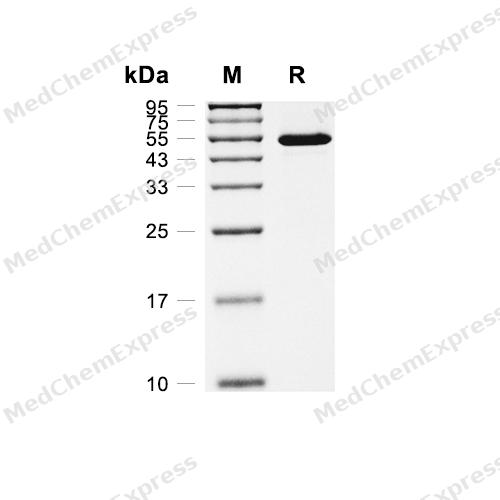
Purity - SDS-PAGE


Technical Parameters
-
Species Human
-
Source E. coli
-
Tag Tag Free
-
Accession
P35557-1/NP_000153.1 (L2-Q465)
-
Molecular Construction
-
N-term
-
GCK (L2-Q465)
Accession # P35557-1/NP_000153.1 -
C-term
-
-
Protein Length
Full Length of Isoform-1
-
Synonyms
GCK; Hexokinase D, Pancreatic Isozyme; Prev. MODY2; Hexokinase 4; HK4; Hexokinase-D; Glucokinase (Hexokinase 4); FGQTL3; Hexokinase Type IV; PNDM1; Hexokinase-4; HHF3; HK IV; HXKP; HKIV; LGLK; Maturity Onset Diabetes Of The Young 2; GLK; ATP:D-Hexose 6-Ph
-
AA Sequence
LDDRARMEAAKKEKVEQILAEFQLQEEDLKKVMRRMQKEMDRGLRLETHEEASVKMLPTYVRSTPEGSEVGDFLSLDLGGTNFRVMLVKVGEGEEGQWSVKTKHQMYSIPEDAMTGTAEMLFDYISECISDFLDKHQMKHKKLPLGFTFSFPVRHEDIDKGILLNWTKGFKASGAEGNNVVGLLRDAIKRRGDFEMDVVAMVNDTVATMISCYYEDHQCEVGMIVGTGCNACYMEEMQNVELVEGDEGRMCVNTEWGAFGDSGELDEFLLEYDRLVDESSANPGQQLYEKLIGGKYMGELVRLVLLRLVDENLLFHGEASEQLRTRGAFETRFVSQVESDTGDRKQIYNILSTLGLRPSTTDCDIVRRACESVSTRAAHMCSAGLAGVINRMRESRSEDVMRITVGVDGSVYKLHPSFKERFHASVRRLTPSCEITFIESEEGSGRGAALVSAVACKKACMLGQ
-
Molecular Weight
Approximately 55 kDa
-
Purity
≥ 95%, as determined by reducing SDS-PAGE.


Product Properties
Solution.
Supplied as a 0.22 μm filtered solution of 50 mM Tris-HCl, 300 mM NaCl, pH 7.4, 10% glycerol.
Note: For SPR assay, please replace the buffer. Primary amine components (e.g., Tris, imidazole) can affect protein-coupled chips.
<1 EU/μg, determined by LAL method.
Please use rapid thawing with running water to thaw the protein.
Stored at -80°C for 1 year from date of receipt. It is stable at -20°C for 3 months after opening. It is recommended to freeze aliquots at -80°C for extended storage. Avoid repeated freeze-thaw cycles.
Shipping with dry ice.


Documentation
-
Data Sheet (238 KB)
-
SDS (251 KB)
- English - EN (251 KB)
- Français - FR (251 KB)
- Deutsch - DE (251 KB)
- Norwegian - NO (251 KB)
- Español - ES (251 KB)
- Swedish - SV (251 KB)
- Italian - IT (251 KB)
- Korean - KR (251 KB)
- Portuguese - PT (251 KB)
-
Handling Instructions (2659 KB)

Calculators
Concentration (start) × Volume (start) = Concentration (final) × Volume (final)


 Powered by Bioz

