



HO-2/HMOX2 Protein, Human (His)

Based on 1 Customer Validation
Through its catalytic activity, HO-2/HMOX2 protein promotes the oxidative cleavage of heme at the α-methylene bridge carbon, thereby releasing carbon monoxide (CO). This process simultaneously produces biliverdin IXalpha and releases the central heme iron chelate in the form of ferrous iron. HO-2/HMOX2 Protein, Human (His) is the recombinant human-derived HO-2/HMOX2 protein, expressed by E. coli , with C-6*His labeled tag.
- Species: Human
- Source: E. coli
-
Storage:Stored at -80°C for 1 year from date of receipt. It is stable at -20°C for 3 months after opening. It is recommended to freeze aliquots at -80°C for extended storage. Avoid repeated freeze-thaw cycles.


To place orders, for customer services and technical support, please contact: MedChemExpress USA
Tel: 609-228-6898 E-mail: [email protected] [email protected]


-
 Biological Activity
-
Technical Parameters
-
Product Properties
- Documentation
- Help & FAQs




Biological Activity
Description
Through its catalytic activity, HO-2/HMOX2 protein promotes the oxidative cleavage of heme at the α-methylene bridge carbon, thereby releasing carbon monoxide (CO). This process simultaneously produces biliverdin IXalpha and releases the central heme iron chelate in the form of ferrous iron. HO-2/HMOX2 Protein, Human (His) is the recombinant human-derived HO-2/HMOX2 protein, expressed by E. coli , with C-6*His labeled tag.
Background
Heme oxygenase-2 (HO-2), encoded by the HMOX2 gene, is a critical enzyme that catalyzes the oxidative cleavage of heme at the alpha-methene bridge carbon, resulting in the release of carbon monoxide (CO) and the generation of biliverdin IXalpha. Simultaneously, the enzyme liberates the central heme iron chelate as ferrous iron. This reaction represents a pivotal step in heme catabolism and serves as a regulatory mechanism for maintaining cellular heme homeostasis. The release of carbon monoxide and biliverdin, along with the liberation of ferrous iron, underscores the multifunctional role of HO-2 in both gasotransmitter signaling and the recycling of iron. The enzymatic activity of HO-2 is essential for various physiological processes, including antioxidant defense, anti-inflammatory responses, and the regulation of vascular tone.
Verified Bioactivity
Measured by its ability to oxidize hemin to biliverdin. The specific activity is >3.5 pmol/min/μg.
MCE Validation Data
-
Purity - SDS-PAGE
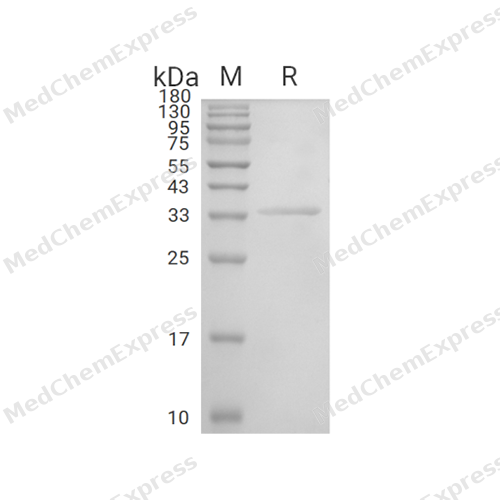
Purity - SDS-PAGE


Technical Parameters
-
Species Human
-
Source E. coli
-
Tag C-6*His
-
Accession
P30519-1 (S2-L291)
-
Molecular Construction
-
N-term
-
HMOX2-1 (S2-L291)
Accession # P30519-1 -
6*His
-
C-term
-
-
Protein Length
Cytoplasmic Domain
-
Synonyms
HMOX2; Heme Oxygenase (Biliverdin-Producing); Heme Oxygenase 2; Heme Oxygenase; HO-2; HO2; Heme Oxygenase (Decycling) 2
-
AA Sequence
SAEVETSEGVDESEKKNSGALEKENQMRMADLSELLKEGTKEAHDRAENTQFVKDFLKGNIKKELFKLATTALYFTYSALEEEMERNKDHPAFAPLYFPMELHRKEALTKDMEYFFGENWEEQVQCPKAAQKYVERIHYIGQNEPELLVAHAYTRYMGDLSGGQVLKKVAQRALKLPSTGEGTQFYLFENVDNAQQFKQLYRARMNALDLNMKTKERIVEEANKAFEYNMQIFNELDQAGSTLARETLEDGFPVHDGKGDMRKCPFYAAEQDKGALEGSSCPFRTAMAVL
-
Molecular Weight
Approximately 31 kDa & 35 kDa, based on SDS-PAGE under reducing conditions.
-
Purity
≥ 95%, as determined by reducing SDS-PAGE.


Product Properties
Solution
Supplied as a 0.22 μm filtered solution of 50 mM Tris-HCl, 300 mM NaCl, pH 7.4.
Note: For SPR assay, please replace the buffer. Primary amine components (e.g., Tris, imidazole) can affect protein-coupled chips.
<1 EU/μg, determined by LAL method.
Stored at -80°C for 1 year from date of receipt. It is stable at -20°C for 3 months after opening. It is recommended to freeze aliquots at -80°C for extended storage. Avoid repeated freeze-thaw cycles.
Shipping with dry ice.


Documentation
-
Data Sheet (237 KB)
-
SDS (252 KB)
- English - EN (252 KB)
- Français - FR (252 KB)
- Deutsch - DE (252 KB)
- Norwegian - NO (252 KB)
- Español - ES (252 KB)
- Swedish - SV (252 KB)
- Italian - IT (252 KB)
- Korean - KR (252 KB)
- Portuguese - PT (252 KB)
-
Handling Instructions (2659 KB)

Calculators
Concentration (start) × Volume (start) = Concentration (final) × Volume (final)


 Powered by Bioz

