



HSP60 Protein, Human (His-GST)
Based on 2 publication(s) in Google Scholar
The HSP60 protein is a mitochondrial chaperone that facilitates protein import and assembly. HSP60 Protein, Human (His-GST) is the recombinant human-derived HSP60 protein, expressed by E. coli , with N-His, N-GST labeled tag.
- Species: Human
- Source: E. coli
-
Storage:Stored at -20°C for 2 years from date of receipt. After reconstitution, it is stable at 4°C for 1 week or -20°C for longer (with carrier protein). It is recommended to freeze aliquots at -20°C or -80°C for extended storage.


To place orders, for customer services and technical support, please contact: MedChemExpress USA
Tel: 609-228-6898 E-mail: [email protected] [email protected]


-
 Biological Activity
-
Technical Parameters
-
Product Properties
- Documentation
- Help & FAQs




Biological Activity
Description
The HSP60 protein is a mitochondrial chaperone that facilitates protein import and assembly. HSP60 Protein, Human (His-GST) is the recombinant human-derived HSP60 protein, expressed by E. coli , with N-His, N-GST labeled tag.
Background
HSP60 protein serves as a chaperonin with pivotal roles in mitochondrial protein import and macromolecular assembly. Collaborating with Hsp10, it facilitates the accurate folding of imported proteins and, under stress conditions in the mitochondrial matrix, may prevent misfolding while promoting the refolding and proper assembly of unfolded polypeptides. The structural units of these chaperonins comprise heptameric rings of the large subunit Hsp60, forming a back-to-back double ring. In a cyclic process, Hsp60 ring complexes sequentially bind one unfolded substrate protein per ring, followed by ATP binding and association with two heptameric rings of the co-chaperonin Hsp10. This cyclic interaction leads to the sequestration of the substrate protein within the inner cavity of Hsp60, allowing it to fold undisturbed by other cell components for a certain period. The synchronized hydrolysis of ATP in all Hsp60 subunits results in the dissociation of the chaperonin rings, leading to the release of ADP and the properly folded substrate protein (Probable).
Verified Bioactivity
1.Measured in a cell proliferation assay using A549 cells.The ED50 for this effect is 0.213 μg/mL, corresponding to a specific activity is 4701.457 Unit/mg.
2.HSP60 has ATPase activity at the time of manufacture of 487.28 µM phosphate liberated/h/µg protein at 37°C (pH7.5) in the presence of ATP using a Malachite Green assay.
MCE Validation Data
-
Purity - SDS-PAGE
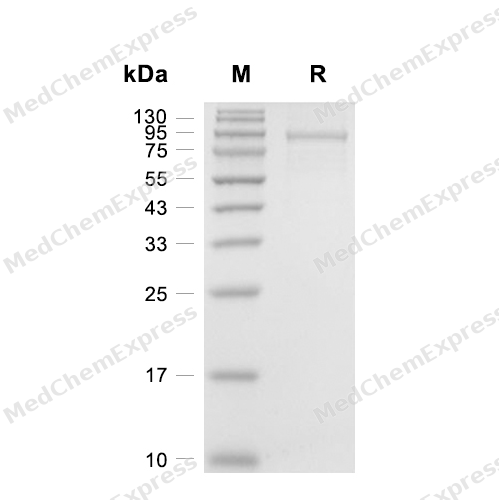
Purity - SDS-PAGE


Publications (2)
-
Journal Impact Factor
-
Most Recent
-
Cell Metab
Gut microbiota-derived lysine phenylacetylation impairs mitochondrial function and is alleviated by SIRT3. [Abstract]2026 Jun 24:S1550-4131(26)00226-3. PMID: 42341761 -


Technical Parameters
-
Species Human
-
Source E. coli
-
Tag N-GST;N-6*His
-
Accession
P10809-1 (L2-F573)
-
Molecular Construction
-
N-term
-
His-GST
-
HSP60 (L2-F573)
Accession # P10809-1 -
C-term
-
-
Protein Length
Full length
-
Synonyms
HSPD1; HuCHA60; Prev. SPG13; CPN60; HSP60; Spastic Paraplegia 13 (Autosomal Dominant); 60 KDa Heat Shock Protein, Mitochondrial; Epididymis Secretory Sperm Binding Protein; Mitochondrial Matrix Protein P1; Heat Shock 60kD Protein 1 (Chaperonin); 60 KDa Ch
-
AA Sequence
LRLPTVFRQMRPVSRVLAPHLTRAYAKDVKFGADARALMLQGVDLLADAVAVTMGPKGRTVIIEQSWGSPKVTKDGVTVAKSIDLKDKYKNIGAKLVQDVANNTNEEAGDGTTTATVLARSIAKEGFEKISKGANPVEIRRGVMLAVDAVIAELKKQSKPVTTPEEIAQVATISANGDKEIGNIISDAMKKVGRKGVITVKDGKTLNDELEIIEGMKFDRGYISPYFINTSKGQKCEFQDAYVLLSEKKISSIQSIVPALEIANAHRKPLVIIAEDVDGEALSTLVLNRLKVGLQVVAVKAPGFGDNRKNQLKDMAIATGGAVFGEEGLTLNLEDVQPHDLGKVGEVIVTKDDAMLLKGKGDKAQIEKRIQEIIEQLDVTTSEYEKEKLNERLAKLSDGVAVLKVGGTSDVEVNEKKDRVTDALNATRAAVEEGIVLGGGCALLRCIPALDSLTPANEDQKIGIEIIKRTLKIPAMTIAKNAGVEGSLIVEKIMQSSSEVGYDAMAGDFVNMVEKGIIDPTKVVRTALLDAAGVASLLTTAEVVVTEIPKEEKDPGMGAMGGMGGGMGGGMF
-
Molecular Weight
Approximately 83-88 kDa, based on SDS-PAGE under reducing conditions, due to the glycosylation.
-
Glycosylation
Yes
-
Purity
≥ 90%, as determined by reducing SDS-PAGE.


Product Properties
Lyophilized powder
Lyophilized from a 0.22 μm filtered solution of PBS, pH 7.4, 8% trehalose.
It is not recommended to reconstitute to a concentration less than 100 μg/mL in ddH2O.
Stored at -20°C for 2 years from date of receipt. After reconstitution, it is stable at 4°C for 1 week or -20°C for longer (with carrier protein). It is recommended to freeze aliquots at -20°C or -80°C for extended storage.
Room temperature in continental US; may vary elsewhere.


Documentation
-
Data Sheet (239 KB)
-
SDS (252 KB)
- English - EN (252 KB)
- Français - FR (252 KB)
- Deutsch - DE (252 KB)
- Norwegian - NO (252 KB)
- Español - ES (252 KB)
- Swedish - SV (252 KB)
- Italian - IT (252 KB)
- Korean - KR (252 KB)
- Portuguese - PT (252 KB)
-
Handling Instructions (2659 KB)

Calculators
Concentration (start) × Volume (start) = Concentration (final) × Volume (final)


 Powered by Bioz

