



HSP90AA1 Protein, Human (His-SUMO)
Based on 4 publication(s) in Google Scholar
The HSP90AA1 protein is an important molecular chaperone that coordinates the maturation and regulation of specific target proteins critical for cell cycle control and signal transduction. Its ATPase activity drives a functional cycle that induces conformational changes in client proteins for activation. HSP90AA1 Protein, Human (His-SUMO) is the recombinant human-derived HSP90AA1 protein, expressed by E. coli , with N-6*His, N-SUMO labeled tag.
- Species: Human
- Source: E. coli
-
Storage:Stored at -20°C for 2 years from date of receipt. After reconstitution, it is stable at 4°C for 1 week or -20°C for longer (with carrier protein). It is recommended to freeze aliquots at -20°C or -80°C for extended storage.


To place orders, for customer services and technical support, please contact: MedChemExpress USA
Tel: 609-228-6898 E-mail: [email protected] [email protected]


-
 Biological Activity
-
Technical Parameters
-
Product Properties
- Documentation
- Help & FAQs




Biological Activity
Description
The HSP90AA1 protein is an important molecular chaperone that coordinates the maturation and regulation of specific target proteins critical for cell cycle control and signal transduction. Its ATPase activity drives a functional cycle that induces conformational changes in client proteins for activation. HSP90AA1 Protein, Human (His-SUMO) is the recombinant human-derived HSP90AA1 protein, expressed by E. coli , with N-6*His, N-SUMO labeled tag.
Background
HSP90AA1 protein, a molecular chaperone, plays a crucial role in the maturation, structural maintenance, and regulation of specific target proteins involved in cell cycle control and signal transduction. Operating through a functional cycle linked to its ATPase activity, essential for its chaperone function, HSP90AA1 induces conformational changes in client proteins, activating them. Dynamic interactions with co-chaperones modulate substrate recognition, the ATPase cycle, and chaperone function. Engaging with diverse client protein classes through co-chaperones, it forms functional chaperones that release properly folded client proteins and co-chaperones in an ADP-bound partially open conformation. Apart from its chaperone activity, HSP90AA1 plays a critical role in mitochondrial import by delivering preproteins to the mitochondrial import receptor TOMM70. It also contributes to the regulation of the transcription machinery at multiple levels, altering transcription factor levels, modulating epigenetic modifiers, and participating in histone eviction from gene promoters. Furthermore, HSP90AA1 binds bacterial lipopolysaccharide, mediating LPS-induced inflammatory responses, including TNF secretion. It antagonizes STUB1-mediated inhibition of TGF-beta signaling and facilitates the association of TOMM70 with IRF3 or TBK1 in the mitochondrial outer membrane, promoting host antiviral responses. In the context of microbial infection, HSP90AA1 interferes with N.meningitidis NadA-mediated invasion of human cells, influencing the adhesion and entry of E.coli expressing NadA into human Chang cells based on its expression levels.
Verified Bioactivity
Measured by its ability to catalyze 25 µM ATP substrate at room temperature for 10 minutes. The specific activity is >20 nmol/min/mg.
MCE Validation Data
-
Purity - SDS-PAGE
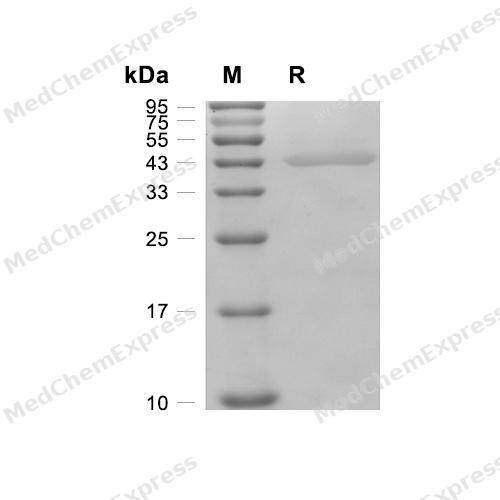
Purity - SDS-PAGE


Publications (4)
-
Journal Impact Factor
-
Most Recent
-
Phytomedicine
Deciphering the core antiviral mechanism of Yinqiao powder: Inhibition of dengue virus adsorption mediated by wogonin via host receptor HSP90AA1 blockade. [Abstract]2026 Jul:156:158184. PMID: 42061084 -
J Med Chem
Bardoxolone Derivatives as Novel Pseudo-Natural Necroptosis Inhibitors by Destabilizing HSP90 Client Proteins. [Abstract]2025 Apr 30. PMID: 40307003 -
Food Funct
Ameliorative effect of docosahexaenoic acid-acylated astaxanthin ester on diabetic nephropathy: association with the trehalose/HSP90AA1 and colon-kidney axis. [Abstract]2026 May 18. PMID: 42149022 -
Heliyon
Bioactive components in prunella vulgaris for treating Hashimoto's disease via regulation of innate immune response in human thyrocytes. [Abstract]2024 Aug 13;10(16):e36103. PMID: 39253271


Technical Parameters
-
Species Human
-
Source E. coli
-
Tag N-6*His;N-SUMO
-
Accession
P07900-1 (D9-D232)
-
Molecular Construction
-
N-term
-
6*His-SUMO
-
HSP90AA1 (D9-D232)
Accession # P07900-1 -
C-term
-
-
Protein Length
Full Length of Interaction with NR3C1 Region
-
Synonyms
HSP90AA1; Heat Shock 86 KDa; Prev. HSPC1; FLJ31884; Prev. HSPCA; HSP90A; Prev. HSPCAL4; HSP 86; HSP90N; HSP86; Hsp89; LAP-2; Hsp90; Heat Shock Protein 90kDa Alpha Family Class A Member 1; Heat Shock Protein 90kDa Alpha (Cytosolic), Class A Member 1; Heat
-
AA Sequence
DQPMEEEEVETFAFQAEIAQLMSLIINTFYSNKEIFLRELISNSSDALDKIRYESLTDPSKLDSGKELHINLIPNKQDRTLTIVDTGIGMTKADLINNLGTIAKSGTKAFMEALQAGADISMIGQFGVGFYSAYLVAEKVTVITKHNDDEQYAWESSAGGSFTVRTDTGEPMGRGTKVILHLKEDQTEYLEERRIKEIVKKHSQFIGYPITLFVEKERDKEVSD
-
Molecular Weight
Approximately 43 kDa, based on SDS-PAGE under reducing conditions.
-
Purity
≥ 90%, as determined by reducing SDS-PAGE.


Product Properties
Lyophilized powder
1.Lyophilized from a 0.22 μm filtered solution of 20 mM Tris-HCl, 0.5 M NaCl, 6% trehalose, pH 8.0.
2.Lyophilized from a 0.22 μm filtered solution of PBS, pH 7.4.
Please refer to the lot-specific COA for specific buffer information.
Note: For SPR assay, please replace the buffer. Primary amine components (e.g., Tris, imidazole) can affect protein-coupled chips.
<1 EU/μg, determined by LAL method.
It is not recommended to reconstitute to a concentration less than 100 μg/mL in ddH2O.
Stored at -20°C for 2 years from date of receipt. After reconstitution, it is stable at 4°C for 1 week or -20°C for longer (with carrier protein). It is recommended to freeze aliquots at -20°C or -80°C for extended storage.
Room temperature in continental US; may vary elsewhere.


Documentation
-
Data Sheet (237 KB)
-
SDS (254 KB)
- English - EN (254 KB)
- Français - FR (254 KB)
- Deutsch - DE (254 KB)
- Norwegian - NO (254 KB)
- Español - ES (254 KB)
- Swedish - SV (254 KB)
- Italian - IT (254 KB)
- Korean - KR (254 KB)
- Portuguese - PT (254 KB)
-
Handling Instructions (2659 KB)

Calculators
Concentration (start) × Volume (start) = Concentration (final) × Volume (final)


 Powered by Bioz

