



IL-25/IL-17E Protein, Mouse (HEK293, His, solution)
Based on 2 publication(s) in Google Scholar
Interleukin-25 (IL-25), also known as IL-17E, belongs to the IL-17 cytokine family. IL-25 activates NF-κB, MAPKs and JAK/STAT signaling pathways. IL-25 exerts singal transduction through receptors composed of IL17RA and IL17RB. IL-25/IL-17E Protein, Mouse (HEK293, His, solution) is the recombinant mouse-derived IL-25/IL-17E protein, expressed by HEK293 , with N-His labeled tag.
- Species: Mouse
- Source: HEK293
-
Storage:Stored at -80°C for 1 year from date of receipt. It is stable at -20°C for 3 months after opening. It is recommended to freeze aliquots at -80°C for extended storage. Avoid repeated freeze-thaw cycles.


To place orders, for customer services and technical support, please contact: MedChemExpress USA
Tel: 609-228-6898 E-mail: [email protected] [email protected]


-
 Biological Activity
-
Technical Parameters
-
Product Properties
- Documentation
- Help & FAQs




Biological Activity
Description
Interleukin-25 (IL-25), also known as IL-17E, belongs to the IL-17 cytokine family. IL-25 activates NF-κB, MAPKs and JAK/STAT signaling pathways[1]. IL-25 exerts singal transduction through receptors composed of IL17RA and IL17RB[7]. IL-25/IL-17E Protein, Mouse (HEK293, His, solution) is the recombinant mouse-derived IL-25/IL-17E protein, expressed by HEK293 , with N-His labeled tag.
Background
and is also produced by various immune cells such as CD8+ T cells, mast cells, macrophages, dendritic cells (DCs), eosinophils, basophils, group 2 innate lymphoid cells (ILC2s), epithelial and endothelial cells[1][2][3][4][5][6]. IL-25 exerts singal transduction through receptors composed of IL17RA and IL17RB[7]. IL-25 induces the expression of IL-4, IL-5, IL-13, TGF-β, and G-CSF[8][9]. IL-25 can stimulate cell proliferation, inhibition of apoptosis, production of inflammatory cytokines and chemokines, modulation of cell-cell adhesion, and cell motility in nonimmune cells[10][11][12][13]. IL-25 activates NF-κB, MAPKs and JAK/STATs signaling pathways[1][14]. The sequence homology of IL-25 between human and mouse, mouse and rat is 78.88% and 91.12% respectively.
Verified Bioactivity
1. Measured by its ability to induce CXCL1/GROα secretion in HT29. The ED50 for this effect is 3-14 ng/mL.
2.Immobilized IL17RB Protein, Mouse, Recombinant (hFc Tag) at 2 μg/mL (100 μL/well) can bind IL25/IL17E Protein, Mouse, Recombinant (His Tag),the EC50 is 4-20 ng/mL.
MCE Validation Data
-
Purity - SDS-PAGE
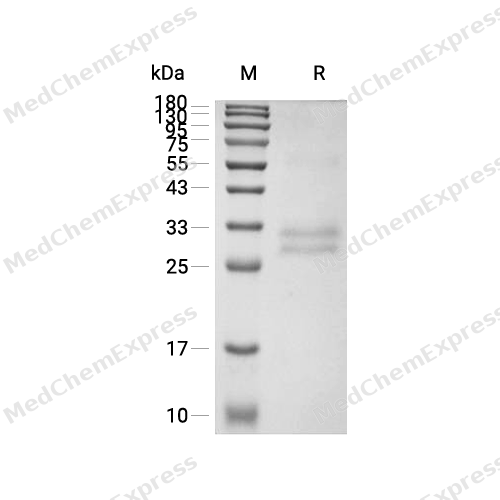
Purity - SDS-PAGE


Publications (2)
-
Journal Impact Factor
-
Most Recent
-
Int Immunopharmacol
Interleukin 25 promotes muscle regeneration in sarcopenia by regulating macrophage-mediated Sonic Hedgehog signaling. [Abstract]2024 Sep 30:139:112662. PMID: 39038385 -
Mol Neurobiol
Pachymic Acid Promotes ILC2 Migration to the Brain via Dynein Axonemal Heavy Chain 9 Upregulation. [Abstract]2025 Dec 3;63(1):240. PMID: 41335398


Technical Parameters
-
Species Mouse
-
Source HEK293
-
Tag N-His
-
Accession
Q8VHH8 (V17-A169)
-
Molecular Construction
-
N-term
-
His
-
IL-17E (V17-A169)
Accession # Q8VHH8 -
C-term
-
-
Protein Length
Full Length of Mature Protein
-
Synonyms
IL25; IL-25; Prev. IL17E; Interleukin-25; IL-17E; Interleukin 17E; Interleukin 25; Interleukin-17E
-
AA Sequence
VSLRIQEGCSHLPSCCPSKEQEPPEEWLKWSSASVSPPEPLSHTHHAESCRASKDGPLNSRAISPWSYELDRDLNRVPQDLYHARCLCPHCVSLQTGSHMDPLGNSVPLYHNQTVFYRRPCHGEEGTHRRYCLERRLYRVSLACVCVRPRVMA
-
Predicted Molecular Mass
20 kDa
-
Molecular Weight
Approximately 30-35 kDa, based on SDS-PAGE under reducing conditions, due to the glycosylation.
-
Glycosylation
Yes
-
Purity
≥ 95%, as determined by reducing SDS-PAGE.


Product Properties
Solution
Supplied as a 0.22 μm filtered solution of PBS, pH 7.4.
<1 EU/μg, determined by LAL method.
Stored at -80°C for 1 year from date of receipt. It is stable at -20°C for 3 months after opening. It is recommended to freeze aliquots at -80°C for extended storage. Avoid repeated freeze-thaw cycles.
Shipping with dry ice.


Documentation
-
Data Sheet (237 KB)
-
SDS (251 KB)
- English - EN (251 KB)
- Français - FR (251 KB)
- Deutsch - DE (251 KB)
- Norwegian - NO (251 KB)
- Español - ES (251 KB)
- Swedish - SV (251 KB)
- Italian - IT (251 KB)
- Korean - KR (251 KB)
- Portuguese - PT (251 KB)
-
Handling Instructions (2659 KB)

Calculators
Concentration (start) × Volume (start) = Concentration (final) × Volume (final)


 Powered by Bioz

