



IL-36 beta/IL-1F8 Protein, Human (153a.a)
Based on 1 Customer Validation
IL-36 beta/IL-1F8 protein signals through IL-36R, activates NF-kappa-B and MAPK pathways, and induces pro-inflammatory responses. It is present in the epithelial barrier and shares the IL-1 system coreceptor IL1RAP. IL-36 beta/IL-1F8 Protein, Human (153a.a) is the recombinant human-derived IL-36 beta/IL-1F8 protein, expressed by E. coli , with tag free. The total length of IL-36 beta/IL-1F8 Protein, Human (153a.a) is 153 a.a., with molecular weight of ~ 17.2 kDa.
- Species: Human
- Source: E. coli
-
Storage:Stored at -20°C for 2 years from date of receipt. After reconstitution, it is stable at 4°C for 1 week or -20°C for longer (with carrier protein). It is recommended to freeze aliquots at -20°C or -80°C for extended storage.


To place orders, for customer services and technical support, please contact: MedChemExpress USA
Tel: 609-228-6898 E-mail: [email protected] [email protected]


-
 Biological Activity
-
Technical Parameters
-
Product Properties
- Documentation
- Help & FAQs




Biological Activity
Description
IL-36 beta/IL-1F8 protein signals through IL-36R, activates NF-kappa-B and MAPK pathways, and induces pro-inflammatory responses. It is present in the epithelial barrier and shares the IL-1 system coreceptor IL1RAP. IL-36 beta/IL-1F8 Protein, Human (153a.a) is the recombinant human-derived IL-36 beta/IL-1F8 protein, expressed by E. coli , with tag free. The total length of IL-36 beta/IL-1F8 Protein, Human (153a.a) is 153 a.a., with molecular weight of ~ 17.2 kDa.
Background
IL-36 beta/IL-1F8 protein is a cytokine that binds to and activates the IL1RL2/IL-36R receptor, leading to the activation of NF-kappa-B and MAPK signaling pathways in target cells, resulting in a pro-inflammatory response. It is part of the IL-36 signaling system, which is believed to be present in epithelial barriers and involved in local inflammatory responses, similar to the IL-1 system. IL-36 beta stimulates the production of interleukin-6 and interleukin-8 in various cell types, including synovial fibroblasts, articular chondrocytes, and mature adipocytes. It also induces the expression of antimicrobial peptides and matrix metalloproteases. In the skin, IL-36 beta acts on keratinocytes, dendritic cells, and indirectly on T-cells to promote tissue infiltration, cell maturation, and cell proliferation. In cultured keratinocytes, IL-36 beta induces the expression of chemokines and pro-inflammatory cytokines, such as CCL3, CCL4, CCL5, CCL2, CCL17, CCL22, CL20, CCL5, CCL2, CCL17, CCL22, CXCL8, CCL20, CXCL1, TNF-alpha, IL-8, and IL-6. It interacts with the cargo receptor TMED10, facilitating its translocation from the cytoplasm into the ERGIC and subsequent secretion.
Verified Bioactivity
Measured by its ability to induce IL-8 secretion by A431 human epithelial carcinoma cells. The ED50 for this effect is 7.502 ng/mL. Corresponding to a specific activity is 1.33×10^5 U/mg.
MCE Validation Data
-
Purity - SDS-PAGE
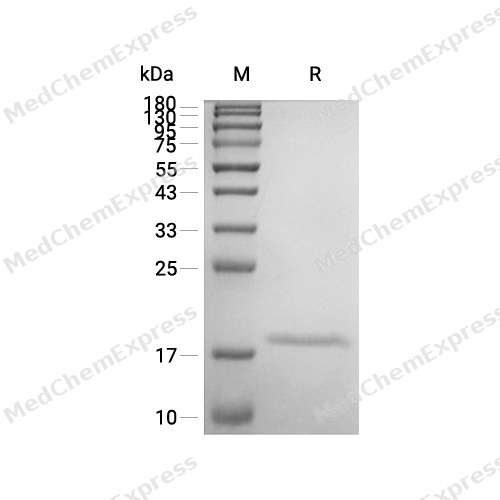
Purity - SDS-PAGE
-
Bioactivity - Cell-Based Assay
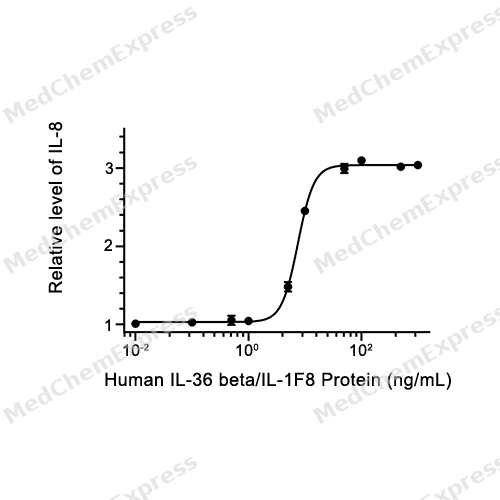
Bioactivity - Cell-Based Assay


Technical Parameters
-
Species Human
-
Source E. coli
-
Tag Tag Free
-
Accession
Q9NZH7-2 (R5-E157)
-
Molecular Construction
-
N-term
-
IL-36β (R5-E157)
Accession # Q9NZH7-2 -
C-term
-
-
Protein Length
Full Length of Isoform-2
-
Synonyms
IL36B; Interleukin-36 Beta; Prev. IL1F8; MGC126880; IL-1H2; MGC126882; IL-1F8; FIL1 Eta; IL1H2; IL-1 Eta; FILI-(ETA); Interleukin-1 Superfamily E; IL1-ETA; Family Of Interleukin 1-Eta; FIL1; IL-1F8 (FIL1-Eta); Interleukin 1 Family, Member 8 (Eta); FIL1-(E
-
AA Sequence
REAAPKSYAIRDSRQMVWVLSGNSLIAAPLSRSIKPVTLHLIACRDTEFSDKEKGNMVYLGIKGKDLCLFCAEIQGKPTLQLKEKNIMDLYVEKKAQKPFLFFHNKEGSTSVFQSVSYPGWFIATSTTSGQPIFLTKERGITNNTNFYLDSVE
-
Predicted Molecular Mass
17.2 kDa
-
Molecular Weight
Approximately 18 kDa, based on SDS-PAGE under reducing conditions.
-
Purity
≥ 95%, as determined by reducing SDS-PAGE.


Product Properties
Lyophilized powder
Lyophilized from a 0.22 μm filtered solution of 40 mM PB, 300 mM NaCl, pH 7.4.
<1 EU/μg, determined by LAL method.
It is not recommended to reconstitute to a concentration less than 100 μg/mL in ddH2O. For long term storage it is recommended to add a carrier protein (0.1% BSA, 5% HSA, 10% FBS or 5% Trehalose).
Stored at -20°C for 2 years from date of receipt. After reconstitution, it is stable at 4°C for 1 week or -20°C for longer (with carrier protein). It is recommended to freeze aliquots at -20°C or -80°C for extended storage.
Room temperature in continental US; may vary elsewhere.


Documentation
-
Data Sheet (237 KB)
-
SDS (252 KB)
- English - EN (252 KB)
- Français - FR (252 KB)
- Deutsch - DE (252 KB)
- Norwegian - NO (252 KB)
- Español - ES (252 KB)
- Swedish - SV (252 KB)
- Italian - IT (252 KB)
- Korean - KR (252 KB)
- Portuguese - PT (252 KB)
-
Handling Instructions (2659 KB)

Calculators
Concentration (start) × Volume (start) = Concentration (final) × Volume (final)


 Powered by Bioz

