



PDCE2 Protein, Mouse (HEK293, His)
Based on 2 publication(s) in Google Scholar
PDCE2 Protein, a vital element in the pyruvate dehydrogenase complex, is integral to cellular metabolism. It catalyzes the conversion of pyruvate to acetyl-CoA and CO2, connecting glycolysis to the tricarboxylic acid (TCA) cycle. PDCE2's catalytic function is essential for efficient pyruvate utilization, ensuring the flow of carbon compounds through key metabolic pathways crucial for energy production and cellular homeostasis. PDCE2 Protein, Mouse (HEK293, His) is the recombinant mouse-derived PDCE2 protein, expressed by HEK293 , with N-10*His labeled tag.
- Species: Mouse
- Source: HEK293
-
Storage:Stored at -20°C for 2 years from date of receipt. After reconstitution, it is stable at 4°C for 1 week or -20°C for longer (with carrier protein). It is recommended to freeze aliquots at -20°C or -80°C for extended storage.


To place orders, for customer services and technical support, please contact: MedChemExpress USA
Tel: 609-228-6898 E-mail: [email protected] [email protected]


-
 Biological Activity
-
Technical Parameters
-
Product Properties
- Documentation
- Help & FAQs




Biological Activity
Description
PDCE2 Protein, a vital element in the pyruvate dehydrogenase complex, is integral to cellular metabolism. It catalyzes the conversion of pyruvate to acetyl-CoA and CO2, connecting glycolysis to the tricarboxylic acid (TCA) cycle. PDCE2's catalytic function is essential for efficient pyruvate utilization, ensuring the flow of carbon compounds through key metabolic pathways crucial for energy production and cellular homeostasis. PDCE2 Protein, Mouse (HEK293, His) is the recombinant mouse-derived PDCE2 protein, expressed by HEK293 , with N-10*His labeled tag.
Background
PDCE2 protein is a key component of the pyruvate dehydrogenase complex, a critical enzyme assembly that plays a pivotal role in cellular metabolism. This complex orchestrates the comprehensive conversion of pyruvate into acetyl-CoA and CO2, serving as a crucial metabolic link connecting glycolysis to the tricarboxylic acid (TCA) cycle. The catalytic function of PDCE2 is integral to the efficient utilization of pyruvate, ensuring the flux of carbon compounds through key metabolic pathways essential for energy production and cellular homeostasis.
Verified Bioactivity
Immobilized PDCE2 at 2 μg/mL (100 μL/well) can bind anti- PDCE2 Antibody. The ED50 for this effect is 10.24 ng/mL.
MCE Validation Data
-
Purity - SDS-PAGE
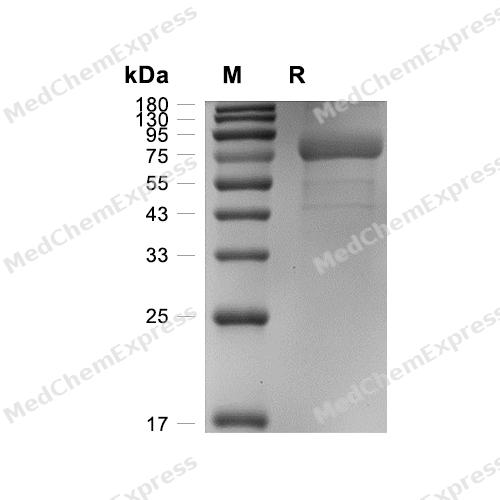
Purity - SDS-PAGE


Publications (2)
-
Journal Impact Factor
-
Most Recent
-
Mater Today Bio
Dual molecularly imprinted nanocomposite with transferrin mediated glioma targeting and cholesterol exhaustion for synergistic cuproptosis/immune checkpoint blockade/immunogenic cell death. [Abstract]2025 Aug 16:34:102209. PMID: 40893371 -
Hepatol Res
Dendritic Cell-Depleted Mice Develop the Autoimmune Biliary Disease That Serologically and Pathogenically Models Human Primary Biliary Cholangitis. [Abstract]2025 Aug 6. PMID: 40767254


Technical Parameters
-
Species Mouse
-
Source HEK293
-
Tag N-10*His
-
Accession
Q8BMF4 (S86-L642)
-
Molecular Construction
-
N-term
-
10*His
-
PDCE2 (S86-L642)
Accession # Q8BMF4 -
C-term
-
-
Protein Length
Full Length of Mature Protein
-
Synonyms
DLAT; E2 Component Of Pyruvate Dehydrogenase Complex; Prev. DLTA; M2 Antigen Complex 70 KDa Subunit; PDC-E2; PDCE2; Dihydrolipoyllysine-Residue Acetyltransferase Component Of Pyruvate Dehydrogenase Complex, Mitochondrial; PBC; Dihydrolipoamide Acetyltrans
-
AA Sequence
SLPPHQKVPLPSLSPTMQAGTIARWEKKEGEKISEGDLIAEVETDKATVGFESLEECYMAKILVPEGTRDVPVGSIICITVEKPQDIEAFKNYTLDLAAAAAPQAAPAAAPAPAAAPAAPSASAPGSSYPTHMQIVLPALSPTMTMGTVQRWEKKVGEKLSEGDLLAEIETDKATIGFEVQEEGYLAKILVPEGTRDVPLGAPLCIIVEKQEDIAAFADYRPTEVTSLKPQAAPPAPPPVAAVPPTPQPVAPTPSAAPAGPKGRVFVSPLAKKLAAEKGIDLTQVKGTGPEGRIIKKDIDSFVPSKAAPAAAAAMAPPGPRVAPAPAGVFTDIPISNIRRVIAQRLMQSKQTIPHYYLSVDVNMGEVLLVRKELNKMLEGKGKISVNDFIIKASALACLKVPEANSSWMDTVIRQNHVVDVSVAVSTPAGLITPIVFNAHIKGLETIASDVVSLASKAREGKLQPHEFQGGTFTISNLGMFGIKNFSAIINPPQACILAIGASEDKLIPADNEKGFDVASVMSVTLSCDHRVVDGAVGAQWLAEFKKYLEKPITMLL
-
Molecular Weight
Approximately 75-95 kDa, based on SDS-PAGE under reducing conditions.
-
Purity
≥ 90%, as determined by reducing SDS-PAGE.


Product Properties
Lyophilized powder.
Lyophilized from a 0.22 μm filtered solution of 50 mM Tris-HCl, 300 mM NaCl, pH 7.4, 10% glycerol.
Note: For SPR assay, please replace the buffer. Primary amine components (e.g., Tris, imidazole) can affect protein-coupled chips.
<1 EU/μg, determined by LAL method.
It is not recommended to reconstitute to a concentration less than 100 μg/mL in ddH2O. For long term storage it is recommended to add a carrier protein (0.1% BSA, 5% HSA, 10% FBS or 5% Trehalose).
Stored at -20°C for 2 years from date of receipt. After reconstitution, it is stable at 4°C for 1 week or -20°C for longer (with carrier protein). It is recommended to freeze aliquots at -20°C or -80°C for extended storage.
Room temperature in continental US; may vary elsewhere.


Documentation
-
Data Sheet (239 KB)
-
SDS (254 KB)
- English - EN (254 KB)
- Français - FR (254 KB)
- Deutsch - DE (254 KB)
- Norwegian - NO (254 KB)
- Español - ES (254 KB)
- Swedish - SV (254 KB)
- Italian - IT (254 KB)
- Korean - KR (254 KB)
- Portuguese - PT (254 KB)
-
Handling Instructions (2659 KB)

Calculators
Concentration (start) × Volume (start) = Concentration (final) × Volume (final)


 Powered by Bioz

