



PFKM Protein, Human (HEK293, His)

Based on 1 Customer Validation
PFKM protein, a key regulator in cellular metabolism, catalyzes the phosphorylation of D-fructose 6-phosphate to fructose 1,6-bisphosphate, initiating glycolysis. This fundamental enzymatic step controls glucose entry into glycolysis, influencing downstream energy production and cellular metabolism. PFKM's pivotal role highlights its significance in orchestrating metabolic flux and maintaining cellular energy balance. PFKM Protein, Human (HEK293, His) is the recombinant human-derived PFKM protein, expressed by HEK293 , with C-6*His labeled tag.
- Species: Human
- Source: HEK293
-
Storage:Stored at -80°C for 1 year from date of receipt. It is stable at -20°C for 3 months after opening. It is recommended to freeze aliquots at -80°C for extended storage. Avoid repeated freeze-thaw cycles.


To place orders, for customer services and technical support, please contact: MedChemExpress USA
Tel: 609-228-6898 E-mail: [email protected] [email protected]


-
 Biological Activity
-
Technical Parameters
-
Product Properties
- Documentation
- Help & FAQs




Biological Activity
Description
PFKM protein, a key regulator in cellular metabolism, catalyzes the phosphorylation of D-fructose 6-phosphate to fructose 1,6-bisphosphate, initiating glycolysis. This fundamental enzymatic step controls glucose entry into glycolysis, influencing downstream energy production and cellular metabolism. PFKM's pivotal role highlights its significance in orchestrating metabolic flux and maintaining cellular energy balance. PFKM Protein, Human (HEK293, His) is the recombinant human-derived PFKM protein, expressed by HEK293 , with C-6*His labeled tag.
Background
The PFKM protein assumes a pivotal role in cellular metabolism by catalyzing the phosphorylation of D-fructose 6-phosphate to fructose 1,6-bisphosphate using ATP as a substrate. This enzymatic activity marks the initial and committing step of glycolysis, a fundamental metabolic pathway central to energy production. By facilitating the conversion of fructose 6-phosphate to fructose 1,6-bisphosphate, PFKM plays a key role in regulating the entry of glucose into the glycolytic pathway, thereby influencing downstream energy production and cellular metabolic processes. The significance of PFKM in catalyzing this essential reaction underscores its importance in orchestrating the metabolic flux and maintaining cellular energy balance.
Verified Bioactivity
Measured by its ability to phosphorylate fructose-6-phosphate.The specific activity is >100 pmol/min/μg, as measured under the described conditions.
MCE Validation Data
-
Purity - SDS-PAGE
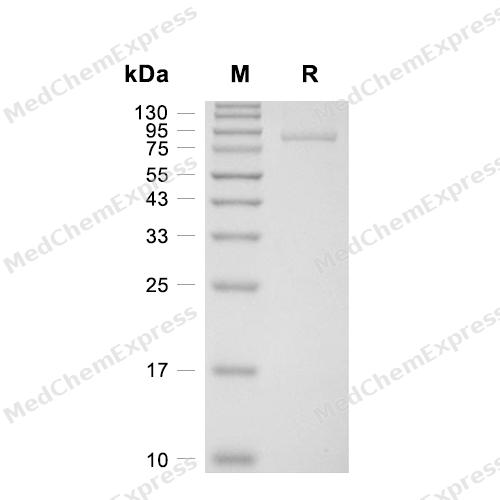
Purity - SDS-PAGE

Assay Procedure
Materials
Assay buffer (10x): 250 mM HEPES, 1.5 M NaCl, 100 mM MgCl2, 100 mM CaCl2, pH 7.0
PFKM Protein, Human (HEK293, His) (HY-P71090)
Substrate: ATP, Fructose-6-Phosphate (HY-137834)
Standard: ATP
Procedure
1. Dilute the 10x assay buffer with deionized water to prepare 1xassay buffer.
2. Reaction Mixture: Prepare a reaction mixture containing 0.05 mM ATP and 2.5 mM Fructose-6-Phosphate in 1x assay buffer.
3. Dilute Human PFKM to 10 μg/mL in 1x assay buffer.
4. Standard Curve Preparation: Dilute ATP to 0, 0.3, 0.6, 1.2, 2.5, 5, 10, 20, 40, 50 μM in 1x assay buffer. Add 50 μL of each concentration to the wells as standard wells.
5. Experimental Group: Mix 20 μL of 100 μg/mL PFKM protein with 30 μL of reaction mixture.
Blank Group: Mix 20 μL of 1X Assay Buffer with 30 μL of reaction mixture.
6. Add 50 μL of Kinase-LumiTM Enhanced Chemiluminescent Kinase Detection Reagent to Reagent to the standard wells, experimental wells, and blank wells. Mix thoroughly.
7. Incubate at 25oC for 10 minutes, then perform chemiluminescence detection using a multimode microplate reader.
8. Calculate specific activity:
Specific Activity (pmol/min/μg) = | Adjusted ATP consumption* (nmol) x 1000 (pmol/nmol) |
| Incubation time (min) x amount of enzyme (μg) |
*Adjusted for Substrate Blank
**Derived using calibration standard
Per Well:
Human PFKM: 1.25 μg
ATP: 20 μM
Fructose-6-Phosphate:


Technical Parameters
-
Species Human
-
Source HEK293
-
Tag C-6*His
-
Accession
P08237-1 (T2-V780)
-
Molecular Construction
-
N-term
-
PFKM (T2-V780)
Accession # P08237-1 -
6*His
-
C-term
-
-
Protein Length
Full Length of Isoform-1 Mature Protein
-
Synonyms
PFKM; Phosphofructokinase Muscle Isoform 4; Prev. PFKX; 6-Phosphofructokinase, Muscle Type; Phosphofructo-1-Kinase Isozyme A; 6-Phosphofructo-1-Kinase; 6-Phosphofructokinase Type A; Phosphofructokinase 1; Phosphohexokinase; Phosphofructokinase-M; PPP1R122
-
AA Sequence
THEEHHAAKTLGIGKAIAVLTSGGDAQGMNAAVRAVVRVGIFTGARVFFVHEGYQGLVDGGDHIKEATWESVSMMLQLGGTVIGSARCKDFREREGRLRAAYNLVKRGITNLCVIGGDGSLTGADTFRSEWSDLLSDLQKAGKITDEEATKSSYLNIVGLVGSIDNDFCGTDMTIGTDSALHRIMEIVDAITTTAQSHQRTFVLEVMGRHCGYLALVTSLSCGADWVFIPECPPDDDWEEHLCRRLSETRTRGSRLNIIIVAEGAIDKNGKPITSEDIKNLVVKRLGYDTRVTVLGHVQRGGTPSAFDRILGSRMGVEAVMALLEGTPDTPACVVSLSGNQAVRLPLMECVQVTKDVTKAMDEKKFDEALKLRGRSFMNNWEVYKLLAHVRPPVSKSGSHTVAVMNVGAPAAGMNAAVRSTVRIGLIQGNRVLVVHDGFEGLAKGQIEEAGWSYVGGWTGQGGSKLGTKRTLPKKSFEQISANITKFNIQGLVIIGGFEAYTGGLELMEGRKQFDELCIPFVVIPATVSNNVPGSDFSVGADTALNTICTTCDRIKQSAAGTKRRVFIIETMGGYCGYLATMAGLAAGADAAYIFEEPFTIRDLQANVEHLVQKMKTTVKRGLVLRNEKCNENYTTDFIFNLYSEEGKGIFDSRKNVLGHMQQGGSPTPFDRNFATKMGAKAMNWMSGKIKESYRNGRIFANTPDSGCVLGMRKRALVFQPVAELKDQTDFEHRIPKEQWWLKLRPILKILAKYEIDLDTSDHAHLEHITRKRSGEAAV
-
Molecular Weight
Approximately 93 kDa, based on SDS-PAGE under reducing conditions.
-
Glycosylation
Yes
-
Purity
≥ 95%, as determined by reducing SDS-PAGE.


Product Properties
Solution
Supplied as a 0.2 μm filtered solution of 20 mM PB, 150 mM NaCl, 5 mM EDTA, 5% Trehalose, pH 6.9.
<1 EU/μg, determined by LAL method.
Stored at -80°C for 1 year from date of receipt. It is stable at -20°C for 3 months after opening. It is recommended to freeze aliquots at -80°C for extended storage. Avoid repeated freeze-thaw cycles.
Shipping with dry ice.


Documentation
-
Data Sheet (240 KB)
-
SDS (252 KB)
- English - EN (252 KB)
- Français - FR (252 KB)
- Deutsch - DE (252 KB)
- Norwegian - NO (252 KB)
- Español - ES (252 KB)
- Swedish - SV (252 KB)
- Italian - IT (252 KB)
- Korean - KR (252 KB)
- Portuguese - PT (252 KB)
-
Handling Instructions (2659 KB)

Calculators
Concentration (start) × Volume (start) = Concentration (final) × Volume (final)


 Powered by Bioz

