



PTPRD Protein, Human (HEK293, His)

Based on 1 Customer Validation
PTPRD protein is a receptor-type protein tyrosine phosphatase involved in various cellular processes related to cytoskeletal proteins. It regulates cell adhesion, motility, migration, cell cycle, neuronal growth, ion channel regulation, immune response, cancer cell invasion and apoptosis. PTPRD Protein, Human (HEK293, His) is the recombinant human-derived PTPRD protein, expressed by HEK293 , with C-His labeled tag.
- Species: Human
- Source: HEK293
-
Storage:Stored at -20°C for 2 years from date of receipt. After reconstitution, it is stable at 4°C for 1 week or -20°C for longer (with carrier protein). It is recommended to freeze aliquots at -20°C or -80°C for extended storage.


To place orders, for customer services and technical support, please contact: MedChemExpress USA
Tel: 609-228-6898 E-mail: [email protected] [email protected]


-
 Biological Activity
-
Technical Parameters
-
Product Properties
- Documentation
- Help & FAQs




Biological Activity
Description
PTPRD protein is a receptor-type protein tyrosine phosphatase involved in various cellular processes related to cytoskeletal proteins. It regulates cell adhesion, motility, migration, cell cycle, neuronal growth, ion channel regulation, immune response, cancer cell invasion and apoptosis. PTPRD Protein, Human (HEK293, His) is the recombinant human-derived PTPRD protein, expressed by HEK293 , with C-His labeled tag.
Background
PKCE, a calcium-independent, phospholipid- and diacylglycerol (DAG)-dependent serine/threonine-protein kinase, plays vital roles in regulating various cellular processes associated with cytoskeletal proteins. It is involved in cell adhesion, motility, migration, cell cycle, neuron growth, ion channel regulation, immune response, cancer cell invasion, and apoptosis. PKCE mediates integrin-dependent signaling, influencing cell adhesion to the extracellular matrix, and phosphorylates proteins such as MARCKS, PTK2/FAK, vimentin (VIM), keratin-8 (KRT8), and IQGAP1 to modulate diverse cellular functions. It contributes to cell migration in response to growth factors, participates in cytokinesis, regulates myofilament function in cardiac myocytes, and is implicated in the pathogenesis of dilated cardiomyopathy. Additionally, PKCE influences neurite outgrowth, synaptic potentiation, and the immune response by phosphorylating various substrates, including GABRG2, TRPV1, CACNA1B, STAT3, TICAM2/TRAM, and NLRP5/MATER. It emerges as a multifaceted kinase with wide-ranging impacts on cellular physiology and pathology.
Verified Bioactivity
Measured by its binding ability in a functional ELISA. When recombinant human PTPRD is Immobilized at 1 µg/mL (100 µL/well) can bind Biotinylated human IL1RAPL1. The ED50 for this effect is 169.5 ng/mL.
MCE Validation Data
-
Bioactivity - ELISA
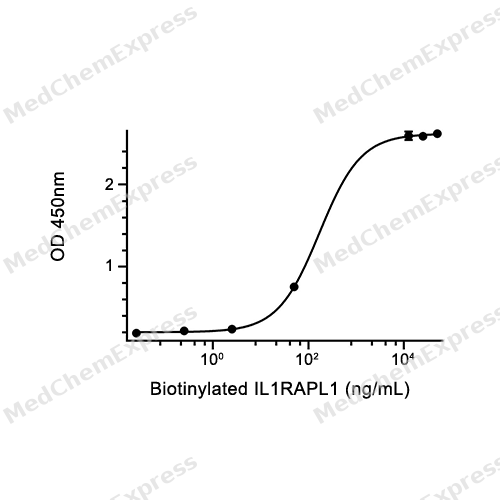
Bioactivity - ELISA


Technical Parameters
-
Species Human
-
Source HEK293
-
Tag C-His
-
Accession
P23468-1 (E21-E1265)
-
Molecular Construction
-
N-term
-
PTPRD (E21-E1265)
Accession # P23468-1 -
His
-
C-term
-
-
Protein Length
Extracellular Domain
-
Synonyms
PTPRD; R-PTP-Delta; Protein Tyrosine Phosphatase Receptor Type D; Protein Tyrosine Phosphatase, Receptor Type, Delta Polypeptide; Receptor-Type Tyrosine-Protein Phosphatase Delta; Protein-Tyrosine Phosphatase Delta; PTPD; HPTPDELTA; HPTP; RPTPDELTA; Rcept
-
AA Sequence
ETPPRFTRTPVDQTGVSGGVASFICQATGDPRPKIVWNKKGKKVSNQRFEVIEFDDGSGSVLRIQPLRTPRDEAIYECVASNNVGEISVSTRLTVLREDQIPRGFPTIDMGPQLKVVERTRTATMLCAASGNPDPEITWFKDFLPVDTSNNNGRIKQLRSESIGGTPIRGALQIEQSEESDQGKYECVATNSAGTRYSAPANLYVRELREVRRVPPRFSIPPTNHEIMPGGSVNITCVAVGSPMPYVKWMLGAEDLTPEDDMPIGRNVLELNDVRQSANYTCVAMSTLGVIEAIAQITVKALPKPPGTPVVTESTATSITLTWDSGNPEPVSYYIIQHKPKNSEELYKEIDGVATTRYSVAGLSPYSDYEFRVVAVNNIGRGPPSEPVLTQTSEQAPSSAPRDVQARMLSSTTILVQWKEPEEPNGQIQGYRVYYTMDPTQHVNNWMKHNVADSQITTIGNLVPQKTYSVKVLAFTSIGDGPLSSDIQVITQTGVPGQPLNFKAEPESETSILLSWTPPRSDTIANYELVYKDGEHGEEQRITIEPGTSYRLQGLKPNSLYYFRLAARSPQGLGASTAEISARTMQSKPSAPPQDISCTSPSSTSILVSWQPPPVEKQNGIITEYSIKYTAVDGEDDKPHEILGIPSDTTKYLLEQLEKWTEYRITVTAHTDVGPGPESLSVLIRTNEDVPSGPPRKVEVEAVNSTSVKVSWRSPVPNKQHGQIRGYQVHYVRMENGEPKGQPMLKDVMLADAQWEFDDTTEHDMIISGLQPETSYSLTVTAYTTKGDGARSKPKLVSTTGAVPGKPRLVINHTQMNTALIQWHPPVDTFGPLQGYRLKFGRKDMEPLTTLEFSEKEDHFTATDIHKGASYVFRLSARNKVGFGEEMVKEISIPEEVPTGFPQNLHSEGTTSTSVQLSWQPPVLAERNGIITKYTLLYRDINIPLLPMEQLIVPADTTMTLTGLKPDTTYDVKVRAHTSKGPGPYSPSVQFRTLPVDQVFAKNFHVKAVMKTSVLLSWEIPENYNSAMPFKILYDDGKMVEEVDGRATQKLIVNLKPEKSYSFVLTNRGNSAGGLQHRVTAKTAPDVLRTKPAFIGKTNLDGMITVQLPEVPANENIKGYYIIIVPLKKSRGKFIKPWESPDEMELDELLKEISRKRRSIRYGREVELKPYIAAHFDVLPTEFTLGDDKHYGGFTNKQLQSGQEYVFFVLAVMEHAESKMYATSPYSDPVVSMDLDPQPITDEEE
-
Predicted Molecular Mass
139.5 kDa
-
Molecular Weight
Approximately 116-130 kDa & 12-14 kDa, based on SDS-PAGE under reducing conditions, due to the glycosylation.
-
Glycosylation
Yes
-
Purity
≥ 90%, as determined by reducing SDS-PAGE.


Product Properties
Lyophilized powder.
Lyophilized from a 0.22 μm filtered solution of 20 mM Tris-HCl, 0.5 M NaCl, 6% trehalose, pH 8.0.
Note: For SPR assay, please replace the buffer. Primary amine components (e.g., Tris, imidazole) can affect protein-coupled chips.
<1 EU/μg, determined by LAL method.
It is not recommended to reconstitute to a concentration less than 100 μg/mL in ddH2O.
Stored at -20°C for 2 years from date of receipt. After reconstitution, it is stable at 4°C for 1 week or -20°C for longer (with carrier protein). It is recommended to freeze aliquots at -20°C or -80°C for extended storage.
Room temperature in continental US; may vary elsewhere.


Documentation
-
Data Sheet (243 KB)
-
SDS (251 KB)
- English - EN (251 KB)
- Français - FR (251 KB)
- Deutsch - DE (251 KB)
- Norwegian - NO (251 KB)
- Español - ES (251 KB)
- Swedish - SV (251 KB)
- Italian - IT (251 KB)
- Korean - KR (251 KB)
- Portuguese - PT (251 KB)
-
Handling Instructions (2659 KB)

Calculators
Concentration (start) × Volume (start) = Concentration (final) × Volume (final)


 Powered by Bioz

