



PVR/CD155 Protein, Human (HEK293)
Based on 1 Customer Validation
The PVR/CD155 protein plays a key role in initiating natural killer (NK) cell effector functions by binding to CD96, CD226 and TIGIT receptors. These interactions form mature immune synapses that trigger adhesion, lytic granule secretion, interferon-γ (IFN-γ), and cytotoxicity of activated NK cells. PVR/CD155 Protein, Human (HEK293) is the recombinant human-derived PVR/CD155 protein, expressed by HEK293 , with tag free.
- Species: Human
- Source: HEK293
-
Storage:Stored at -80°C for 1 year from date of receipt. It is stable at -20°C for 3 months after opening. It is recommended to freeze aliquots at -80°C for extended storage. Avoid repeated freeze-thaw cycles.


To place orders, for customer services and technical support, please contact: MedChemExpress USA
Tel: 609-228-6898 E-mail: [email protected] [email protected]


-
 Biological Activity
-
Technical Parameters
-
Product Properties
- Documentation
- Help & FAQs




Biological Activity
Description
The PVR/CD155 protein plays a key role in initiating natural killer (NK) cell effector functions by binding to CD96, CD226 and TIGIT receptors. These interactions form mature immune synapses that trigger adhesion, lytic granule secretion, interferon-γ (IFN-γ), and cytotoxicity of activated NK cells. PVR/CD155 Protein, Human (HEK293) is the recombinant human-derived PVR/CD155 protein, expressed by HEK293 , with tag free.
Background
PVR/CD155 Protein assumes a pivotal role in orchestrating natural killer (NK) cell adhesion and initiating NK cell effector functions by binding to two distinct NK cell receptors, CD96 and CD226. These receptor interactions converge at the cell-cell contact site, culminating in the formation of a mature immunological synapse between the NK cell and the target cell. This event triggers adhesion, secretion of lytic granules, interferon-gamma (IFN-gamma), and activation of cytotoxicity in activated NK cells. PVR/CD155 may additionally facilitate NK cell-target cell modular exchange and PVR transfer to the NK cell, particularly crucial in tumor cells expressing high levels of PVR. In such instances, the transfer mechanism may induce fratricide NK cell activation, providing a mechanism for tumors to evade the immune response. Furthermore, PVR/CD155 is implicated in mediating tumor cell invasion and migration. In the context of microbial infection, the protein acts as a receptor for poliovirus and potentially plays a role in the axonal transport of the virus. This function involves targeting virion-PVR-containing endocytic vesicles to the microtubular network through interaction with DYNLT1, thereby facilitating axonal retrograde transport of the virus.
Verified Bioactivity
1.Measured by its ability to bind human TIGIT-hFc in a functional ELISA.
2.Human TIGIT (HY-P71363) immobilized on CM5 Chip can bind Human PVR with an affinity constant of 5.693 μM as determined in a SPR assay.
3.Measured by its binding ability in a functional ELISA. When Recombinant CD155 Protein is immobilized at 5 μg/mL (100 μL/well) can bind Recombinant Biotinylated Human TIGIT(HY-P71363). The ED50 for this effect is 1.457 μg/mL.
MCE Validation Data
-
Purity - SDS-PAGE
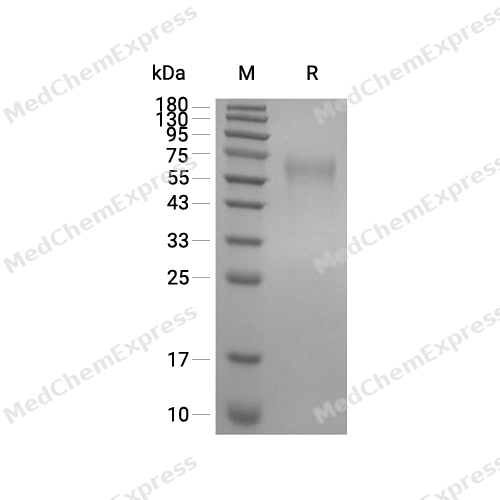
Purity - SDS-PAGE
-
Bioactivity - SPR
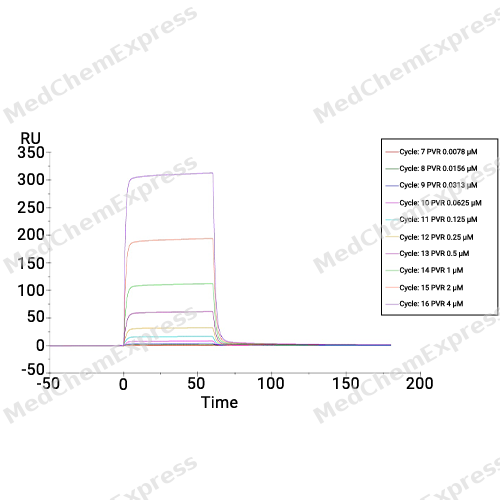
Bioactivity - SPR


Technical Parameters
-
Species Human
-
Source HEK293
-
Tag Tag Free
-
Accession
P15151-1 (W21-N343)
-
Molecular Construction
-
N-term
-
PVR (W21-N343)
Accession # P15151-1 -
C-term
-
-
Protein Length
Extracellular Domain
-
Synonyms
PVR; Tage4; Prev. PVS; Nectin-Like Protein 5; Poliovirus Receptor; Poliovirus Receptor, Isoform CRA_c; Necl-5; Nectin-Like 5; CD155; CD155 Antigen; NECL5; NECL-5; PVR Cell Adhesion Molecule; HVED
-
AA Sequence
WPPPGTGDVVVQAPTQVPGFLGDSVTLPCYLQVPNMEVTHVSQLTWARHGESGSMAVFHQTQGPSYSESKRLEFVAARLGAELRNASLRMFGLRVEDEGNYTCLFVTFPQGSRSVDIWLRVLAKPQNTAEVQKVQLTGEPVPMARCVSTGGRPPAQITWHSDLGGMPNTSQVPGFLSGTVTVTSLWILVPSSQVDGKNVTCKVEHESFEKPQLLTVNLTVYYPPEVSISGYDNNWYLGQNEATLTCDARSNPEPTGYNWSTTMGPLPPFAVAQGAQLLIRPVDKPINTTLICNVTNALGARQAELTVQVKEGPPSEHSGISRN
-
Predicted Molecular Mass
35.1 kDa
-
Molecular Weight
Approximately 50-66 kDa, based on SDS-PAGE under reducing conditions, due to the glycosylation.
-
Glycosylation
Yes
-
Purity
≥ 90%, as determined by reducing SDS-PAGE.


Product Properties
Solution
Supplied as a 0.22 μm filtered solution of PBS, pH 7.4.
<1 EU/μg, determined by LAL method.
Stored at -80°C for 1 year from date of receipt. It is stable at -20°C for 3 months after opening. It is recommended to freeze aliquots at -80°C for extended storage. Avoid repeated freeze-thaw cycles.
Shipping with dry ice.


Documentation
-
Data Sheet (237 KB)
-
SDS (252 KB)
- English - EN (252 KB)
- Français - FR (252 KB)
- Deutsch - DE (252 KB)
- Norwegian - NO (252 KB)
- Español - ES (252 KB)
- Swedish - SV (252 KB)
- Italian - IT (252 KB)
- Korean - KR (252 KB)
- Portuguese - PT (252 KB)
-
Handling Instructions (2659 KB)

Calculators
Concentration (start) × Volume (start) = Concentration (final) × Volume (final)


 Powered by Bioz

