



RNF43 Protein, Human (HEK293, His)

Based on 1 Customer Validation
RNF43 protein is encoded by the RNF43 gene and is a RING-type E3 ubiquitin ligase. It negatively regulates Wnt signaling by increasing ubiquitination of Frizzled receptors, resulting in reduced surface levels of these receptors. RNF43 Protein, Human (HEK293, His) is the recombinant human-derived RNF43 protein, expressed by HEK293 , with C-His labeled tag.
- Species: Human
- Source: HEK293
-
Storage:Stored at -20°C for 2 years from date of receipt. After reconstitution, it is stable at 4°C for 1 week or -20°C for longer (with carrier protein). It is recommended to freeze aliquots at -20°C or -80°C for extended storage.


To place orders, for customer services and technical support, please contact: MedChemExpress USA
Tel: 609-228-6898 E-mail: [email protected] [email protected]


-
 Biological Activity
-
Technical Parameters
-
Product Properties
- Documentation
- Help & FAQs




Biological Activity
Description
RNF43 protein is encoded by the RNF43 gene and is a RING-type E3 ubiquitin ligase. It negatively regulates Wnt signaling by increasing ubiquitination of Frizzled receptors, resulting in reduced surface levels of these receptors. RNF43 Protein, Human (HEK293, His) is the recombinant human-derived RNF43 protein, expressed by HEK293 , with C-His labeled tag.
Background
The RNF43 gene encodes a RING-type E3 ubiquitin ligase, predicted to encompass a transmembrane domain, a protease-associated domain, an ectodomain, and a cytoplasmic RING domain. This protein is implicated in the negative regulation of Wnt signaling, exerting its influence through increased ubiquitination of frizzled receptors and inducing alterations in their subcellular distribution, ultimately resulting in reduced surface levels of these receptors. Notably, mutations in this gene have been identified in various tumor cells, including those associated with colorectal and endometrial cancers. The gene exhibits broad expression, with notable levels observed in the duodenum (RPKM 7.1), colon (RPKM 6.1), and 24 other tissues. The multifaceted role of RNF43 highlights its significance in modulating critical cellular pathways and its potential implications in tumorigenesis.
Verified Bioactivity
Human R-Spondin 3, His Tag immobilized on CM5 Chip can bind Human RNF43, His Tag with an affinity constant of 0.255-0.781 μM as determined in SPR assay (Biacore T200).
MCE Validation Data
-
Purity - SDS-PAGE
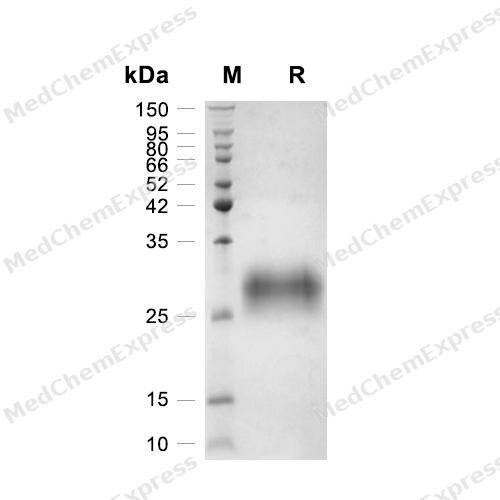
Purity - SDS-PAGE
-
Bioactivity - SPR
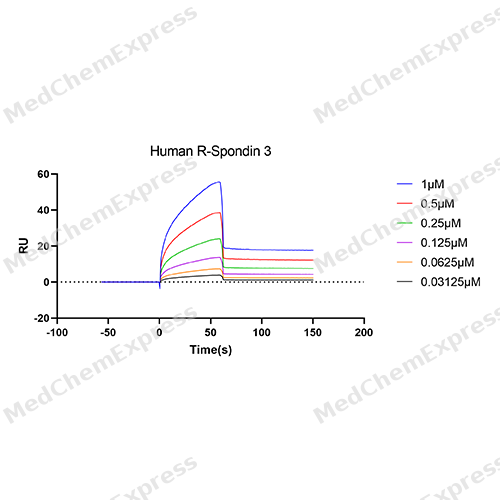
Bioactivity - SPR


Technical Parameters
-
Species Human
-
Source HEK293
-
Tag C-His
-
Accession
Q68DV7-1/NP_060233.3 (G24-Y197)
-
Molecular Construction
-
N-term
-
RNF43 (G24-Y197)
Accession # Q68DV7-1/NP_060233.3 -
His
-
C-term
-
-
Protein Length
Extracellular Domain
-
Synonyms
RNF43; DKFZp781H0392; Ring Finger Protein 43; FLJ20315; RNF124; RING-Type E3 Ubiquitin Transferase; URCC; RING Finger Protein 43; RING-Type E3 Ubiquitin Transferase RNF43; SSPCS; E3 Ubiquitin-Protein Ligase RNF43
-
AA Sequence
GFGRTGLVLAAAVESERSAEQKAIIRVIPLKMDPTGKLNLTLEGVFAGVAEITPAEGKLMQSHPLYLCNASDDDNLEPGFISIVKLESPRRAPRPCLSLASKARMAGERGASAVLFDITEDRAAAEQLQQPLGLTWPVVLIWGNDAEKLMEFVYKNQKAHVRIELKEPPAWPDY
-
Molecular Weight
Approximately 25-38 kDa, based on SDS-PAGE under reducing conditions, due to the glycosylation.
-
Glycosylation
Yes
-
Purity
≥ 95%, as determined by reducing SDS-PAGE.


Product Properties
Lyophilized powder.
Lyophilized from a 0.22 μm filtered solution of PBS, pH 7.4.
<1 EU/μg, determined by LAL method.
It is not recommended to reconstitute to a concentration less than 100 μg/mL in ddH2O. For long term storage it is recommended to add a carrier protein (0.1% BSA, 5% HSA, 10% FBS or 5% Trehalose).
Stored at -20°C for 2 years from date of receipt. After reconstitution, it is stable at 4°C for 1 week or -20°C for longer (with carrier protein). It is recommended to freeze aliquots at -20°C or -80°C for extended storage.
Room temperature in continental US; may vary elsewhere.


Documentation
-
Data Sheet (236 KB)
-
SDS (251 KB)
- English - EN (251 KB)
- Français - FR (251 KB)
- Deutsch - DE (251 KB)
- Norwegian - NO (251 KB)
- Español - ES (251 KB)
- Swedish - SV (251 KB)
- Italian - IT (251 KB)
- Korean - KR (251 KB)
- Portuguese - PT (251 KB)
-
Handling Instructions (2659 KB)

Calculators
Concentration (start) × Volume (start) = Concentration (final) × Volume (final)


 Powered by Bioz

