



SIRT1 Protein, Human (His)
Based on 5 publication(s) in Google Scholar
SIRT1 is an NAD-dependent protein deacetylase that integrates multiple cellular functions—cell cycle progression, DNA damage response, metabolism, apoptosis, and autophagy—by regulating the acetylation of various target proteins.SIRT1 responds to changes in the NAD(+)/NADH ratio caused by factors such as glucose deprivation, affecting chromatin remodeling through histone deacetylation, resulting in transcriptional regulation. SIRT1 Protein, Human (His) is the recombinant human-derived SIRT1 protein, expressed by E.coli , with N-6*His labeled tag.
- Species: Human
- Source: E. coli
-
Storage:Stored at -20°C for 2 years from date of receipt. After reconstitution, it is stable at 4°C for 1 week or -20°C for longer (with carrier protein). It is recommended to freeze aliquots at -20°C or -80°C for extended storage.


To place orders, for customer services and technical support, please contact: MedChemExpress USA
Tel: 609-228-6898 E-mail: [email protected] [email protected]


-
 Biological Activity
-
Technical Parameters
-
Product Properties
- Documentation
- Help & FAQs


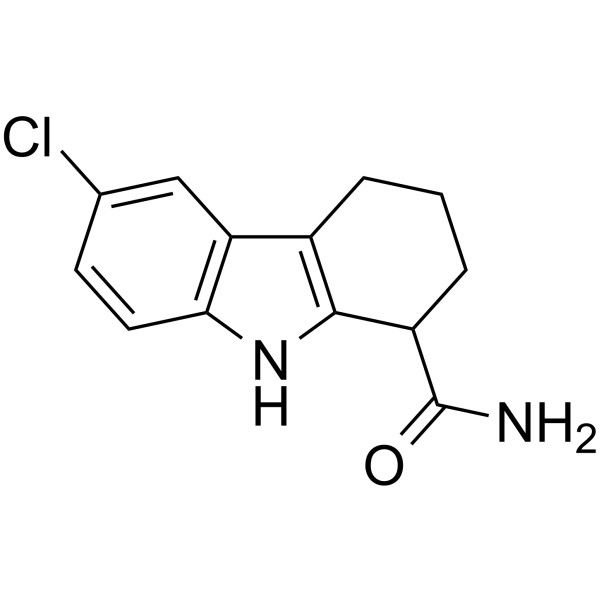


Biological Activity
Description
SIRT1 is an NAD-dependent protein deacetylase that integrates multiple cellular functions—cell cycle progression, DNA damage response, metabolism, apoptosis, and autophagy—by regulating the acetylation of various target proteins.SIRT1 responds to changes in the NAD(+)/NADH ratio caused by factors such as glucose deprivation, affecting chromatin remodeling through histone deacetylation, resulting in transcriptional regulation. SIRT1 Protein, Human (His) is the recombinant human-derived SIRT1 protein, expressed by E.coli , with N-6*His labeled tag.
Background
SIRT1, a NAD-dependent protein deacetylase, orchestrates the integration of various cellular functions, including cell cycle progression, response to DNA damage, metabolism, apoptosis, and autophagy, by modulating the acetylation status of numerous target proteins. Functioning as a sensor of the NAD(+)/NADH ratio, SIRT1 responds to changes in cellular energetics induced by factors such as glucose deprivation and caloric restriction. Its wide-ranging impact encompasses chromatin remodeling through histone deacetylation, ultimately leading to transcriptional regulation. SIRT1 engages in diverse interactions, deacetylating transcription factors, coregulators, and histones, thereby exerting both positive and negative regulation on target gene expression. Additionally, SIRT1 is implicated in critical processes such as DNA damage response, autophagy, circadian rhythm regulation, and metabolic homeostasis. Its multifaceted roles extend to the regulation of various cellular pathways and the maintenance of genomic integrity, highlighting its significance in cellular physiology and stress response.
Verified Bioactivity
Measured by its ability to remove the acetyl group from a fluorogenic peptide substrate Ac-RGK(Ac)-AMC in a coupled assay that incubate at room temperature in mode for 45 minutes. The specific activity is >15 pmol/min/μg.
MCE Validation Data
-
Purity - SDS-PAGE
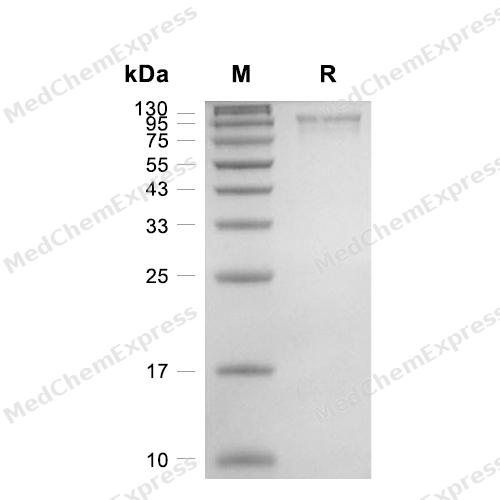
Purity - SDS-PAGE


Publications (5)
-
Journal Impact Factor
-
Most Recent
-
Phytomedicine
Jiao-tai-wan and its component coptisine attenuate PCOS by regulating mitochondrial cholesterol import through suppression of SIRT1 ubiquitination. [Abstract]2025 Nov 25:148:157446. PMID: 41145090
SIRT1 Protein, Human (His) purchased from MedChemExpress. Usage Cited in: Phytomedicine. 2025 Nov 25:148:157446. [Abstract]
SPR results for coptisine and SIRT1 (50 μg/mL) protein.
-
Phytomedicine
Neuro-skeletal crosstalk: Brain-derived 5-HT mediates the bone-protective effects of β-Sitosterol against postmenopausal osteoporosis. [Abstract]2025 Sep 9:148:157248. PMID: 40961541
SIRT1 Protein, Human (His) purchased from MedChemExpress. Usage Cited in: Phytomedicine. 2025 Sep 9:148:157248. [Abstract]
Kinetic fitting results for the interaction between βS and SIRT1 (50 μg/mL) obtained via surface plasmon resonance (SPR) analysis.
-
Cell Death Discov
2026 Mar 19;12(1):156. PMID: 41856994 -
J Transl Med
Didymin alleviates metabolic dysfunction-associated fatty liver disease (MAFLD) via the stimulation of Sirt1-mediated lipophagy and mitochondrial biogenesis. [Abstract]2023 Dec 19;21(1):921. PMID: 38115075
SIRT1 Protein, Human (His) purchased from MedChemExpress. Usage Cited in: J Transl Med. 2023 Dec 19;21(1):921. [Abstract]
MST analysis of the interaction between Didymin and Sirt1 (50 nM).
-
Int J Mol Sci
Cordycepin Ameliorates Constant Light-Induced Thermogenic Dysfunction in Brown Adipose Tissue by Activating SIRT1-Mediated Mitochondrial Homeostasis. [Abstract]2026 May 13;27(10):4351. PMID: 42196331


Technical Parameters
-
Species Human
-
Source E. coli
-
Tag N-6*His
-
Accession
Q96EB6-1 (A2-S747)
-
Molecular Construction
-
N-term
-
6*His
-
SIRT1 (A2-S747)
Accession # Q96EB6-1 -
C-term
-
-
Protein Length
Full Length of Isoform-1
-
Synonyms
SIRT1; Sirtuin (Silent Mating Type Information Regulation 2, S. Cerevisiae, Homolog) 1; Sirtuin 1; Sirtuin (Silent Mating Type Information Regulation 2 Homolog) 1 (S. Cerevisiae); SIR2L1; Protein Acetyllysine N-Acetyltransferase; NAD-Dependent Protein Dea
-
AA Sequence
ADEAALALQPGGSPSAAGADREAASSPAGEPLRKRPRRDGPGLERSPGEPGGAAPEREVPAAARGCPGAAAAALWREAEAEAAAAGGEQEAQATAAAGEGDNGPGLQGPSREPPLADNLYDEDDDDEGEEEEEAAAAAIGYRDNLLFGDEIITNGFHSCESDEEDRASHASSSDWTPRPRIGPYTFVQQHLMIGTDPRTILKDLLPETIPPPELDDMTLWQIVINILSEPPKRKKRKDINTIEDAVKLLQECKKIIVLTGAGVSVSCGIPDFRSRDGIYARLAVDFPDLPDPQAMFDIEYFRKDPRPFFKFAKEIYPGQFQPSLCHKFIALSDKEGKLLRNYTQNIDTLEQVAGIQRIIQCHGSFATASCLICKYKVDCEAVRGDIFNQVVPRCPRCPADEPLAIMKPEIVFFGENLPEQFHRAMKYDKDEVDLLIVIGSSLKVRPVALIPSSIPHEVPQILINREPLPHLHFDVELLGDCDVIINELCHRLGGEYAKLCCNPVKLSEITEKPPRTQKELAYLSELPPTPLHVSEDSSSPERTSPPDSSVIVTLLDQAAKSNDDLDVSESKGCMEEKPQEVQTSRNVESIAEQMENPDLKNVGSSTGEKNERTSVAGTVRKCWPNRVAKEQISRRLDGNQYLFLPPNRYIFHGAEVYSDSEDDVLSSSSCGSNSDSGTCQSPSLEEPMEDESEIEEFYNGLEDEPDVPERAGGAGFGTDGDDQEAINEAISVKQEVTDMNYPSNKS
-
Molecular Weight
Approximately 96 kDa, based on SDS-PAGE under reducing conditions.
-
Purity
≥ 90%, as determined by reducing SDS-PAGE.


Product Properties
Lyophilized powder
1.Lyophilized from a 0.22 μm filtered solution of 20 mM Tris-HC1, 0.5 M NaCl, 6% Trehalose, pH 8.0.
2.Lyophilized from a 0.22 μm filtered solution of PBS, pH 7.4, 8% trehalose.
Please refer to the lot-specific COA for specific buffer information.
Note: For SPR assay, please replace the buffer. Primary amine components (e.g., Tris, imidazole) can affect protein-coupled chips.
<1 EU/μg, determined by LAL method.
It is not recommended to reconstitute to a concentration less than 100 μg/mL in ddH2O.
Stored at -20°C for 2 years from date of receipt. After reconstitution, it is stable at 4°C for 1 week or -20°C for longer (with carrier protein). It is recommended to freeze aliquots at -20°C or -80°C for extended storage.
Room temperature in continental US; may vary elsewhere.


Documentation
-
Data Sheet (240 KB)
-
SDS (254 KB)
- English - EN (254 KB)
- Français - FR (254 KB)
- Deutsch - DE (254 KB)
- Norwegian - NO (254 KB)
- Español - ES (254 KB)
- Swedish - SV (254 KB)
- Italian - IT (254 KB)
- Korean - KR (254 KB)
- Portuguese - PT (254 KB)
-
Handling Instructions (2659 KB)

Calculators
Concentration (start) × Volume (start) = Concentration (final) × Volume (final)


 Powered by Bioz

