



SPARCL1 Protein, Mouse (HEK293, His)

Based on 1 Customer Validation
SPARCL1 protein has important functions such as calcium ion, collagen and extracellular matrix binding. SPARCL1 mainly plays a role in glutamatergic synaptic membrane adhesion. SPARCL1 Protein, Mouse (HEK293, His) is the recombinant mouse-derived SPARCL1 protein, expressed by HEK293 , with C-His, C-10*His labeled tag.
- Species: Mouse
- Source: HEK293
-
Storage:Stored at -20°C for 2 years from date of receipt. After reconstitution, it is stable at 4°C for 1 week or -20°C for longer (with carrier protein). It is recommended to freeze aliquots at -20°C or -80°C for extended storage.


To place orders, for customer services and technical support, please contact: MedChemExpress USA
Tel: 609-228-6898 E-mail: [email protected] [email protected]


-
 Biological Activity
-
Technical Parameters
-
Product Properties
- Documentation
- Help & FAQs




Biological Activity
Description
SPARCL1 protein has important functions such as calcium ion, collagen and extracellular matrix binding. SPARCL1 mainly plays a role in glutamatergic synaptic membrane adhesion. SPARCL1 Protein, Mouse (HEK293, His) is the recombinant mouse-derived SPARCL1 protein, expressed by HEK293 , with C-His, C-10*His labeled tag.
Background
SPARCL1 protein is a multifunctional molecule with calcium ion, collagen and extracellular matrix binding activities. It is mainly localized at glutamatergic synapses and participates in the synaptic membrane adhesion process. SPARCL1 is widely expressed in multiple systems, including cardiovascular, central nervous, male reproductive, respiratory and sensory organ systems, and is particularly highly expressed in adult bladder and cortex, suggesting that it plays a key role in these tissues. The protein is highly conserved in evolution, and the existence of its human homolog SPARC like 1 further confirms its functional importance.
Verified Bioactivity
Measured by its ability to inhibit the cell growth of Mv-1-Lu mink lung epithelial cells. The ED50 for this effect is 0.8933 μg/mL, corresponding to a specific activity is 1.12×10³ units/mg.
MCE Validation Data
-
Purity - SDS-PAGE
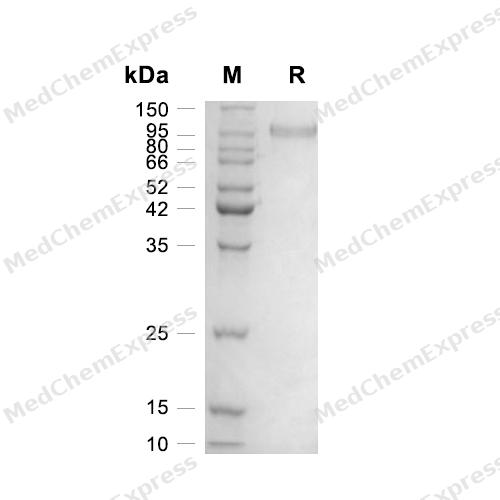
Purity - SDS-PAGE
-
Bioactivity - Cell-Based Assay
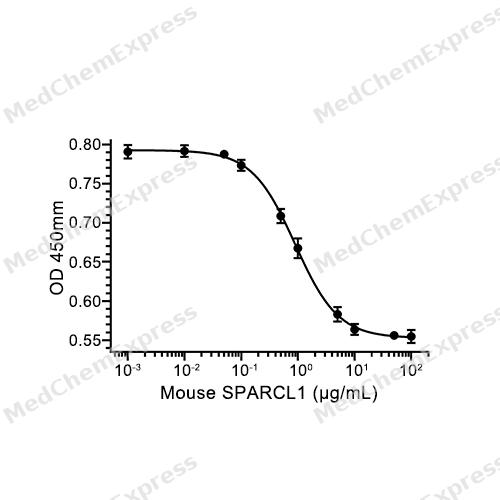
Bioactivity - Cell-Based Assay


Technical Parameters
-
Species Mouse
-
Source HEK293
-
Tag C-10*His
-
Accession
EDL20231.1 (I17-F650)
-
Molecular Construction
-
N-term
-
SPARCL1 (I17-F650)
Accession # EDL20231.1 -
His
-
C-term
-
-
Protein Length
Full Length of Mature Protein
-
Synonyms
SPARCL1; Hevin; SPARC Like 1; PIG33; SPARC-Like Protein 1; Proliferation-Inducing Protein 33; MAST9; SPARC-Like 1 (Mast9, Hevin); High Endothelial Venule Protein; SPARC-Like 1 (Hevin); MAST 9; SC1
-
AA Sequence
IPTSTRFLSDHSNPTTATLVTPEDATVPIAGVEATADIENHPNDKAEKPSALNSEEETHEQSTEQDKTYSFEVDLKDEEDGDGDLSVDPTEGTLTLDLQEGTSEPQQKSLPENGDFPATVSTSYVDPNQRANITKGKESQEQPVSDSHQQPNESSKQTQDLKAEESQTQDPDIPNEEEEEEEEEEEEEEEEPEDIGAPSDNQEEGKEPLEEQPTSKWEGNREQSDDTLEESSQPTQISKTEKHQSEQGNQGQESDSEAEGEDKAAGSKEHIPHTEQQDQEGKAGLEAIGNQKDTDEKAVSTEPTDAAVVPRSHGGAGDNGGGDDSKHGAGDDYFIPSQEFLEAERMHSLSYYLKYGGGEETTTGESENRREAADNQEAKKAESSPNAEPSDEGNSREHSAGSCTNFQCKRGHICKTDPQGKPHCVCQDPETCPPAKILDQACGTDNQTYASSCHLFATKCRLEGTKKGHQLQLDYFGACKSIPACTDFEVAQFPLRMRDWLKNILMQLYEPNPKHGGYLNEKQRSKVKKIYLDEKRLLAGDHPIELLLRDFKKNYHMYVYPVHWQFNELDQHPADRILTHSELAPLRASLVPMEHCITRFFEECDPNKDKHITLKEWGHCFGIKEEDIDENLLF
-
Predicted Molecular Mass
72.2 kDa
-
Molecular Weight
Approximately 118 kDa, based on SDS-PAGE under reducing conditions.
-
Glycosylation
Yes
-
Purity
≥ 95%, as determined by reducing SDS-PAGE.


Product Properties
Lyophilized powder
Lyophilized from a 0.2 μm filtered solution of 20 mM PB, 150 mM NaCl, pH 7.4.
<1 EU/μg, determined by LAL method.
It is not recommended to reconstitute to a concentration less than 100 μg/mL in ddH2O. For long term storage it is recommended to add a carrier protein (0.1% BSA, 5% HSA, 10% FBS or 5% Trehalose).
Stored at -20°C for 2 years from date of receipt. After reconstitution, it is stable at 4°C for 1 week or -20°C for longer (with carrier protein). It is recommended to freeze aliquots at -20°C or -80°C for extended storage.
Room temperature in continental US; may vary elsewhere.


Documentation
-
Data Sheet (239 KB)
-
SDS (251 KB)
- English - EN (251 KB)
- Français - FR (251 KB)
- Deutsch - DE (251 KB)
- Norwegian - NO (251 KB)
- Español - ES (251 KB)
- Swedish - SV (251 KB)
- Italian - IT (251 KB)
- Korean - KR (251 KB)
- Portuguese - PT (251 KB)
-
Handling Instructions (2659 KB)

Calculators
Concentration (start) × Volume (start) = Concentration (final) × Volume (final)


 Powered by Bioz

