



STAT1 Protein, Human (sf9, His-GST)
Based on 2 publication(s) in Google Scholar
STAT1 is a signal transducer and activator of transcription that responds to interferons, KITLG/SCF, and growth factors. After type I IFN binds, STAT1 and STAT2 form ISGF3, which translocates to the nucleus and activates ISG transcription. STAT1 Protein, Human (sf9, His-GST) is the recombinant human-derived STAT1 protein, expressed by Sf9 insect cells , with N-10*His, N-GST labeled tag.
- Species: Human
- Source: Sf9 insect cells
-
Storage:Stored at -20°C for 2 years from date of receipt. After reconstitution, it is stable at 4°C for 1 week or -20°C for longer (with carrier protein). It is recommended to freeze aliquots at -20°C or -80°C for extended storage.


To place orders, for customer services and technical support, please contact: MedChemExpress USA
Tel: 609-228-6898 E-mail: [email protected] [email protected]


-
 Biological Activity
-
Technical Parameters
-
Product Properties
- Documentation
- Help & FAQs




Biological Activity
Description
STAT1 is a signal transducer and activator of transcription that responds to interferons, KITLG/SCF, and growth factors. After type I IFN binds, STAT1 and STAT2 form ISGF3, which translocates to the nucleus and activates ISG transcription. STAT1 Protein, Human (sf9, His-GST) is the recombinant human-derived STAT1 protein, expressed by Sf9 insect cells , with N-10*His, N-GST labeled tag.
Background
STAT1 is a signal transducer and transcription activator that plays a crucial role in mediating cellular responses to interferons (IFNs), cytokine KITLG/SCF, and various growth factors. Upon binding of type I IFN (IFN-alpha and IFN-beta) to cell surface receptors, STAT1 undergoes tyrosine phosphorylation and forms a dimer with STAT2. This complex, known as ISGF3 transcription factor, translocates to the nucleus and activates the transcription of IFN-stimulated genes (ISG), establishing an antiviral state. In response to type II IFN (IFN-gamma), STAT1 is phosphorylated at both tyrosine and serine residues, forming a homodimer (GAF) that enters the nucleus and binds to the IFN-gamma activated sequence (GAS), driving the expression of target genes and inducing a cellular antiviral state. Additionally, STAT1 becomes activated in response to KITLG/SCF and KIT signaling and may mediate cellular responses to activated FGFR1, FGFR2, FGFR3, and FGFR4. Furthermore, in the small intestine, STAT1 associates with Gasdermin-D and promotes the transcription of CIITA, inducing the formation of type 1 regulatory T (Tr1) cells. STAT1 interacts with various proteins, including PIAS1, IFNAR1, IFNAR2, NMI, CREBBP/CBP, PTK2/FAK1, SRC, ERBB4, PARP9, DTX3L, EP300/p300, and IFNGR1, contributing to its diverse cellular functions.
Verified Bioactivity
Measured in a cytotoxicity assay using HepG2 cells. The ED50 for this effect is 3.085-3.292 μg/mL, corresponding to a specific activity is 303.767-324.149 units/mg.
MCE Validation Data
-
Purity - SDS-PAGE
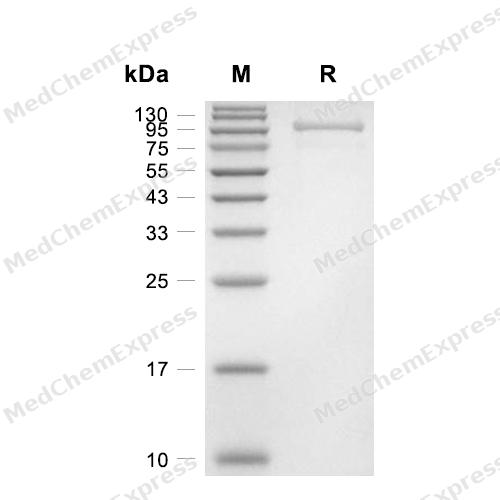
Purity - SDS-PAGE
-
Bioactivity - Cell-Based Assay
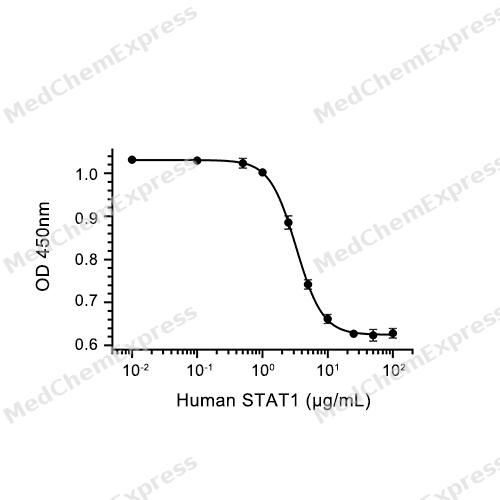
Bioactivity - Cell-Based Assay


Publications (2)
-
Journal Impact Factor
-
Most Recent
-
Cell
Pyruvate is a natural suppressor of interferon signaling by inducing STAT1 protein pyruvylation. [Abstract]2026 Feb 27:S0092-8674(26)00110-8. PMID: 41763198 -
Cell Discov
2025 Apr 8;11(1):34. PMID: 40195316


Technical Parameters
-
Species Human
-
Source Sf9 insect cells
-
Tag N-10*His;N-GST
-
Accession
P42224-2 (M1-V712)
-
Molecular Construction
-
N-term
-
His-GST
-
STAT1 (M1-V712)
Accession # P42224-2 -
C-term
-
-
Protein Length
Full Length of Isoform-2
-
Synonyms
STAT1; Signal Transducer And Activator Of Transcription 1, 91kD; Signal Transducer And Activator Of Transcription 1; Signal Transducer And Activator Of Transcription; Transcription Factor ISGF-3 Components P91/P84; CANDF7; STAT91; IMD31A; ISGF-3; IMD31B;
-
AA Sequence
MSQWYELQQLDSKFLEQVHQLYDDSFPMEIRQYLAQWLEKQDWEHAANDVSFATIRFHDLLSQLDDQYSRFSLENNFLLQHNIRKSKRNLQDNFQEDPIQMSMIIYSCLKEERKILENAQRFNQAQSGNIQSTVMLDKQKELDSKVRNVKDKVMCIEHEIKSLEDLQDEYDFKCKTLQNREHETNGVAKSDQKQEQLLLKKMYLMLDNKRKEVVHKIIELLNVTELTQNALINDELVEWKRRQQSACIGGPPNACLDQLQNWFTIVAESLQQVRQQLKKLEELEQKYTYEHDPITKNKQVLWDRTFSLFQQLIQSSFVVERQPCMPTHPQRPLVLKTGVQFTVKLRLLVKLQELNYNLKVKVLFDKDVNERNTVKGFRKFNILGTHTKVMNMEESTNGSLAAEFRHLQLKEQKNAGTRTNEGPLIVTEELHSLSFETQLCQPGLVIDLETTSLPVVVISNVSQLPSGWASILWYNMLVAEPRNLSFFLTPPCARWAQLSEVLSWQFSSVTKRGLNVDQLNMLGEKLLGPNASPDGLIPWTRFCKENINDKNFPFWLWIESILELIKKHLLPLWNDGCIMGFISKERERALLKDQQPGTFLLRFSESSREGAITFTWVERSQNGGEPDFHAVEPYTKKELSAVTFPDIIRNYKVMAAENIPENPLKYLYPNIDKDHAFGKYYSRPKEAPEPMELDGPKGTGYIKTELISVSEV
-
Predicted Molecular Mass
111 kDa
-
Molecular Weight
Approximately 105 kDa, based on SDS-PAGE under reducing conditions.
-
Purity
≥ 90%, as determined by reducing SDS-PAGE.


Product Properties
Lyophilized powder
1.Lyophilized from a 0.22 μm filtered solution of 20 mM Tris-HCL, 500 mM NaCl, pH 7.4, 8% trehalose.
2.Lyophilized from a 0.22 μm filtered solution of 20 mM Tris-HCL, 500 mM NaCl, pH 7.4, 5% trehalose, 5% mannitol, 0.01% Tween80.
Note: For SPR assay, please replace the buffer. Primary amine components (e.g., Tris, imidazole) can affect protein-coupled chips.
Please refer to the lot-specific COA for specific buffer information.
<1 EU/μg, determined by LAL method.
It is not recommended to reconstitute to a concentration less than 100 μg/mL in ddH2O.
Stored at -20°C for 2 years from date of receipt. After reconstitution, it is stable at 4°C for 1 week or -20°C for longer (with carrier protein). It is recommended to freeze aliquots at -20°C or -80°C for extended storage.
Room temperature in continental US; may vary elsewhere.


Documentation
-
Data Sheet (240 KB)
-
SDS (252 KB)
- English - EN (252 KB)
- Français - FR (252 KB)
- Deutsch - DE (252 KB)
- Norwegian - NO (252 KB)
- Español - ES (252 KB)
- Swedish - SV (252 KB)
- Italian - IT (252 KB)
- Korean - KR (252 KB)
- Portuguese - PT (252 KB)
-
Handling Instructions (2659 KB)

Calculators
Concentration (start) × Volume (start) = Concentration (final) × Volume (final)


 Powered by Bioz

