



Thioredoxin/TXN Protein, Human (His)
Based on 1 publication(s) in Google Scholar
Thioredoxin/TXN Protein, Human (His) is a thiol-oxidoreductase enzyme which control cellular redox homeostasis.
- Species: Human
- Source: E. coli
-
Storage:Stored at -20°C for 2 years from date of receipt. After reconstitution, it is stable at 4°C for 1 week or -20°C for longer (with carrier protein). It is recommended to freeze aliquots at -20°C or -80°C for extended storage.


To place orders, for customer services and technical support, please contact: MedChemExpress USA
Tel: 609-228-6898 E-mail: [email protected] [email protected]


-
 Biological Activity
-
Technical Parameters
-
Product Properties
- Documentation
- References
- Help & FAQs




Biological Activity
Description
Thioredoxin/TXN Protein, Human (His) is a thiol-oxidoreductase enzyme which control cellular redox homeostasis.
Background
Thioredoxins are small thiol-oxidoreductase enzymes that control cellular redox homeostasis[1]. Human thioredoxin acts as a danger-associated molecular pattern (DAMP) on the immune system and is released upon stress from skin cells. Human thioredoxin leads to the release of IL-13 and IL-10 from human peripheral blood mononuclear cells[2].
Verified Bioactivity
Measured by its ability to catalyze the reduction of insulin. The reaction leads to precipitation, which can be measured by absorbance at 650 nm. The specific activity is 0.5-3.07 A650/min/mg.
MCE Validation Data
-
Purity - SDS-PAGE
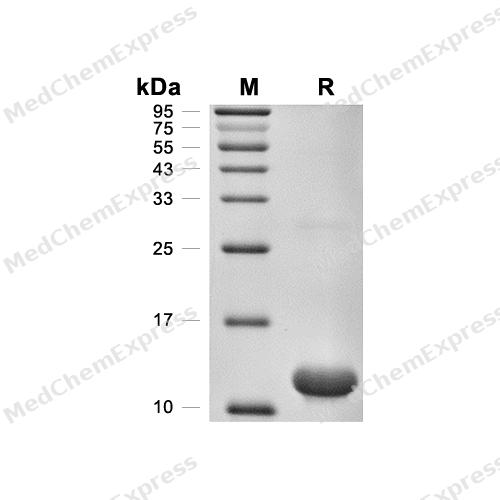
Purity - SDS-PAGE


Publications (1)
-
Journal Impact Factor
-
Most Recent


Technical Parameters
-
Species Human
-
Source E. coli
-
Tag N-6*His
-
Accession
P10599 (V2-V105)
-
Molecular Construction
-
N-term
-
6*His
-
TXN (V2-V105)
Accession # P10599 -
C-term
-
-
Protein Length
Full Length
-
Synonyms
TXN; TRDX; TRX; TRX1; Thioredoxin; Trx; ATL-derived factor; ADF; Surface-associated sulphydryl protein; SASP; TXN Delta 3; Thioredoxin-2; Allergen Hom S Trx; Thioredoxin Delta 3; Thioredoxin, Mitochondrial; Testicular Tissue Protein Li 199; ADF; Surface-A
-
AA Sequence
VKQIESKTAFQEALDAAGDKLVVVDFSATWCGPCKMIKPFFHSLSEKYSNVIFLEVDVDDCQDVASECEVKCMPTFQFFKKGQKVGEFSGANKEKLEATINELV
-
Predicted Molecular Mass
13.9 kDa
-
Molecular Weight
Approximately 14 kDa, based on SDS-PAGE under reducing conditions.
-
Purity
≥ 95%, as determined by reducing SDS-PAGE.


Product Properties
Lyophilized powder.
Lyophilized from a 0.22 μm filtered solution of 20 mM PB, 1 mM EDTA, 2 mM DTT, pH 7.2 or 50 mM Tris-HCl, 300 mM NaCl, pH 7.4.
Note: For SPR assay, please replace the buffer. Primary amine components (e.g., Tris, imidazole) can affect protein-coupled chips.
<1.0 EU/μg, determined by LAL method.
It is not recommended to reconstitute to a concentration less than 100 μg/mL in ddH2O. For long term storage it is recommended to add a carrier protein (0.1% BSA, 5% HSA, 10% FBS or 5% Trehalose).
Stored at -20°C for 2 years from date of receipt. After reconstitution, it is stable at 4°C for 1 week or -20°C for longer (with carrier protein). It is recommended to freeze aliquots at -20°C or -80°C for extended storage.
Room temperature in continental US; may vary elsewhere.


Documentation
-
Data Sheet (261 KB)
-
SDS (251 KB)
- English - EN (251 KB)
- Français - FR (251 KB)
- Deutsch - DE (251 KB)
- Norwegian - NO (251 KB)
- Español - ES (251 KB)
- Swedish - SV (251 KB)
- Italian - IT (251 KB)
- Korean - KR (251 KB)
- Portuguese - PT (251 KB)
-
Handling Instructions (2659 KB)


References
[1]. Léveillard T, et al. Cell Signaling with Extracellular Thioredoxin and Thioredoxin-Like Proteins: Insight into Their Mechanisms of Action. Oxid Med Cell Longev. 2017;2017:8475125. [Content Brief]
[2]. Roesner LM, et al. Human thioredoxin, a damage-associated molecular pattern and Malassezia-crossreactive autoallergen, modulates immune responses via the C-type lectin receptors Dectin-1 and Dectin-2. Sci Rep. 2019 Aug 1;9(1):11210. [Content Brief]

Calculators
Concentration (start) × Volume (start) = Concentration (final) × Volume (final)


 Powered by Bioz

