



Vaspin Protein, Human (HEK293, His)
Based on 1 Customer Validation
Vaspin is an adipokine that regulates adipogenesis, metabolism, and inflammation by binding to the chemokine receptors CMKLR1 and CMKLR2. It mainly regulates adipocyte differentiation and affects lipid and glucose metabolism genes. Vaspin Protein, Human (HEK293, His) is the recombinant human-derived Vaspin protein, expressed by HEK293 , with C-10*His labeled tag.
- Species: Human
- Source: HEK293
-
Storage:Stored at -80°C for 1 year from date of receipt. It is stable at -20°C for 3 months after opening. It is recommended to freeze aliquots at -80°C for extended storage. Avoid repeated freeze-thaw cycles.


To place orders, for customer services and technical support, please contact: MedChemExpress USA
Tel: 609-228-6898 E-mail: [email protected] [email protected]


-
 Biological Activity
-
Technical Parameters
-
Product Properties
- Documentation
- Help & FAQs




Biological Activity
Description
Vaspin is an adipokine that regulates adipogenesis, metabolism, and inflammation by binding to the chemokine receptors CMKLR1 and CMKLR2. It mainly regulates adipocyte differentiation and affects lipid and glucose metabolism genes. Vaspin Protein, Human (HEK293, His) is the recombinant human-derived Vaspin protein, expressed by HEK293 , with C-10*His labeled tag.
Background
Chemerin/RARRES2, an adipocyte-secreted protein (adipokine), orchestrates a multifaceted impact on adipogenesis, metabolism, and inflammation by activating the chemokine-like receptor 1 (CMKLR1) and also serving as a ligand for CMKLR2. While it can bind to C-C chemokine receptor-like 2 (CCRL2) with lower affinity, its primary role involves positively regulating adipocyte differentiation and influencing the expression of genes associated with lipid and glucose metabolism. Furthermore, Chemerin/RARRES2 plays a pivotal role in angiogenesis, essential for white adipose tissue expansion. As a pro-inflammatory adipokine, it amplifies the secretion of pro-inflammatory and prodiabetic adipokines, contributing to impaired metabolic function and systemic effects such as altered insulin sensitivity, disrupted glucose and lipid metabolism, and compromised vascular function in various tissues. Its enzymatic cleavage by different proteases can confer both pro- and anti-inflammatory properties. Acting as a chemotactic factor, it attracts leukocyte populations expressing CMKLR1, including plasmacytoid dendritic cells, myeloid dendritic cells, macrophages, and natural killer cells. Chemerin/RARRES2 also exhibits an anti-inflammatory role by inhibiting TNF/TNFA-induced VCAM1 expression and monocyte adhesion in vascular endothelial cells. This effect is mediated through the inhibition of NF-kappa-B and CRK/p38 activation, involving stimulation of AKT1/NOS3 signaling and nitric oxide production. This dual role in inflammation and metabolism suggests a potential link between chronic inflammation and obesity-related disorders, such as type 2 diabetes and cardiovascular disease. Additionally, Chemerin/RARRES2 demonstrates antimicrobial function in the skin.
Verified Bioactivity
Measured by its ability to inhibit KLK7 cleavage 10 μM Mca-RPKPVE-Nval-WRK(Dnp)-NH2(HY-P2185A ) that incubate at 37°C for 2 hours. The IC50 value is 11.04 nM.
MCE Validation Data
-
Purity - SDS-PAGE
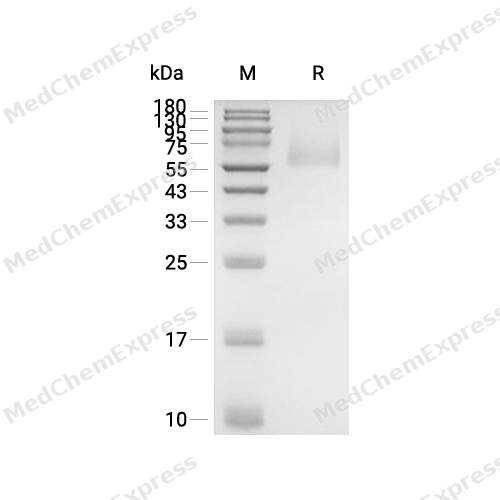
Purity - SDS-PAGE


Technical Parameters
-
Species Human
-
Source HEK293
-
Tag C-10*His
-
Accession
Q8IW75 (L21-K414)
-
Molecular Construction
-
N-term
-
Vaspin (L21-K414)
Accession # Q8IW75 -
10*His
-
C-term
-
-
Protein Length
Full Length of Mature Protein
-
Synonyms
SERPINA12; Serine (Or Cysteine) Proteinase Inhibitor, Clade A (Alpha-1 Antiproteinase, Antitrypsin), Member 12; Serpin Family A Member 12; Serpin Peptidase Inhibitor, Clade A (Alpha-1 Antiproteinase, Antitrypsin), Member 12; Vaspin; Serpin A12; OL-64; Vis
-
AA Sequence
LKPSFSPRNYKALSEVQGWKQRMAAKELARQNMDLGFKLLKKLAFYNPGRNIFLSPLSISTAFSMLCLGAQDSTLDEIKQGFNFRKMPEKDLHEGFHYIIHELTQKTQDLKLSIGNTLFIDQRLQPQRKFLEDAKNFYSAETILTNFQNLEMAQKQINDFISQKTHGKINNLIENIDPGTVMLLANYIFFRARWKHEFDPNVTKEEDFFLEKNSSVKVPMMFRSGIYQVGYDDKLSCTILEIPYQKNITAIFILPDEGKLKHLEKGLQVDTFSRWKTLLSRRVVDVSVPRLHMTGTFDLKKTLSYIGVSKIFEEHGDLTKIAPHRSLKVGEAVHKAELKMDERGTEGAAGTGAQTLPMETPLVVKIDKPYLLLIYSEKIPSVLFLGKIVNPIGK
-
Predicted Molecular Mass
46.5 kDa
-
Molecular Weight
Approximately 50-60 kDa, based on SDS-PAGE under reducing conditions.
-
Glycosylation
Yes
-
Purity
≥ 95%, as determined by reducing SDS-PAGE.


Product Properties
Solution
Supplied as a 0.22 μm filtered solution of 20 mM Tris-HCl, 150 mM NaCl, pH 7.5.
Note: For SPR assay, please replace the buffer. Primary amine components (e.g., Tris, imidazole) can affect protein-coupled chips.
<1 EU/μg, determined by LAL method.
Stored at -80°C for 1 year from date of receipt. It is stable at -20°C for 3 months after opening. It is recommended to freeze aliquots at -80°C for extended storage. Avoid repeated freeze-thaw cycles.
Shipping with dry ice.


Documentation
-
Data Sheet (238 KB)
-
SDS (254 KB)
- English - EN (254 KB)
- Français - FR (254 KB)
- Deutsch - DE (254 KB)
- Norwegian - NO (254 KB)
- Español - ES (254 KB)
- Swedish - SV (254 KB)
- Italian - IT (254 KB)
- Korean - KR (254 KB)
- Portuguese - PT (254 KB)
-
Handling Instructions (2659 KB)

Calculators
Concentration (start) × Volume (start) = Concentration (final) × Volume (final)


 Powered by Bioz

