



Resolvin E2

Based on 1 Customer Validation
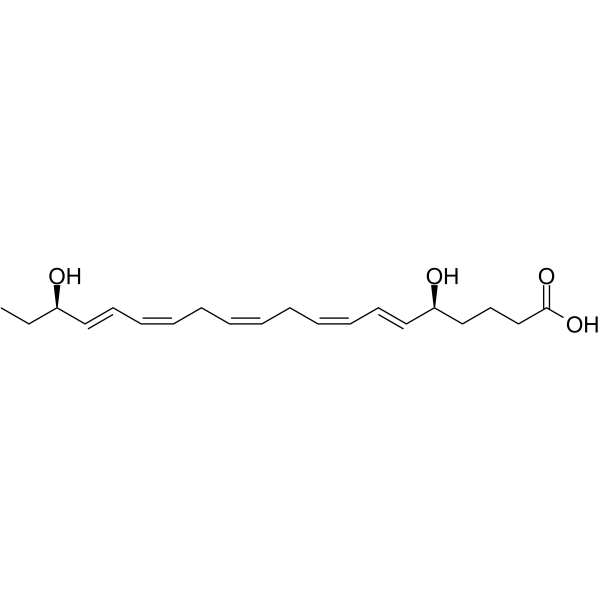
Resolvin E2 ((-)-Resolvin E2) is an endogenous lipid mediator produced from eicosapentaenoic acid (EPA) under the catalysis of 5-lipoxygenase (5-LOX), and its production increases in hypoxic environments. Resolvin E2 antagonizes BLT1, partially activates ChemR23, and promotes ubiquitin-proteasome-mediated degradation of COX-2. Resolvin E2 reduces the production of prostaglandin E2, blocks polymorphonuclear leukocyte infiltration, and promotes the resolution of airway inflammation. Resolvin E2 ameliorates lipopolysaccharide (LPS) (HY-D1056)-induced depressive-like behaviors. Resolvin E2 can be used in research related to depression, murine peritonitis, neonatal asthma, and other conditions.
Nos produits utilisent uniquement pour la recherche. Nous ne vendons pas aux patients.
- Pureté : 98.5%
- CAS No.: 865532-70-3
- Formule: C20H30O4
- Masse moléculaire:334.45
-
Stockage:
Solution, -20°C, 2 years

To place orders, for customer services and technical support, please contact: MedChemExpress USA
Tel: 609-228-6898 E-mail: [email protected] [email protected]


-
 Activité biologique
-
Chemical Information
- Protocole
- Pureté et documentation
- Références
-
 Help & FAQs




Voir tous les produits spécifiques à Isoform Endogenous Metabolite
MoreVoir tous les produits spécifiques à Isoform Leukotriene Receptor
MoreVoir tous les produits spécifiques à Isoform Chemerin Receptor
More

Activité biologique
Description
In Vitro
Resolvin E2 (10 nM; 2-16 h) suppresses COX-2 protein expression in a time-dependent manner (significantly at 4-16 h) without altering COX-1 levels in human macrophage-like U937 cells[3].
Resolvin E2 (10 nM; 4-16 h) significantly reduces PGE2 production in human macrophage-like U937 cells[3].
Resolvin E2 (10 nM; 8 h) promotes COX-2 protein degradation via the ubiquitin-proteasome system in human macrophage-like U937 cells[3].
MedChemExpress (MCE) has not independently confirmed the accuracy of these methods. They are for reference only.
-
Cell Line:human macrophage-like U937 cells (differentiated with phorbol 12-myristate 13-acetate)
-
Concentration:10 nM
-
Incubation Time:2 h, 4 h, 8 h, 16 h
-
Result:Did not alter COX-1 protein levels at any time point tested.
Suppressed COX-2 protein expression in a time-dependent manner, with statistically significant suppression observed at 4 h, 8 h, and 16 h compared to the 0 h control.
-
Cell Line:human macrophage-like U937 cells (differentiated with phorbol 12-myristate 13-acetate)
-
Concentration:10 nM
-
Incubation Time:2 h, 4 h, 8 h, 16 h
-
Result:Reduced PGE2 production in a time-dependent manner, with statistically significant suppression observed at 4 h, 8 h, and 16 h compared to the 0 h control.
-
Cell Line:human macrophage-like U937 cells (differentiated with phorbol 12-myristate 13-acetate)
-
Concentration:10 nM
-
Incubation Time:2 h, 4 h, 8 h, 16 h
-
Result:Did not suppress COX-2 mRNA expression at any time point tested, with no statistically significant differences compared to the 0 h control.
-
Cell Line:human macrophage-like U937 cells (differentiated with phorbol 12-myristate 13-acetate)
-
Concentration:10 nM (Resolvin E2); 0.3 μM (MG132 pretreatment)
-
Incubation Time:8 h (Resolvin E2); 30 min (MG132 pretreatment)
-
Result:Suppressed COX-2 protein expression when administered alone.
Had its COX-2 protein expression suppression abrogated by pretreatment with 0.3 μM MG132, which restored COX-2 protein levels to a similar level as the untreated control.
In Vivo
Resolvin E2 (1-100 ng; intravenous injection, intraperitoneal injection; single administration) potently reduces human neutrophils (PMN) infiltration in zymosan-induced murine peritonitis[2].
Resolvin E2 (300 ng/mouse; intranasal administration; once daily for 3 consecutive days) alleviates neonatal asthma in high-risk pups by reducing airway eosinophilia, pulmonary tissue infiltration, and allergenic cytokine levels[4].
MedChemExpress (MCE) has not independently confirmed the accuracy of these methods. They are for reference only.
-
Animal Model:BALB/c (male, 11-12 weeks old, LPS-induced depression model)[1]
-
Dosage:1 ng; 10 ng
-
Administration:i.c.v.; single infusion
-
Result:Dose-dependently decreased LPS-induced increases in immobility time in the tail suspension test.
Significantly suppressed LPS-induced increases in immobility time in the forced swim test at the 10 ng i.c.v. dose.
Had no effect on immobility time in saline-injected control mice in either tail suspension or forced swim tests.
Did not affect locomotor activity or anxiety-like behavior (time spent in the center of an open field chamber) in either LPS-challenged or saline-injected mice.
-
Animal Model:FVB (male, 6-8 weeks old, peritonitis induced by intraperitoneal injection of 1 mg zymosan A in 1 mL saline)[2]
-
Dosage:1 ng (i.v., side-by-side comparison); 10 ng (i.v., side-by-side comparison); 100 ng (i.v., side-by-side comparison); 10 ng (i.v., route comparison); 10 ng (i.p.)
-
Administration:i.v.; single dose; i.p.; single dose
-
Result:Reduced PMN infiltration by 11.3% compared to controls.
Reduced PMN infiltration by 17.7% compared to controls.
Reduced PMN infiltration by 33.7% compared to controls.
Reduced PMN infiltration by 47.6% compared to controls.
Reduced PMN infiltration by 34.5% compared to controls.
Combined with 10 ng Resolvin E1 (i.v.) reduced PMN infiltration additively.
Showed potency not significantly different from Resolvin E1 at any tested dose.
-
Animal Model:BALB/c (neonatal, offspring of time-pregnant E13 BALB/c dams; neonatal asthma model induced by maternal gestational exposure to CAPs/DEPs (concentrated urban air particles and diesel exhaust particles) at E14-E20, followed by neonatal OVA (HY-W250978) sensitization and challenge)[4]
-
Dosage:300 ng/mouse
-
Administration:i.n.; once daily; 3 days
-
Result:Reduced BAL eosinophil counts by more than half and eosinophil percentages by ~20% in offspring of CAP- or DEP-exposed dams compared to untreated at-risk pups.
Decreased BAL IL-5 levels in offspring of DEP-exposed dams.
Decreased BAL IL-13 levels in offspring of DEP-exposed dams.
Decreased serum IL-5 levels in offspring of CAP-exposed dams.
Ameliorated lung tissue inflammatory infiltration compared to untreated at-risk pups.
Showed no effect in offspring of PBS-exposed control dams.


Chemical Information
-
CAS No. 865532-70-3
-
Appearance Liquid
-
Masse moléculaire 334.45
-
Formule C20H30O4
-
Color Colorless to light yellow
-
SMILES
CC[C@@H](O)/C=C/C=C\C/C=C\C/C=C\C=C\[C@@H](O)CCCC(O)=O
-
Synonyms
(-)-Resolvin E2
-
Livraison
Room temperature in continental US; may vary elsewhere.
-
Stockage
Solution, -20°C, 2 years


Pureté et documentation
-
Fiche technique (273 KB)
-
SDS (394 KB)
- English - EN (394 KB)
- Français - FR (394 KB)
- Deutsch - DE (394 KB)
- Norwegian - NO (394 KB)
- Español - ES (394 KB)
- Swedish - SV (394 KB)
- Italian - IT (394 KB)
- Korean - KR (394 KB)
- Portuguese - PT (394 KB)
-
Instruction de manipulation (2659 KB)
Références
[1]. Deyama S, et al. Resolvin E1/E2 ameliorate lipopolysaccharide-induced depression-like behaviors via ChemR23. Psychopharmacology (Berl). 2018;235(1):329-336. [Content Brief]
[2]. Tjonahen E, et al. Resolvin E2: identification and anti-inflammatory actions: pivotal role of human 5-lipoxygenase in resolvin E series biosynthesis. Chem Biol. 2006;13(11):1193-1202. [Content Brief]
[3]. Hamaguchi A, et al. Resolvin E1 and Resolvin E2 suppress cyclooxygenase-2 expression through ubiquitin-proteasome-mediated degradation in human macrophage-like U937 cells. Prostaglandins Other Lipid Mediat. 2026;183:107064. [Content Brief]
[4]. Ramar M, et al. Intra-Airway Treatment with Synthetic Lipoxin A4 and Resolvin E2 Mitigates Neonatal Asthma Triggered by Maternal Exposure to Environmental Particles. Int J Mol Sci. 2023;24(7):6145. Published 2023 Mar 24. [Content Brief]

Calculators
Concentration (start) × Volume (start) = Concentration (final) × Volume (final)


Resolvin E2 Related Classifications
HY-133159 Related Classifications
 Powered by Bioz
Keywords
- Resolvin E2
- 865532-70-3
- (-)-Resolvin E2
- Resolvin E 2
- Resolvin E-2
- Endogenous Metabolite
- Leukotriene Receptor
- Chemerin Receptor
- COX
- Lipoxygenase
- COX-1
- murine models
- BLT1
- ChemR23
- neonatal asthma
- eicosapentaenoic acid
- cyclooxygenase-2
- human macrophage-like U937 cells
- ubiquitin-proteasome system
- human neutrophils
- Inhibitor
- inhibitor
- inhibit