

173 Results for "

Target ability

" in MedChemExpress (MCE) Product Catalog:
Products (173)

173 Results for "Target ability" in MCE Product Catalog:

Cat. No.: HY-183161B
Synonyms: Glucose-PEG3400-Azide
Glucose-PEG3400-N3 (Glucose-PEG3400-Azide) is a conjugate composed of glucose, PEG chains, and an azide group (-N3). Glucose-PEG3400-N3 combines the targeted recognition ability of glucose with the azide group that can undergo click chemistry, making it suitable for applications such as constructing targeted drug delivery systems and nanoparticle modification.
loading...
    loading...
Cat. No.: HY-183161C
Synonyms: Glucose-PEG5000-Azide
Glucose-PEG5000-N3 (Glucose-PEG5000-Azide) is a conjugate composed of glucose, PEG chains, and an azide group (-N3). Glucose-PEG5000-N3 combines the targeted recognition ability of glucose with the azide group that can undergo click chemistry, making it suitable for applications such as constructing targeted drug delivery systems and nanoparticle modification.
loading...
    loading...
Cat. No.: HY-183161D
Synonyms: Glucose-PEG10000-Azide
Glucose-PEG10000-N3 (Glucose-PEG10000-Azide) is a conjugate composed of glucose, PEG chains, and an azide group (-N3). Glucose-PEG10000-N3 combines the targeted recognition ability of glucose with the azide group that can undergo click chemistry, making it suitable for applications such as constructing targeted drug delivery systems and nanoparticle modification.
loading...
    loading...
Cat. No.: HY-183162
Glucose-PEG1000-NHS is a conjugate composed of glucose, PEG chains, and an active ester (NHS). Glucose-PEG1000-NHS combines the targeted recognition capabilities of glucose with the ability to rapidly covalently react with molecules containing primary amines (such as proteins, peptides, and amino-modified small molecules) to form stable amide bonds in an NHS ester. This allows for applications such as constructing targeted drug delivery systems and modifying nanoparticles.
loading...
    loading...
Cat. No.: HY-183162A
Glucose-PEG2000-NHS is a conjugate composed of glucose, PEG chains, and an active ester (NHS). Glucose-PEG2000-NHS combines the targeted recognition capabilities of glucose with the ability to rapidly covalently react with molecules containing primary amines (such as proteins, peptides, and amino-modified small molecules) to form stable amide bonds in an NHS ester. This allows for applications such as constructing targeted drug delivery systems and modifying nanoparticles.
loading...
    loading...
Cat. No.: HY-183162B
Glucose-PEG3400-NHS is a conjugate composed of glucose, PEG chains, and an active ester (NHS). Glucose-PEG3400-NHS combines the targeted recognition capabilities of glucose with the ability to rapidly covalently react with molecules containing primary amines (such as proteins, peptides, and amino-modified small molecules) to form stable amide bonds in an NHS ester. This allows for applications such as constructing targeted drug delivery systems and modifying nanoparticles.
loading...
    loading...
Cat. No.: HY-183162C
Glucose-PEG5000-NHS is a conjugate composed of glucose, PEG chains, and an active ester (NHS). Glucose-PEG5000-NHS combines the targeted recognition capabilities of glucose with the ability to rapidly covalently react with molecules containing primary amines (such as proteins, peptides, and amino-modified small molecules) to form stable amide bonds in an NHS ester. This allows for applications such as constructing targeted drug delivery systems and modifying nanoparticles.
loading...
    loading...
Cat. No.: HY-183162D
Glucose-PEG10000-NHS is a conjugate composed of glucose, PEG chains, and an active ester (NHS). Glucose-PEG10000-NHS combines the targeted recognition capabilities of glucose with the ability to rapidly covalently react with molecules containing primary amines (such as proteins, peptides, and amino-modified small molecules) to form stable amide bonds in an NHS ester. This allows for applications such as constructing targeted drug delivery systems and modifying nanoparticles.
loading...
    loading...
Cat. No.: HY-D1005A23
CAS No.: 9003-11-6
Synonyms: PEG-PPG-PEG, 4400 (Average)
Poloxamer 401 L121 is a block copolymer of polyethylene oxide and polypropylene oxide with an average molecular weight of 4400. Poloxamer has the ability to inhibit P-gp. Poloxamer 401 inhibits multiagent resistance and adjuvant activity. Poloxamer 401 can be used as a cosmetic ingredient. Poloxamer 401 can be used in nanoparticle engineering (lymphatic targeting particles) research .
loading...
    loading...
Cat. No.: HY-L135
3,540 compounds

With the progress of modern cancer therapy, the life of cancer patients has been extended. However, after initial treatment and recovery, the development of secondary tumors often leads to cancer recurrence. Cancer stem cells are a small number of cells that tumor growth and reproduction depend on.

Cancer stem cells have strong self-renewal ability, which is the direct cause of tumor occurrence. In addition, cancer stem cells also have the ability to differentiate into different cell types, playing a crucial role in tumor metastasis and development. Chemotherapy and radiotherapy induced DNA damage and apoptosis are common cancer treatments. However, cancer stem cells can effectively protect cancer cells from apoptosis by activating DNA repair ability. Cancer stem cells are regarded as the key "seed" of tumor occurrence, development, metastasis and recurrence. Since its first discovery in leukemia in 1994, cancer stem cells have been considered a promising therapeutic target for cancer treatment.

MCE supplies a unique collection of 3,540 compounds targeting key proteins in cancer stem cells. MCE Cancer Stem Cells Compound Library is a useful tool for cancer stem cells related research and anti-cancer drug development.

Cat. No.: HY-P10739C
CAS No.: 1027630-05-2
Target:  

Collagen Apoptosis

Research Areas:  

Inflammation/Immunology

WYRGRLC is a type II collagen-targeting peptide. WYRGRLC specifically binds to type II collagen α1 in articular cartilage in a sequence-dependent manner. WYRGRLC inhibits the binding of WYRGRL-displaying phage (C1-3) to articular cartilage in a sequence-specific manner. WYRGRLC can act as a retention enhancer to improve the cartilage-targeting ability of polymeric nanoparticles and liposomal nanoplatforms, facilitating the delivery of Rapamycin (HY-10219) to chondrocytes. WYRGRLC can be used in studies related to osteoarthritis .
loading...
    loading...
Cat. No.: HY-123395
CAS No.: 908813-78-5
Target:  

Endogenous Metabolite

Research Areas:  

Neurological Disease

NSC-84096 is an endopeptidase activity inhibitor with the ability to inhibit the activity of botulinum neurotoxin type A light chain (rBoNT/A-LC). NSC-84096 is able to effectively inhibit the enzymatic activity of botulinum neurotoxin in vitro, indicating its potential in inhibiting botulism. The mechanism of action of NSC-84096 may provide hope for the development of small molecule compounds targeting these deadly toxins .
loading...
    loading...
Cat. No.: HY-158067
CAS No.: 2359695-48-8
Purity:  89.40%
Synonyms: DFO-DBCO
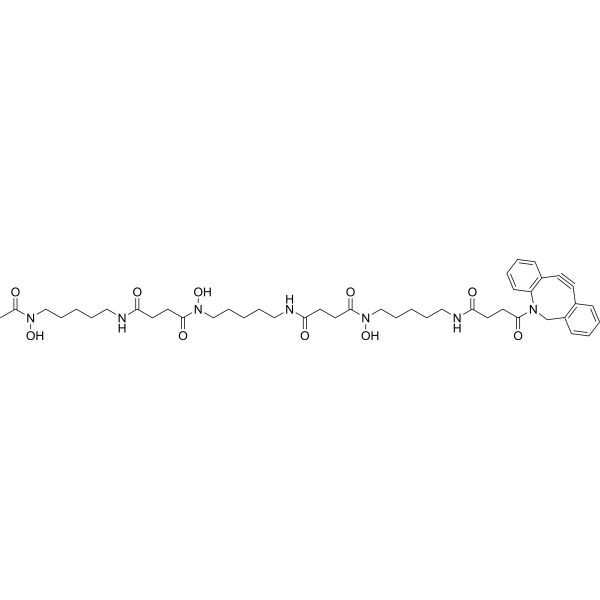
Deferoxamine-DBCO is a bifunctional chelating agent. Deferoxamine-DBCO efficiently chelates with radioactive metals (such as 89Zr) through the DFO structure to achieve radiolabeling. Deferoxamine-DBCO undergoes a metal-free Huisgen cycloaddition reaction with azide-containing biomolecules (such as siRNA, monoclonal antibodies) under bioorthogonal conditions through the DBCO structure to achieve targeted coupling. Deferoxamine-DBCO has efficient metal chelating ability and specific bioorthogonal reaction activity. Deferoxamine-DBCO can be used for targeted radioactive imaging studies of tumors .
loading...
    loading...
Cat. No.: HY-104013R
CAS No.: 220792-57-4
Research Areas:  

Cancer

Aminopurvalanol A (Standard) is the analytical standard of Aminopurvalanol A (HY-104013). This product is intended for research and analytical applications. Aminopurvalanol A is a potent, selective, and cell permeable inhibitor of Cyclins/Cdk complexes. Aminopurvalanol A preferentially targets the G2/M-phase transition inhibiting cancer cell differentiation. Aminopurvalanol A causes the inhibition of sperm fertilizing ability via the inhibition of physiological capacitation-dependent actin polymerization .
loading...
    loading...
Cat. No.: HY-119467
CAS No.: 1366240-73-4
Target:  

Ser/Thr Protease

Research Areas:  

Cancer

MDK0734 is a selective inhibitor that inhibits feline hepsin B endopeptidase and exopeptidase activities. MDK0734 demonstrated efficacy in a cell-based in vitro tumor invasion model, significantly attenuating the invasive ability of MCF-10A neoT cells. MDK0734 provides new potential inhibitors for the development of clinically useful compounds targeting the deleterious effects of feline hepsin B in cancer progression .
loading...
    loading...
Cat. No.: HY-170490
Research Areas:  

Cancer

TTQ-SA is a near-infrared (NIR) spiro-AIEgen (aggregation-induced emission luminogen), that converts near-infrared light (NIR) into thermal energy, causing thermal damage and death of tumor cells. TTQ-SA exhibits cellular uptake and targeting ability in cancer cell MF-7. TTQ-SA silences the expression of survivin gene with combination of DNAzyme, enhances the sensitivity of tumor cells to photothermal therapy .
loading...
    loading...
Cat. No.: HY-133703A
CAS No.: 2858813-30-4
Target:  

Wee1

Research Areas:  

Cancer

i-AZD1775 TFA is a Target Protein Ligand-Linker Conjugate that contains a target protein ligand and a PROTAC linker, and can recruit E3 ligases. i-AZD1775 TFA can be used for the synthesis of Pomalidomide-C3-adavosertib (HY-133618). i-AZD1775 TFA is an immobilizable analogue of AZD1775. i-AZD1775 TFA retains the ability to inhibit WEE1 in vitro. i-AZD1775 TFA can be studied in anticancer research .
loading...
    loading...
Cat. No.: HY-185260
Target:  

Liposome

Research Areas:  

Cancer

AA76-lipid (Compound aa76) is a compound with a C-terminal arginine and histidine. AA76-lipid can be used to prepare pancreas-targeted lipid nanoparticles AH-LNP. After assembling with proteins, the increased size of AH-LNP promotes Capsule-filter-mediated selective accumulation in the pancreas and receptor-mediated endocytosis, thereby enhancing pancreas-targeting ability. AA76-lipid enables highly pancreas-selective delivery of mRNA. AA76-lipid can be used in the research of pancreatic cancer .
loading...
    loading...
Cat. No.: HY-19916A
CAS No.: 1387574-54-0
Synonyms: BAL-101553 dihydrochloride
Research Areas:  

Cancer

Lisavanbulin (BAL-101553) dihydrochloride is the prodrug of the microtubule targeting agent Avanbulin (BAL 27862) (HY-106008). Lisavanbulin dihydrochloride exhibits antitumor activity, especially in tumors that express high levels of end-binding protein 1. Lisavanbulin dihydrochloride has ability to target tumor cell proliferation and affects the tumor microenvironment by reducing tumor microvasculature. Lisavanbulin dihydrochloride is also a spindle assembly checkpoint activator. Lisavanbulin dihydrochloride induces cell cycle arrest and subsequent death or aberrant chromosome segregation. Lisavanbulin dihydrochloride can be studied in research for diffuse large B cell lymphoma (DLBCL) and glioblastoma .
loading...
    loading...
Cat. No.: HY-112624C
CAS No.: 9004-54-0
Dextran (MW 40000) is a complex carbohydrate polymer consisting of glucose molecules linked by glycosidic bonds. Dextran has excellent solubility in water, making it useful as a viscosity modifier or stabilizer in foods, paints and adhesives. In the biomedical field, dextran is often used as a plasma expander because of its ability to increase blood volume when administered intravenously. It can also be modified to create dextran-based drug delivery systems, such as targeted nanoparticles.
loading...
    loading...

