14 Results for "

β-oxidation enzyme

" in MedChemExpress (MCE) Product Catalog:
Products (14)

14 Results for "β-oxidation enzyme" in MCE Product Catalog:

2
2 Cited Publications
Cat. No.: HY-N2118
CAS No.: 521-32-4
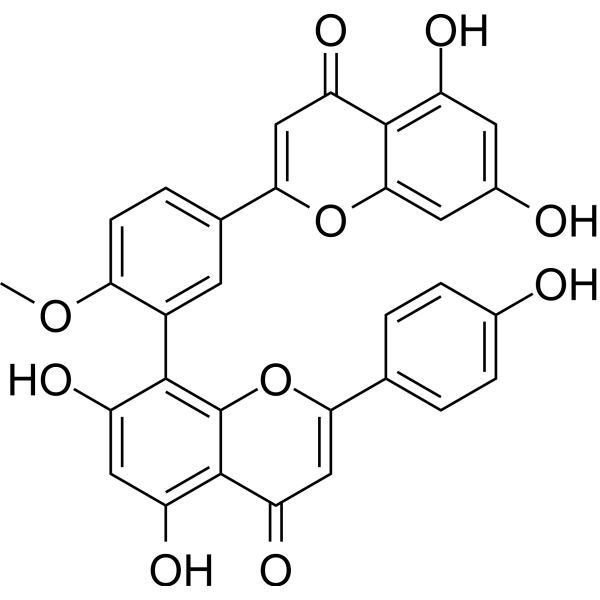
Bilobetin, an active component of Ginkgo biloba, can reduce blood lipids and improve the effects of insulin. Bilobetin ameliorated insulin resistance, increased the hepatic uptake and oxidation of lipids, reduced very-low-density lipoprotein triglyceride secretion and blood triglyceride levels, enhanced the expression and activity of enzymes involved in β-oxidation and attenuated the accumulation of triglycerides and their metabolites in tissues. Bilobetin also increased the phosphorylation, nuclear translocation and activity of PPARα accompanied by elevated cAMP level and PKA activity .
loading...
    loading...
Cat. No.: HY-E70009
CAS No.: 61116-22-1
Synonyms: ACO
Research Areas:  

Others

Acyl-CoA oxidase (ACO) is a peroxisomal catalyst. Acyl-CoA oxidase acts as a key rate-limiting enzyme in the process of peroxisomal fatty acid β-oxidation. Acyl-CoA oxidase participates in lipid catabolism and phytohormone biosynthesis pathways .
loading...
    loading...
Cat. No.: HY-N8469
CAS No.: 2430-94-6
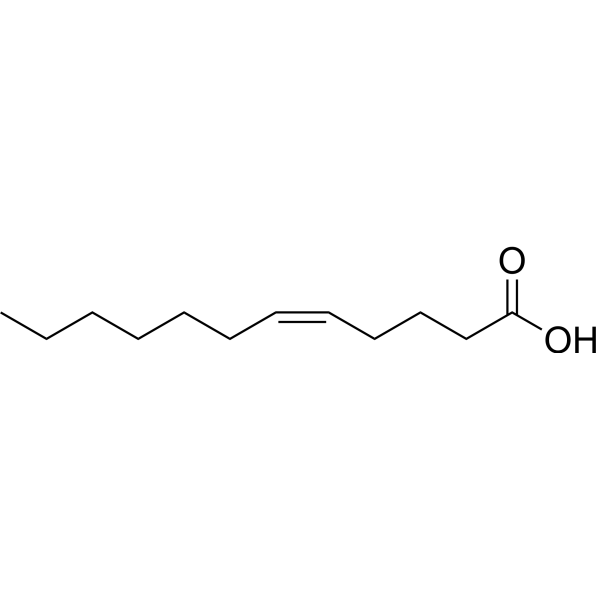
cis-5-Dodecenoic acid is an inhibitor of COX-I and COX-II with anti-inflammatory activity. cis-5-Dodecenoic acid reduces prostaglandin synthesis by inhibiting COX enzyme activity and is involved in the fatty acid -β oxidative metabolic pathway. The metabolic rate of cis-5-Dodecenoic acid is significantly lower than that of saturated fatty acids. cis-5-Dodecenoic acid can be used in the research of anti-inflammation, fatty acid metabolism mechanisms and related physiological and pathological processes .
loading...
    loading...
Cat. No.: HY-175673
CAS No.: 2211175-99-2
LCB-2151 (Compound 2), a nucleoside analogue, is an anticancer agent. LCB-2151 disrupts the two primary sources of ATP production (glycolysis and mitochondrial oxidative phosphorylation), reducing the bioenergetic capacity of KRAS-mutated pancreatic cancer cells and inducing ROS formation. LCB-2151 effectively inhibits key enzymes (such as CACT and CPT2) in glycolysis, the TCA cycle and fatty acid β-oxidation. LCB-2151 has significant cytotoxicity and induces cells apoptosis. LCB-2151 can be used for radiation therapy of cancers research .
loading...
    loading...
Cat. No.: HY-166119
CAS No.: 6709-57-5
Synonyms: Linoleoyl Coenzyme A; 9(Z),12(Z)-Octadecadienoyl Coenzyme A; 9Z,12Z-Octadecadienoyl-CoA; 9Z,12Z-Octadecadienoyl-coenzyme A
Research Areas:  

Metabolic Disease

Linoleoyl-CoA (Linoleoyl Coenzyme A) is a long-chain acyl-CoA ester formed from linoleic acid and coenzyme A. Linoleoyl-CoA serves as a key activated fatty acid intermediate involved in lipid biosynthesis, fatty acid β-oxidation and the regulation of cellular metabolism. Elevated levels of Linoleoyl-CoA in skeletal muscle correlate with increased lipid availability, insulin resistance and metabolic dysregulation and can be used for activity assays of acyl-CoA synthetases, acyltransferases and fatty acid metabolic enzymes .
loading...
    loading...
Cat. No.: HY-E70241
CAS No.: 157786-88-4
Research Areas:  

Infection Metabolic Disease

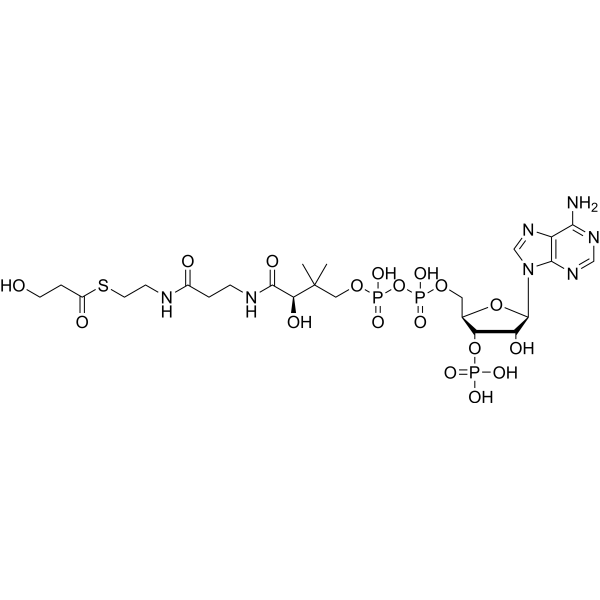
3-Hydroxypropionyl-CoA is a metabolic intermediate and enzyme substrate/product that functions in multiple metabolic pathways. 3-Hydroxypropionyl-CoA serves as a substrate for 3-Hydroxypropionyl-CoA dehydratase (HY-E71752), a product of 3-hydroxypropionyl-CoA synthetase, and a hydrolysis substrate for Ehd3p. 3-Hydroxypropionyl-CoA participates in autotrophic CO2 fixation, modified β-oxidation, and reverse hydration reactions. Accumulation of 3-Hydroxypropionyl-CoA inhibits fatty acid β-oxidation at the Fox2p site and induces metabolic toxicity. 3-Hydroxypropionyl-CoA can be used in studies of hematogenously disseminated candidiasis .
loading...
    loading...
Cat. No.: HY-19109
CAS No.: 107813-63-8
Target:  

Leukotriene Receptor

Research Areas:  

Others

RG-7152 is a tetrazolyl-substituted leukotriene D4 receptor antagonist that can induce peroxisomal β-oxidation and peroxisome bifunctional enzymes (PBEs) in hepatocytes in various animal models. It has been shown to significantly increase PBE levels and β-oxidation activity in rat and mouse liver homogenates, while smaller effects were observed in guinea pigs and monkeys and no effect in dogs. In vitro studies have also shown that it can induce PBEs comparable to clofibric acid, indicating its potential as a peroxisome proliferator .
loading...
    loading...
Cat. No.: HY-19227
CAS No.: 153655-35-7
Target:  

PPAR

Research Areas:  

Cardiovascular Disease

BM 170249 is a peroxisome proliferator, particularly in the perivenous region of the central acini in the liver. BM 170249 significantly reduces serum triglyceride and cholesterol levels in rats. BM 170249 strongly induces the activity of key enzymes in the peroxisome fatty acid β-oxidation system (such as acyl-CoA oxidase AOX, multifunctional enzyme PH, and thiolase PT), but leads to decreased activity of catalase and uricase in peroxisome components. BM 170249 could be used in lipid-lowering studies .
loading...
    loading...
Cat. No.: HY-B1520
CAS No.: 24818-79-9
Synonyms: Aluminum clofibrate
Target:  

PPAR

Research Areas:  

Cancer

Aluminium clofibrate is an orally active peroxisome proliferator. Aluminium clofibrate increases peroxisomal β-oxidation enzyme activities, elevates catalase. Aluminium clofibrate can be used in the research of cancer .
loading...
    loading...
Cat. No.: HY-149545
CAS No.: 214038-32-1
Synonyms: 1,3-Dipalmitoyl-2-docosahexaenoyl glycerol
1,3-Palmitin-2-docosahexaenoin (1,3-Dipalmitoyl-2-docosahexaenoyl glycerol) is the isomer of triacylglycerol (TAG), in which docosahexaenoic acid (DHA) is located at the β position (sn-2) of the glycerol backbone. 1,3-Palmitin-2-docosahexaenoin inhibits fatty acid synthase and cholesterol metabolism enzymes, activates carnitine palmitoyltransferase (CPT) in liver mitochondria and promotes β-oxidation of fatty acids. 1,3-Palmitin-2-docosahexaenoin exhibits lipid metabolism regulating activity .
loading...
    loading...
Cat. No.: HY-N2118R
CAS No.: 521-32-4
Bilobetin (Standard) is the analytical standard of Bilobetin. This product is intended for research and analytical applications. Bilobetin, an active component of Ginkgo biloba, can reduce blood lipids and improve the effects of insulin. Bilobetin ameliorated insulin resistance, increased the hepatic uptake and oxidation of lipids, reduced very-low-density lipoprotein triglyceride secretion and blood triglyceride levels, enhanced the expression and activity of enzymes involved in β-oxidation and attenuated the accumulation of triglycerides and their metabolites in tissues. Bilobetin also increased the phosphorylation, nuclear translocation and activity of PPARα accompanied by elevated cAMP level and PKA activity .
loading...
    loading...
Cat. No.: HY-N8469R
CAS No.: 2430-94-6
cis-5-Dodecenoic acid (Standard) is the analytical standard of cis-5-Dodecenoic acid (HY-N8469). This product is intended for research and analytical applications. cis-5-Dodecenoic acid is an inhibitor of COX-I and COX-II with anti-inflammatory activity. cis-5-Dodecenoic acid reduces prostaglandin synthesis by inhibiting COX enzyme activity and is involved in the fatty acid -β oxidative metabolic pathway. The metabolic rate of cis-5-Dodecenoic acid is significantly lower than that of saturated fatty acids. cis-5-Dodecenoic acid can be used in the research of anti-inflammation, fatty acid metabolism mechanisms and related physiological and pathological processes .
loading...
    loading...
Cat. No.: HY-W400421
CAS No.: 58888-84-9
Synonyms: 3-Hydroxy VPA
Target:  

Endogenous Metabolite

Research Areas:  

Metabolic Disease

3-Hydroxyvalproic acid (3-Hydroxy VPA) is a metabolite of valproic acid. 3-Hydroxyvalproic acid is a weak inhibitor of enzymes related to the mitochondrial β-oxidation pathway. 3-Hydroxyvalproic acid is promising for research of diseases related to abnormal valproic acid metabolism .
loading...
    loading...
Cat. No.: HY-E71595
Research Areas:  

Others

2-Methylisocitrate dehydratase (EC 4.2.1.99) is a 3-hydroxybutyryl-CoA dehydratase belonging to the carbon-oxygen lyase subclass of lyases. It catalyzes the dehydration of 3-hydroxybutyryl-CoA to form crotonyl-CoA and is a key enzyme in butyrate metabolism, fatty acid β-oxidation, and polyhydroxybutyrate (PHB) metabolism.
loading...
    loading...
  • 1

