
1. Search Result
Search Result
Results for "

DNA-targeting

" in MedChemExpress (MCE) Product Catalog:

13

Inhibitors & Agonists

1

Peptides

1

MCE Kits

1

Natural
Products

1

Click Chemistry

Cat. No. Product Name Target Research Areas Chemical Structure
  • HY-132180A

    ADC Payload DNA/RNA Synthesis Inflammation/Immunology Cancer
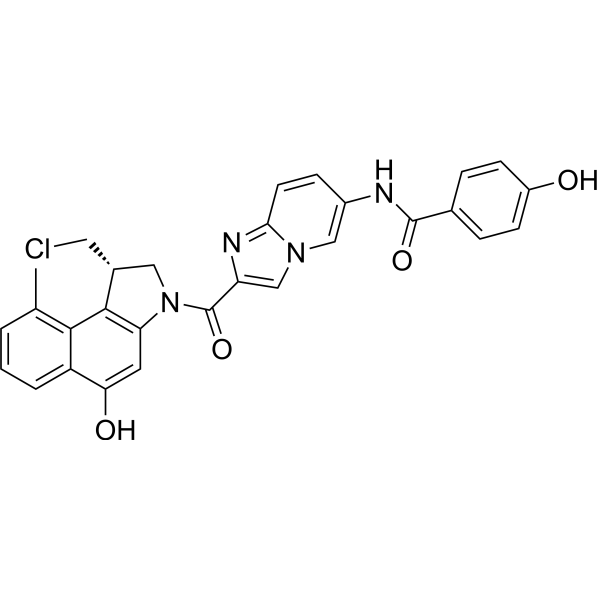
    Seco-DUBA hydrochloride is a DNA-targeting cytotoxic agent. Seco-DUBA hydrochloride binds to the minor groove of A-T-rich DNA regions, alkylates the adenine N3 residue, and undergoes spontaneous spirocyclization to generate active DUBA (HY-160969). Seco-DUBA hydrochloride exerts cytotoxic activity against human cancer cells. The reduced hydrophobicity of Seco-DUBA hydrochloride supports the development of antibody-drug conjugates .
    Seco-DUBA
  • HY-147652

    DNA Stain Others
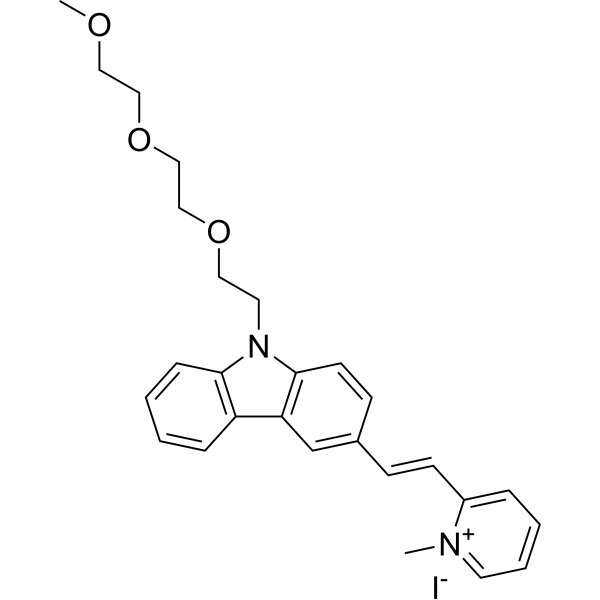
    G-quadruplex DNA fluorescence probe 1 (Compound E1) is a selective G-quadruplex DNA targeting fluorescent probe. G-quadruplex DNA fluorescence probe 1 can pass through membrane and enter living cells with low cytotoxicity .
    G-quadruplex DNA fluorescence probe 1
  • HY-13620

    LU 79553

    Topoisomerase Cancer
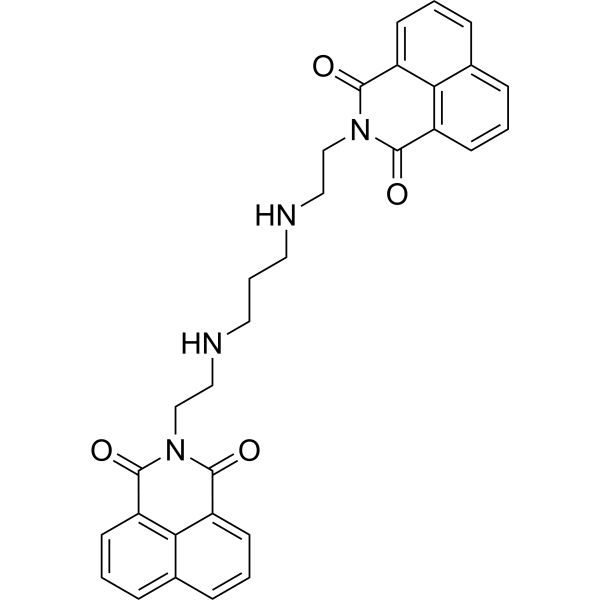
    Elinafide is an anticancer agent with a naphthalimide structure that targets DNA. Elinafide interferes with cell metabolism by inserting a planar ring into the DNA double helix and interacting with enzymes through its side chain.LU-79553 is a DNA-binding topoisomerase II inhibitor. The IC50 value of Elinafide for HT-29 cells is 0.014 μM .
    Elinafide
  • HY-W582504

    CuCl(TPP)3

    DNA Stain Bacterial Fungal Infection Cancer
    Chlorotris(triphenylphosphine)copper (CuCl(TPP)₃) is a DNA-targeted metal complex. Chlorotris(triphenylphosphine)copper involves non-covalent interactions (such as groove binding mode) through the copper(I) center to affect DNA function, showing inhibitory activity against bacteria, fungi, and tumor cells. Chlorotris(triphenylphosphine)copper is promising for research of antibacterial, antitumor, and antioxidant agents .
    Chlorotris(triphenylphosphine)copper
  • HY-118899

    Endogenous Metabolite Cancer
    XR5944 is an anti-tumor compound with DNA-targeting activity. As a topoisomerase inhibitor, XR5944 can effectively inhibit the activities of topoisomerase I and II. XR5944 shows excellent anti-tumor activity against human and mouse tumor cells in vitro and in vivo. XR5944 exhibits significant potency in multiple cell lines, with IC50 values of 0.04-0.4 nM. XR5944 is not affected by atypical drug resistance in cells and remains significantly active even in cells overexpressing P-glycoprotein or multidrug resistance-related proteins. XR5944 showed anti-tumor efficacy in human tumor models of H69 small cell lung cancer and HT29 colon cancer, inducing tumor regression in most animals in the HT29 model. XR5944 can be used to study biological processes related to colon and lung cancer .
    XR5944
  • HY-176495

    DNA Alkylator/Crosslinker DNA/RNA Synthesis Cancer
    SG3683 is a DNA-targeted cytotoxic agent belonging to pyrrolobenzodiazepine (PBD) dimers. SG3683 exerts antitumor activity with an IC50 value of 0.74 nM in MDA-MB-436 cells. SG3683 is promising for research of cancers, such as breast cancer .
    SG3683
  • HY-N16420

    DNA/RNA Synthesis Apoptosis Cancer
    Illudin B is a DNA-targeting cytotoxin that forms interstrand DNA crosslinks via covalent binding, disrupting DNA replication and transcription. Illudin B induces cell cycle arrest and apoptosis, showing toxicity against multiple tumor cells (e.g., leukemia, breast, lung cancer) .
    Illudin B
  • HY-176217

    Biochemical Assay Reagents DNA/RNA Synthesis Cancer
    dA-NHbenzylOCF3 is a DNA-targeted radiosensitizer that enhances the sensitivity of tumor cells to X-rays via the dissociative electron attachment (DEA) mechanism. dA-NHbenzylOCF3 shows low cytotoxicity to normal cells and mainly localizes to the cytoplasm and nucleus after entering cells. dA-NHbenzylOCF3 exerts its radiosensitizing effect by inducing cell cycle arrest at the radiation-sensitive G2/M phase. dA-NHbenzylOCF3 can be used for radiosensitization research on malignant tumors such as prostate cancer and breast cancer .
    dA-NHbenzylOCF3
  • HY-P2548

    EGFR Others
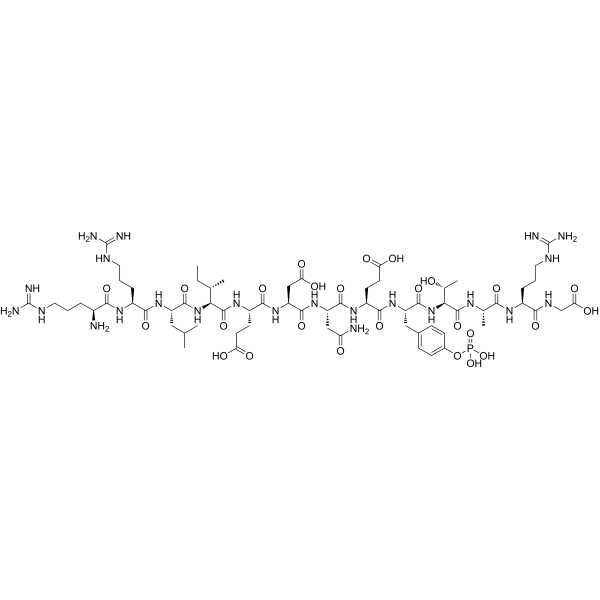
    pp60 (v-SRC) Autophosphorylation Site, Phosphorylated is the phosphorylated peptide of an EGFR substrate. pp60 (v-SRC) Autophosphorylation Site, Phosphorylated can be used for the screening of EGFR Kinase inhibitors via phosphorylated-substrate quantification .
    pp60 (v-SRC) Autophosphorylation Site, Phosphorylated
  • HY-106109

    DNA Alkylator/Crosslinker DNA/RNA Synthesis Cancer
    FK 973 is a dihydrobenzoxazine anticancer agent. FK 973 selectively inhibits DNA synthesis and can form DNA cross-links through cytoplasmic activation. FK 973 exhibits significant antitumor activity in various animal tumor models and human tumor xenografts, with relatively weak myelosuppressive effects. FK 973 is sensitive to neural tumor cells. FK 973 can be used for DNA-targeted antitumor research .
    FK 973
  • HY-169433

    PROTACs HDAC Cancer
    Naph-Se-TMZ is a PROTAC-like HDAC1 degrader. Naph-Se-TMZ can reduce the total HDAC activity in glioma cells and enhance the inhibitory effect of Temozolomide (HY-17364). Naph-Se-TMZ consists of the target protein ligand (red part) Temozolomide (HY-17364), the DNA-targeting intercalator (blue part) Nitro-Naphthalimide-C2-acylamide (HY-169437) and the molecular linker (black part). At the same time, the active control of the target protein ligand is: Temozolomide-amino hydrochloride (HY-169439), and the DNA targeting intercalator + linker is: NNISC-2 (HY-169438) .
    Naph-Se-TMZ
  • HY-152898A

    Biochemical Assay Reagents Others
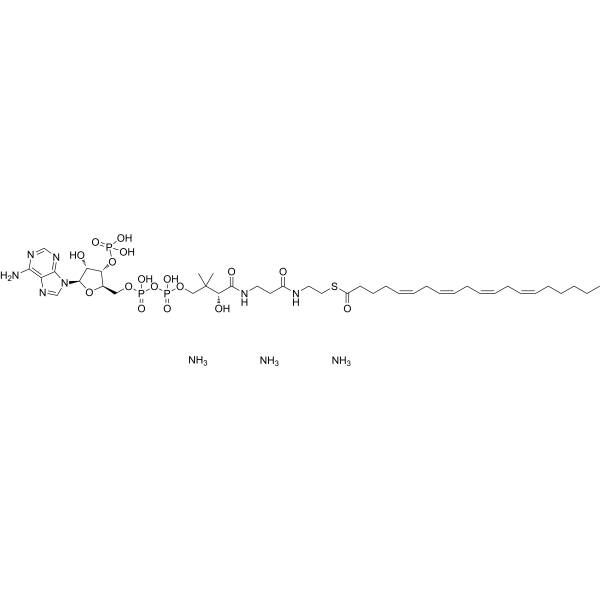
    Arachidonoyl CoA triammonium is used as a substrate in the synthesis of Arachidonoyl amino acids. Arachidonoyl CoA triammonium directly interacts with FadR to inhibit binding at its DNA targets .
    Arachidonoyl CoA triammonium
  • HY-126929

    TXN-B

    DNA Alkylator/Crosslinker Apoptosis Bacterial Parasite Fungal Infection Cancer
    Trioxacarcin B (TXN-B) is a potent cytotoxic agent and DNA-targeted inhibitor. Trioxacarcin B disrupts DNA function and induces apoptosis in cancer cells. Trioxacarcin B not only effectively inhibits the growth of various Gram-positive and Gram-negative bacteria as well as Plasmodium falciparum, but also blocks the colony formation of cancer stem cells, significantly reduces tumor volume and prolongs survival in preclinical in vivo models. The activity of Trioxacarcin B is highly dependent on its intact spiro-epoxide structure; it loses efficacy once this moiety undergoes hydrolysis, and Trioxacarcin B shows no activity against fungi, microalgae and small RNA viruses. Trioxacarcin B can be used for research on bacterial infections, malaria, and various cancers including colon cancer and melanoma .
    Trioxacarcin B

Inquiry Online

Your information is safe with us. * Required Fields.

Salutation


Country or Region *

Applicant Name *


Organization Name *

Department *


Email Address *


Product Name *

Cat. No.


Requested quantity *

Phone Number *


Remarks

Inquiry Online

Inquiry Information

Product Name:
Cat. No.:
Quantity:
MCE Japan Authorized Agent:

