
1. Search Result
Search Result
Results for "

Pseudomonas putida

" in MedChemExpress (MCE) Product Catalog:

18

Inhibitors & Agonists

2

Biochemical Assay Reagents

5

Natural
Products

2

Recombinant Proteins

Cat. No. Product Name Target Research Areas Chemical Structure
  • HY-B1232
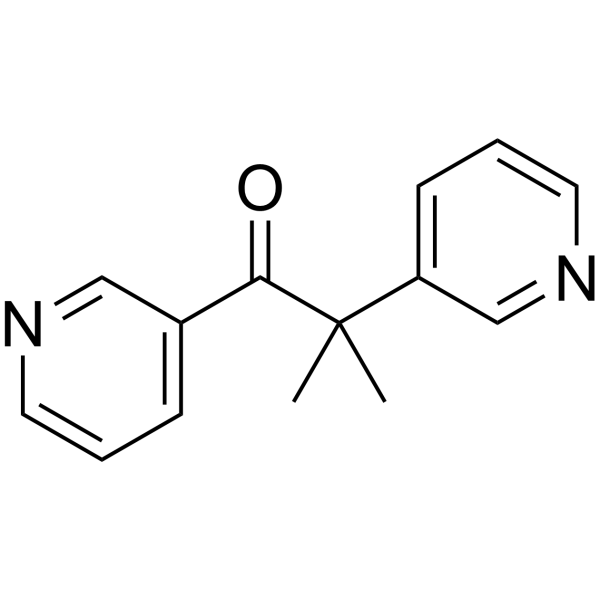
    Metyrapone
    10+ Cited Publications

    Su-4885

    Endogenous Metabolite Cytochrome P450 Autophagy Neurological Disease Metabolic Disease Endocrinology Cancer
    Metyrapone (Su-4885) is a potent and orally active 11β-hydroxylase inhibitor and an autophagy activator, also inhibits the production of aldosterone. Metyrapone inhibits synthesis of endogenous adrenal corticosteroid, decreases glucocorticoid levels, and also affects behavior and emotion. In addition, Metyrapone increases the efficiency of autophagic process via downregulation of mTOR pathway, and interacts with Pseudomonas putida cytochrome P-450. Metyrapone can be used for researching Cushing's syndrome and depression .
    Metyrapone
  • HY-P2838

    Creatinine amidohydrolase; CAH

    Endogenous Metabolite Metabolic Disease
    Creatininase, Microorganism (Creatinine amidohydrolase; CAH), namely creatinine amidohydrolase, from Pseudomonas putida, is a homohexameric enzyme commonly used in biochemical research. Creatininase acts on carbon-nitrogen bonds other than peptide bonds, and can catalyze the hydrolysis of creatinine to creatine, which can then be metabolized by creatinase to urea and sarcosine .
    Creatininase, Microorganism
  • HY-32955

    Bacterial Infection
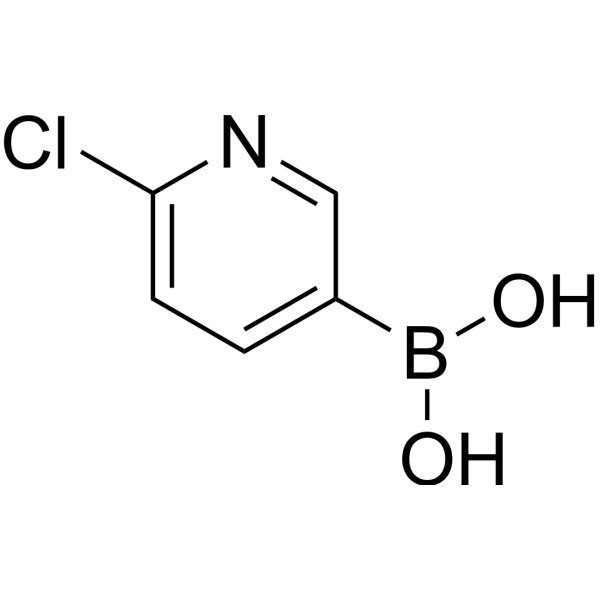
    2-Chloropyridine-5-boronic acid is a mandelate racemase (MR) inhibitor with a Ki value of 8.5 μM against Pseudomonas putida MR .
    2-Chloropyridine-5-boronic acid
  • HY-41465

    Drug Intermediate Others
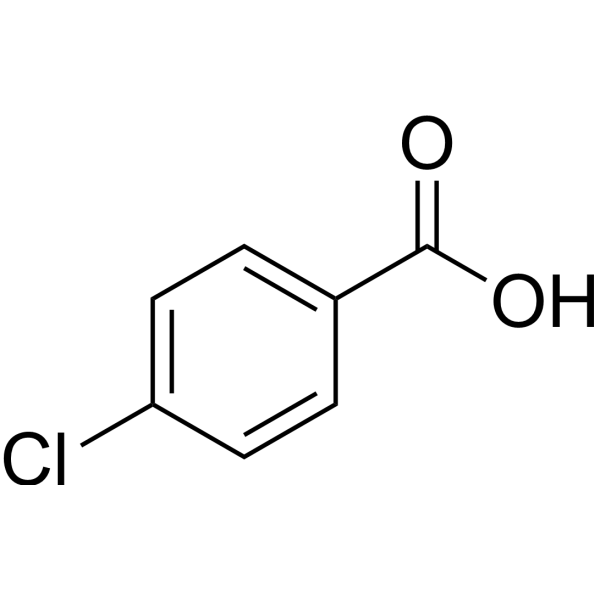
    4-Chlorobenzoic acid is a halogenated aromatic compound that can be used as an industrial chemical and an intermediate in drug synthesis. 4-Chlorobenzoic acid is a persistent organic micropollutant and can be biodegraded through a direct dehalogenation pathway .
    4-Chlorobenzoic acid
  • HY-W012815

    Biochemical Assay Reagents Drug Intermediate Others
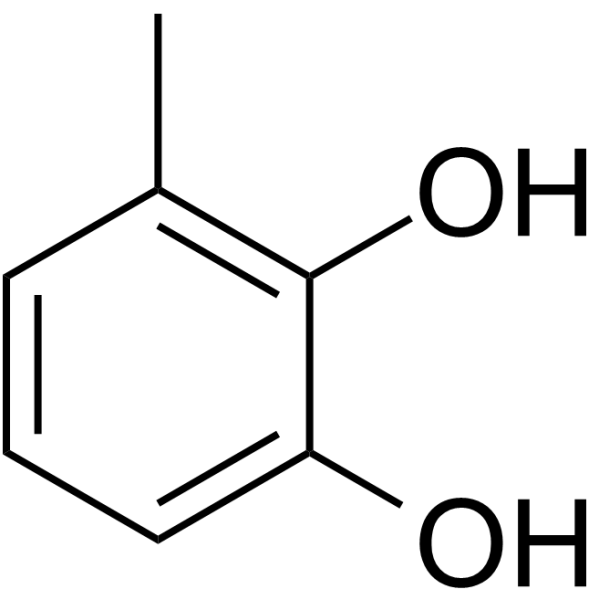
    3-Methylcatechol is a phenolic derivative that can be produced by Pseudomonas putida MC2. 3-Methylcatechol can serve as a molecular building block in chemical synthesis to produce other active compounds .
    3-Methylcatechol
  • HY-W704598

    Biochemical Assay Reagents Bacterial Infection
    Methyl 3-hydroxydodecanoate is a poly (3-hydroxyalkanoate) monomer. Methyl 3-hydroxydodecanoate can be produced with the involvement of Pseudomonas putida Bet001 .
    Methyl 3-hydroxydodecanoate
  • HY-W103225

    Bacterial Infection
    Dihydroanthracene (9,10-Dihydroanthracene) is a substrate for toluene dioxygenase (TDO) expressed by Pseudomonas putida UV4. Toluene dioxygenase (TDO) expressed by Pseudomonas putida UV4 catalyzes the benzylic monooxygenation of Dihydroanthracene to 9-hydroxy-9,10-DHA as the only product .
    Dihydroanthracene
  • HY-W001968

    3-TC

    Drug Intermediate Others
    3-Thiophenecarboxaldehyde is a thiophene derivative substrate for biocatalytic reduction to 3-thiophenemethanol, and can be processed by Pseudomonas putida S12 cells. 3-Thiophenecarboxaldehyde functions as an intermediate compound. 3-Thiophenecarboxaldehyde exhibits toxicity toward Pseudomonas putida S12 cells at elevated concentrations, reducing specific growth rate and final biomass yield .
    3-Thiophenecarboxaldehyde
  • HY-E70348

    Endogenous Metabolite Others
    L-Methionine γ-lyase, pseudomonas putida is a biocatalyst and a key enzyme in new biocatalyst technology. Enzyme engineering focuses on enhancing enzyme reaction kinetics, substrate selectivity, and activity under harsh conditions such as low or high pH. By introducing stimulus responsiveness to these enzyme modifications, dynamic control of activity is also possible .
    L-Methionine γ-lyase, pseudomonas putida
  • HY-121959

    Biochemical Assay Reagents Metabolic Disease
    4-Acetylphenoxyacetic acid is a phenoxyacetic acid derivative. 4-Acetylphenoxyacetic acid can be synthesized from para-acetyl phenol. 4-Acetylphenoxyacetic acid can be used to study phenylacetic acid transport system of Pseudomonas putida U through the aerobic catabolism of phenylacetic aced derivative .
    4-Acetylphenoxyacetic acid
  • HY-E70520

    Biochemical Assay Reagents Inflammation/Immunology Cancer
    Salicylate hydroxylase, Microorganism (EC 1.14.13.1) is a flavin-dependent monooxygenase. Salicylate hydroxylase, Microorganism catalyzes the decarboxylative hydroxylation of salicylate into catechol in the naphthalene degradation pathway in Pseudomonas putida G7. Salicylate hydroxylase, Microorganism has potential biocatalytic applications .
    Salicylate hydroxylase, Microorganism
  • HY-W016584

    Others Infection
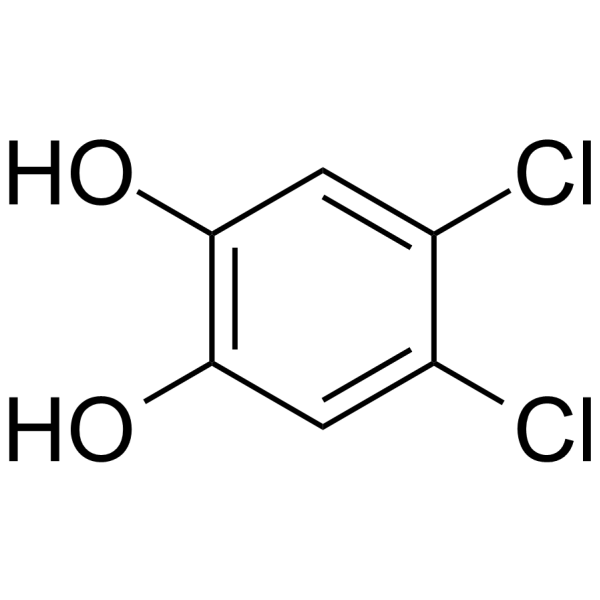
    4,5-Dichlorocatechol is a substrate of the broad-spectrum chlorocatechol 1,2-dioxygenase of pseudomonas chlororaphis RW71. The Ki values for 4,5-dichlorocatechol is 30 nM for the dioxygenase of the Chlorobenzoate-degrading strain Pseudomonas putida AC27 and 4 nM for the dioxygenase of Acidovorax sp. strain PS14 .
    4,5-Dichlorocatechol
  • HY-178924

    Bacterial Infection
    Antibacterial agent 298 exhibits significant antibacterial activity against Pseudomonas putida (ATCC 25922) with an IC50 4.48 µg/mL. Antibacterial agent 298 shows strong antibiofilm activity. Antibacterial agent 298 also inhibits approximately 50% of biofilm formation in L. lactis and P. putida. Antibacterial agent 298 can be used for the study of Bacterial infections caused by multidrug-resistant bacteria (MDR) .
    Antibacterial agent 298
  • HY-113590

    Bacterial Infection
    FR295389 is a dihydroimidazopyrazolium cephalosporin with antibacterial activity. FR295389 shows activity against IMP-type metallo-β-lactamases (MBL)-producing Klebsiella pneumoniae, Acinetobacter baumanii and Pseudomonas putida with MIC values ranging from 4 to 32 mg/mL .
    FR295389
  • HY-W012815R

    Biochemical Assay Reagents Reference Standards Drug Intermediate Others
    3-Methylcatechol (Standard) is the analytical standard of 3-Methylcatechol (HY-W012815). This product is intended for research and analytical applications. 3-Methylcatechol is a phenolic derivative that can be produced by Pseudomonas putida MC2. 3-Methylcatechol can serve as a molecular building block in chemical synthesis to produce other active compounds .
    3-Methylcatechol (Standard)
  • HY-B1232A

    Su-4885 Tartrate

    Endogenous Metabolite Cytochrome P450 Autophagy mTOR Neurological Disease Endocrinology
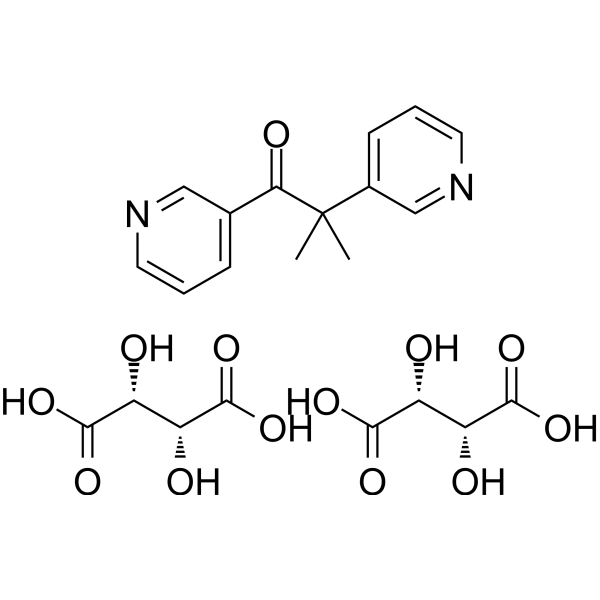
    Metyrapone (Su-4885) Tartrate is a potent and orally active 11β-hydroxylase inhibitor and an autophagy activator, also inhibits the production of aldosterone. Metyrapone Tartrate inhibits synthesis of endogenous adrenal corticosteroid, decreases glucocorticoid levels, and also affects behavior and emotion. In addition, Metyrapone Tartrate increases the efficiency of autophagic process via downregulation of mTOR pathway, and interacts with Pseudomonas putida cytochrome P-450. Metyrapone Tartrate can be used for researching Cushing's syndrome and depression .
    Metyrapone Tartrate
  • HY-B1232R

    Su-4885 (Standard)

    Reference Standards Endogenous Metabolite Cytochrome P450 Autophagy Neurological Disease Metabolic Disease Endocrinology Cancer
    Metyrapone (Standard) is the analytical standard of Metyrapone. This product is intended for research and analytical applications. Metyrapone (Su-4885) is a potent and orally active 11β-hydroxylase inhibitor and an autophagy activator, also inhibits the production of aldosterone. Metyrapone inhibits synthesis of endogenous adrenal corticosteroid, decreases glucocorticoid levels, and also affects behavior and emotion. In addition, Metyrapone increases the efficiency of autophagic process via downregulation of mTOR pathway, and interacts with Pseudomonas putida cytochrome P-450. Metyrapone can be used for researching Cushing's syndrome and depression .
    Metyrapone (Standard)
  • HY-E71342

    Biochemical Assay Reagents Others
    γ-Guanidinobutyraldehyde dehydrogenase (EC 1.2.1.54) is involved in the degradation of arginine in Pseudomonas putida.
    γ-Guanidinobutyraldehyde dehydrogenase

Inquiry Online

Your information is safe with us. * Required Fields.

Salutation


Country or Region *

Applicant Name *


Organization Name *

Department *


Email Address *


Product Name *

Cat. No.


Requested quantity *

Phone Number *


Remarks

Inquiry Online

Inquiry Information

Product Name:
Cat. No.:
Quantity:
MCE Japan Authorized Agent:

