11 Results for "

Symmetrical Dimethylarginine

" in MedChemExpress (MCE) Product Catalog:
Products (11)

11 Results for "Symmetrical Dimethylarginine" in MCE Product Catalog:

4
4 Cited Publications
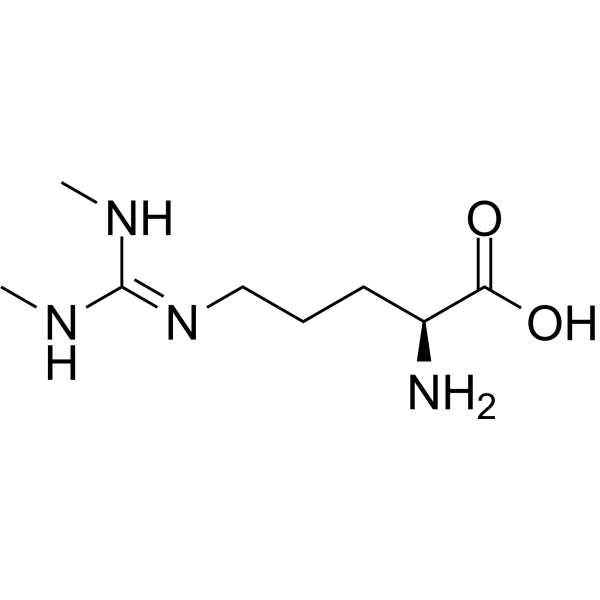
Cat. No.: HY-101410
CAS No.: 30344-00-4
Purity:  ≥98.0%
Synonyms: Symmetric Dimethylarginine; NG,NG'-Dimethyl-L-arginine
SDMA (Symmetric dimethylarginine) is an endogenous inhibitor of nitric oxide (NO) synthase activity. SDMA, a novel kidney biomarker, permits earlier diagnosis of kidney disease than traditional creatinine testing.
loading...
    loading...
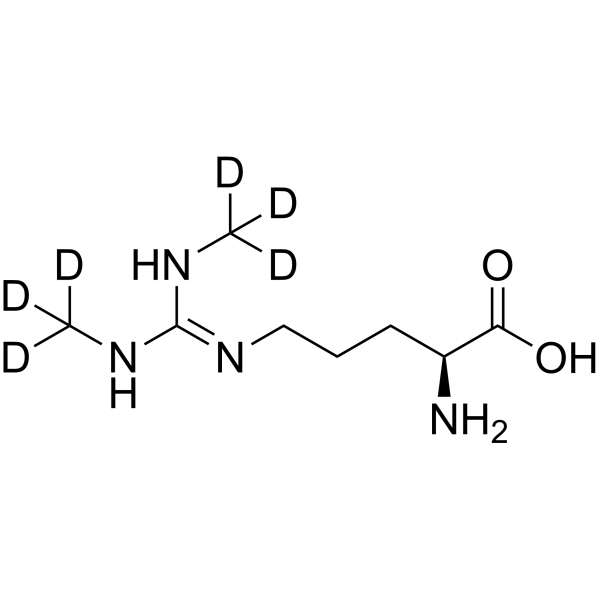
Cat. No.: HY-101410S
CAS No.: 1331888-08-4
Purity:  98.07%
Synonyms: Symmetric Dimethylarginine-d6; NG,NG'-Dimethyl-L-arginine-d6
SDMA-d6 is the deuterium labeled SDMA. SDMA (Symmetric dimethylarginine) is an endogenous inhibitor of nitric oxide (NO) synthase activity .
loading...
    loading...
Cat. No.: HY-101410R
CAS No.: 30344-00-4
Synonyms: Symmetric Dimethylarginine (Standard); NG,NG'-Dimethyl-L-arginine (Standard)
SDMA (Standard) is the analytical standard of SDMA. This product is intended for research and analytical applications. SDMA (Symmetric dimethylarginine) is an endogenous inhibitor of nitric oxide (NO) synthase activity. SDMA, a novel kidney biomarker, permits earlier diagnosis of kidney disease than traditional creatinine testing.
loading...
    loading...
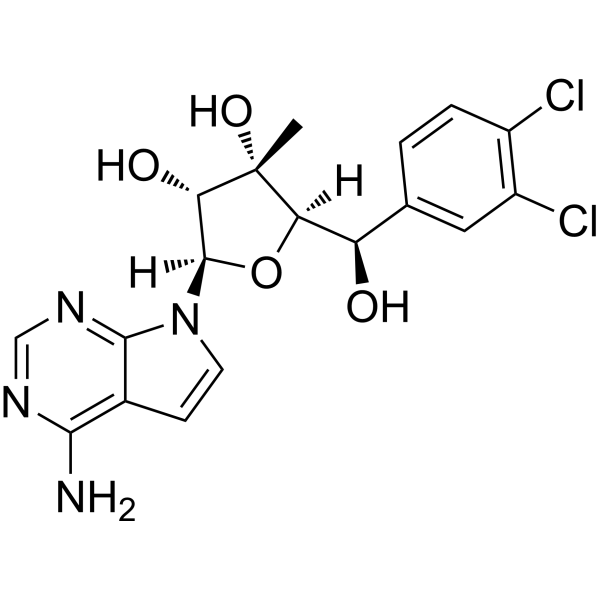
Cat. No.: HY-168263
Research Areas:  

Cancer

PRMT5-IN-45 (compound 36) is a potent and selective PRMT5 inhibitor with an IC50 of 3 nM. PRMT5-IN-45 potently reduces the level of symmetric dimethylarginines (sDMA) and inhibits the proliferation of MOLM-13 cell lines by inducing apoptosis and cell cycle arrest .
loading...
    loading...
Cat. No.: HY-158143
CAS No.: 2918814-97-6
Research Areas:  

Cancer

AZD3470 is an orally active MTA-cooperative PRMT5 inhibitor, selective for MTAP-deficient tumors. AZD3470 induces cell cycle G2/M phase alterations, DNA damage, apoptosis, and symmetric dimethylarginine reduction. AZD3470 alters alternative splicing, increases skipped exon events in DNA repair and cell cycle pathways, and inhibits cancer cell proliferation and tumor growth. AZD3470 can be used for the research of non-small cell lung cancer and MTAP-deleted solid tumors .
loading...
    loading...
Cat. No.: HY-178028
CAS No.: 3113303-04-8
Research Areas:  

Cancer

PRMT5-IN-53 is a gut-restricted and orally active PRMT5 inhibitor with pIC50s of ≥ 9.7 against hPRMT5 and mPRMT5. PRMT5-IN-53 binds to the PRMT5:MEP50 complex with a KD of 11.3 pM. PRMT5-IN-53 effectively inhibits PRMT5 locally in the intestines of mice, significantly reducing the number and area of polyps, while avoiding systemic hematological toxicity (such as anemia, neutropenia). PRMT5-IN-53 can be used for the study of colorectal cancer especially for familial adenomatous polyposis (FAP) .
loading...
    loading...
Cat. No.: HY-141876
CAS No.: 2278356-90-2
PRT543 is an orally active selective PRMT5 inhibitor. PRT543 reduces intracellular symmetric dimethylarginine (sDMA) levels, downregulates the expression of genes related to DNA damage repair and DNA replication pathways, and induces abnormal alternative splicing. PRT543 inhibits the MYB, NOTCH1 and PI3K/AKT signaling pathways, promotes nuclear translocation of FOXO1, upregulates the pro-apoptotic protein BAX, and enhances cellular sensitivity to BCL-2 inhibition. PRT543 disrupts the normal RNA splicing process and exerts a synthetic lethal effect on myeloid tumor cells carrying splicing factor mutations. PRT543 can be used in research related to various cancers including breast cancer, ovarian cancer and acute myeloid leukemia .
loading...
    loading...
Cat. No.: HY-183568
Research Areas:  

Cancer

MAT2A-IN-26 is an orally active MAT2A inhibitor with a human IC50 of 17.53 nM. MAT2A-IN-26 inhibits the enzymatic activity of MAT2A, thereby reducing the levels of S-adenosylmethionine (SAM) and symmetric dimethylarginine (sDMA). MAT2A-IN-26 inhibits the proliferation of MTAP-deficient cancer cells and induces anti-tumor efficacy in xenograft models. MAT2A-IN-26 can be used in non-small cell lung cancer research .
loading...
    loading...
Cat. No.: HY-181260
CAS No.: 3105952-57-3
Research Areas:  

Cancer

PRMT5-MTA-IN-8 is an orally active PRMT5-MTA complex inhibitor (IC50 = 4.4 nM). PRMT5-MTA-IN-8 inhibits the intracellular production of symmetric dimethylarginine (SDMA) as well as the proliferation of MTAP-deficient cells. PRMT5-MTA-IN-8 exerts antitumor efficacy by inhibiting PRMT5, reducing SDMA levels and inducing tumor cell apoptosis in mouse models of triple-negative breast cancer. PRMT5-MTA-IN-8 can be used in research related to cancers such as triple-negative breast cancer .
loading...
    loading...
Cat. No.: HY-189213
Research Areas:  

Cancer

YZ-17 is a PROTAC degrader targeting PRMT5, with DC50 = 2.2 μM (HCC1806 cells). YZ-17 recruits CRBN E3 ligase and induces PRMT5 degradation through the ubiquitin-proteasome system, inhibiting PRMT5-mediated symmetric dimethylarginine modification. YZ-17 co-degrades the PRMT5 adaptor protein MEP50 via a CRBN-dependent mechanism. YZ-17 induces G1 phase cell cycle arrest and inhibits colony formation in cancer cells. YZ-17 exhibits antiproliferative activity in various cancer cells. YZ-17 shows antitumor efficacy in a triple-negative breast cancer xenograft mouse model. YZ-17 can be used for research on triple-negative breast cancer .
loading...
    loading...
Cat. No.: HY-184290
CAS No.: 3062852-59-6
Research Areas:  

Neurological Disease Cancer

PRMT5-IN-56 is a PRMT5⋅MTA complex inhibitor with an IC50 of 0.2 nM, oral activity, and blood-brain barrier penetration. PRMT5-IN-56 inhibits PRMT5 methyltransferase activity in an MTA-cooperative manner, suppresses symmetrical dimethylarginine levels in MTAP-deficient cells. PRMT5-IN-56 suppresses proliferation of MTAP-deleted cancer cells with high selectivity over MTAP-wild type cells. PRMT5-IN-56 induces dose-dependent tumor growth inhibition in subcutaneous xenograft models, inhibits intracranial tumor progression, and prolongs survival in orthotopic brain xenograft models. PRMT5-IN-56 exhibits high intrinsic permeability, good oral bioavailability, and a high brain-to-plasma ratio. PRMT5-IN-56 can be used for the research of MTAP-deleted cancers and glioblastoma .
loading...
    loading...
  • 1

