1. Search Result
Search Result
Pathways Recommended: Neuronal Signaling JAK/STAT Signaling
Results for "

TLR8 signaling

" in MedChemExpress (MCE) Product Catalog:

8

Inhibitors & Agonists

1

Oligonucleotides

Cat. No. Product Name Target Research Areas Chemical Structure
  • HY-116961
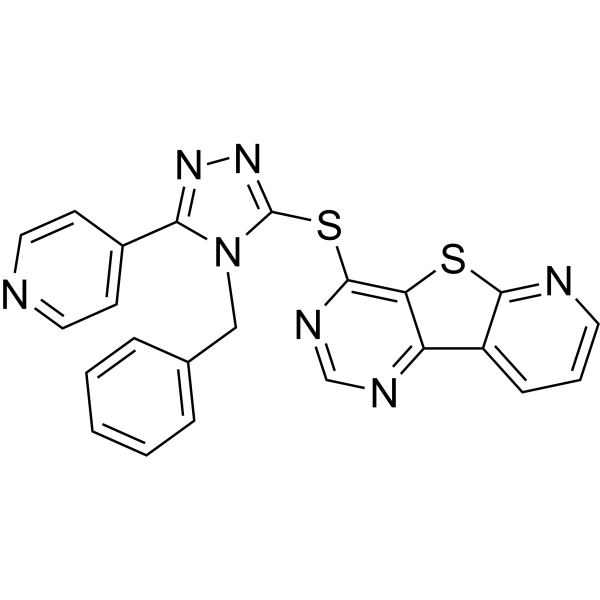
    TH1020
    10+ Cited Publications

    Toll-like Receptor (TLR) Bacterial Infection Inflammation/Immunology
    TH1020 is a potent and selective toll-like receptor 5 (TLR5)/flagellin complex antagonist with an IC50 of 0.85 μM. TH1020 inhbits flagellin-induced TLR5 signaling. TH1020 is inactive against TLR2, TLR3, TLR4, TLR7 and TLR8 .
    TH1020
  • HY-117066
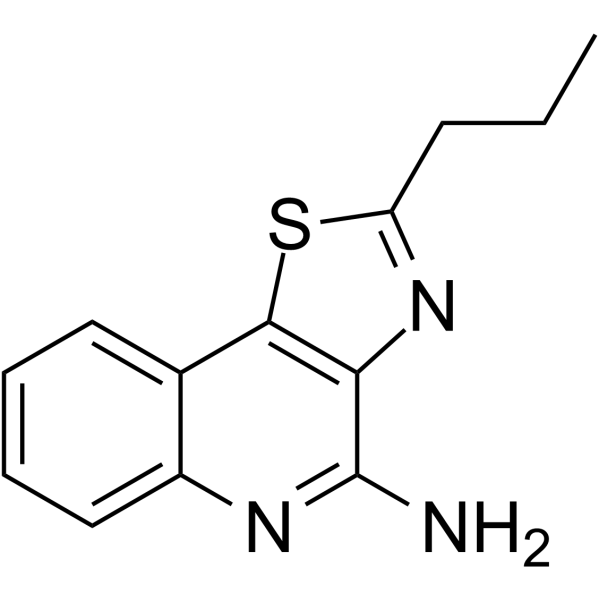
    CL075
    3 Publications Verification

    3M002

    Toll-like Receptor (TLR) Inflammation/Immunology
    CL075 (3M002) is a selective TLR8 agonist with immunomodulating properties. CL075 triggers a MyD88-dependent signaling pathway to elicit production of inflammatory cytokines and type I interferons (IFNs) via activation of NF-κB and IRF7, respectively .
    CL075
  • HY-160229

    R-1075 sodium

    Toll-like Receptor (TLR) MyD88 Caspase Reactive Oxygen Species (ROS) Autophagy Pyroptosis HIV Infection Neurological Disease
    ssRNA40 sodium (R-1075 sodium) is a single-stranded RNA40 derived from HIV-1. ssRNA40 sodium activates the TLR7, TLR8, TLR2, RIG-I, MDA5, MyD88, Caspase-3, IRE1α, NLRP3 inflammasome and IRF7 signaling pathways. ssRNA40 sodium alters mRNA expression in neutrophils, induces pro-inflammatory cytokines, ROS, autophagy (autophagy), pyroptosis (pyroptosis), neuronal death, neurodegeneration, aggregate formation and NK cell activation. ssRNA40 sodium activates the expression of CD62L, CD11b, CD69, MX1, OAS1, ATG7, LC3B and XBP1 in immune cell and neuronal populations. ssRNA40 sodium causes cortical neuron loss and axonal damage in mice in a TLR7-dependent manner. ssRNA40 sodium can be used in research on HIV-1 infection, neurodegeneration, COVID-19 and HIV-associated neurological disorders .
    ssRNA40 sodium
  • HY-147310

    Toll-like Receptor (TLR) Infection
    CU-CPD107 is a potent, selective toll-like receptor 8 (TLR 8) agonist. CU-CPD107 inhibits TLR8 signaling. CU-CPD107 converts to synergistic agonist activities in the presence of ssRNA and induces TLR8 signaling. CU-CPD107 inhibits proinflammatory factor expression and avoids immune responses in the presence of ssRNA .
    CU-CPD107
  • HY-173063

    Toll-like Receptor (TLR) NF-κB MyD88 Inflammation/Immunology
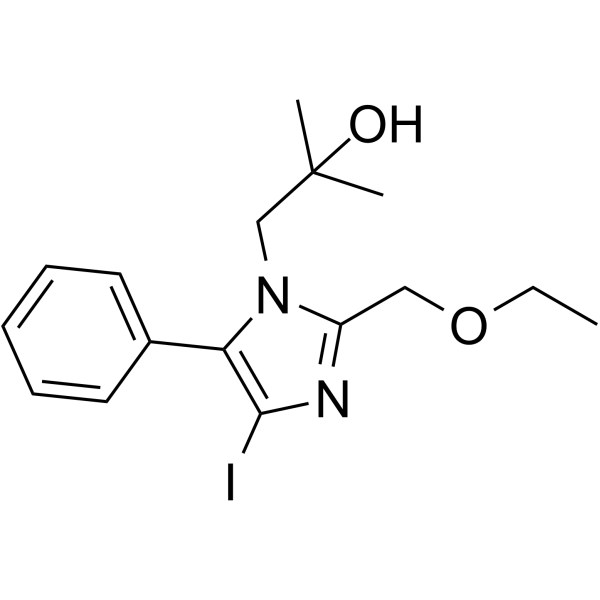
    TLR8 antagonist-1 (Compound 10) is a selective TLR8 antagonist. TLR8 antagonist-1 can inhibit TLR8-mediated inflammation and signaling pathways, reduce the recruitment of MyD88, and inhibit the NF-κB and IRF pathways. TLR8 antagonist-1 has anti-inflammatory activity .
    TLR8 antagonist-1
  • HY-181841

    Toll-like Receptor (TLR) HIV Infection
    TLR8 agonist 10 is a selective TLR8 agonist with an EC50 of 0.019 μM in humans. TLR8 agonist 10 activates TLR8-mediated signaling pathways. As a latency-reversing agent, TLR8 agonist 10 reactivates latent HIV-1 reservoirs. TLR8 agonist 10 activates innate cytotoxic natural killer cells to target HIV-infected CD4 + T cells. TLR8 agonist 10 is applicable to research related to HIV-1 infection .
    TLR8 agonist 10
  • HY-175782

    Toll-like Receptor (TLR) NF-κB p38 MAPK Inflammation/Immunology
    SMU-R39 is a TLR7 and TLR8 antagonist with IC50 values of 3.22 μM and 0.24 μM, respectively. SMU-R39 binds to recombinant mTLR7 protein (KD = 2.36 μM) and to recombinant hTLR8 protein (KD = 105 nM). SMU-R39 suppresses downstream NF-κB and MAPK signaling, and reduces secretion/transcription of pro-inflammatory cytokines (TNF-α, IL-1β, IL-6) in PBMCs and THP-1 cells. SMU-R39 demonstrates anti-inflammatory efficacy in Imiquimod (IMQ) (HY-B0180)-induced psoriasis mouse model. SMU-R39 can be used for the study of autoimmune diseases such as psoriasis .
    SMU-R39
  • HY-181796

    Toll-like Receptor (TLR) Interleukin Related Inflammation/Immunology
    TLR7 antagonist-1 (Compound 44#) is an orally active, selective TLR7 antagonist with an IC50 value of 0.3 nM against TLR7. TLR7 antagonist-1 selectively binds to TLR7, inhibits its activation, and downregulates the c-Rel signaling pathway. TLR7 antagonist-1 downregulates the mRNA levels of proinflammatory cytokines IL-1β, IL-6, and TNF-α. TLR7 antagonist-1 alleviates Imiquimod (HY-B0180)-induced psoriasis-like skin lesions. TLR7 antagonist-1 is applicable to research related to psoriasis .
    TLR7 antagonist-1

Inquiry Online

Your information is safe with us. * Required Fields.

Salutation


Country or Region *

Applicant Name *


Organization Name *

Department *


Email Address *


Product Name *

Cat. No.


Requested quantity *

Phone Number *


Remarks

Inquiry Online

Inquiry Information

Product Name:
Cat. No.:
Quantity:
MCE Japan Authorized Agent:

