
1. Search Result
Search Result
Results for "

Thiazole Orange

" in MedChemExpress (MCE) Product Catalog:

6

Inhibitors & Agonists

5

Fluorescent Dyes

4

Oligonucleotides

Cat. No. Product Name Target Research Areas Chemical Structure
  • HY-D0150
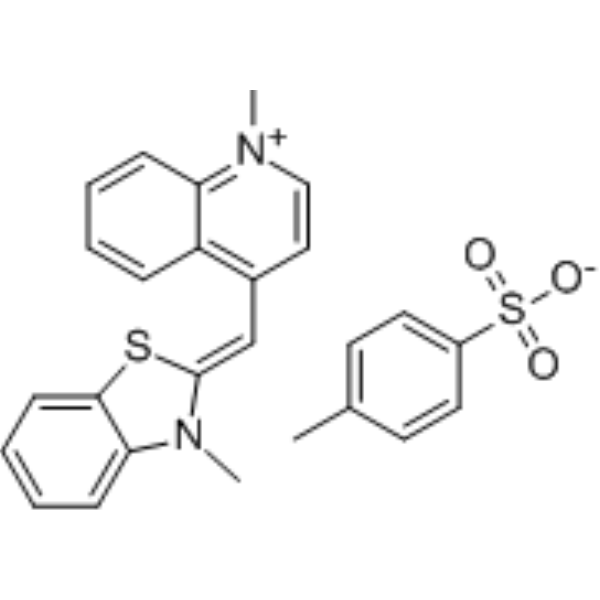
    Thiazole Orange
    1 Publications Verification

    Fluorescent Dye Others
    Thiazole Orange is an asymmetric anthocyanin dye that can be coupled with oligonucleotides (ONs) to prepare fluorescent hybridization probes. Thiazole Orange has been widely used in biomolecular detection and staining of DNA/ RNA in gels and can be used for reticulocyte analysis. Thiazole orange generates a significant fluorescence enhancement and high quantum yield when it binds with nucleic acids, especially RNA. Thiazole orange can permeate living cell membranes. Thiazole orange can use UV light for detection, but can also be detected with blue light. The excitation and emission of Thiazole orange are λex = 510 nm (488 nm and 470 nm also show strong excitation) and λem = 527 nm, respectively .
    Thiazole Orange
  • HY-D0996

    DNA Stain Others
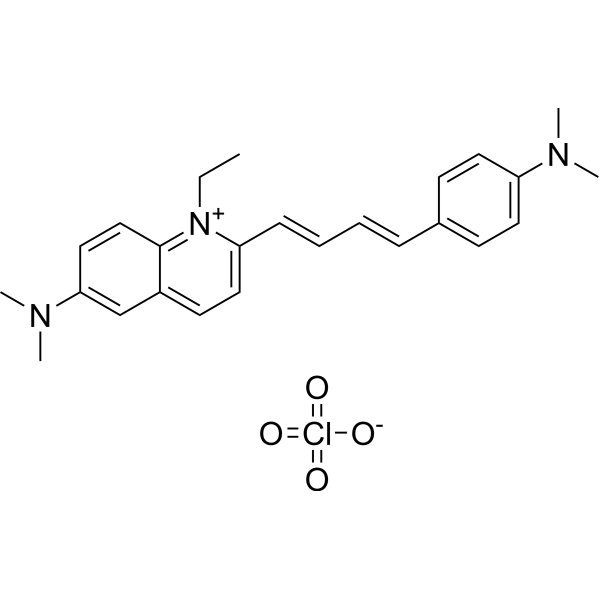
    Lds-751 is a nucleic acid stain that mainly detects DNA. Lds-751 is a nucleic acid stain that mainly detects DNA. Lds-751 has a high affinity for DNA and fluorescence is enhanced after binding, but the maximum emission wavelength is 670nm. Lds-751 and Thiazole orange can be used for the differentiation of red blood cells, platelets, reticulocytes, and nucleated cells and can be stimulated at 488nm. Studies have shown that LDS-751 binds almost exclusively to mitochondria when incubated with nucleated living cells. After nucleated Acridine Orange (HY-101879) staining and LDS-751 treatment of cells, confocal microscopy revealed almost no co-location of the cells. Staining with Rhodamine 123 (HY-D0816), a dye known to bind polarized mitochondria, was almost identical to the pattern observed with LDS-751 .
    LDS-751
  • HY-D0916

    YOYO 1; YOYO1

    Fluorescent Dye Others
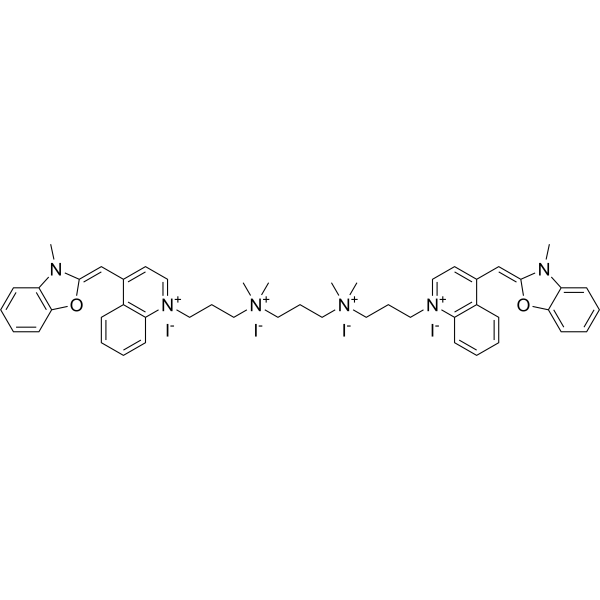
    Thiazole orange dimer YOYO 1 (YOYO 1) is a cell-impermeable cyanine dimer with no inherent fluorescence, and its fluorescence intensity increases significantly upon binding to double-stranded DNA (dsDNA) . Thiazole orange dimer YOYO 1 can serve as a nuclear counterstain or a dead cell indicator (Ex/Em = 505/512 nm).
    Thiazole orange dimer YOYO 1
  • HY-153847

    Biochemical Assay Reagents Others
    RNA Aptamer Mango Ⅱ (sodium) has an exceptionally high affinity to TO1-biotin (a thiazole orange derivative fluorophore), and can be used to visualize RNA expression or localization in live cells. Compared to the original Mango I aptamer, RNA Aptamer Mango Ⅱ (sodium) has markedly improved fluorescent properties, binding affinities, and salt dependencies.
    RNA Aptamer Mango ΙΙ sodium
  • HY-D0150A

    Fluorescent Dye Others
    (Z)-Thiazole Orange iodide is an asymmetric cyanine dye whose fluorescence highly depends on the local environment.(Z)-Thiazole Orange iodide is essentially dark in solution; however, its fluorescence increases a thousandfold when (Z)-Thiazole Orange iodide is introduced into double-stranded DNA and RNA (dsDNA or dsRNA). The maximum absorption of Thiazole Orange in complex with DNA is 509 nm, and the maximum emission is 532 nm. Thiazole Orange solution is widely used for determining the percentage of reticulocytes in human peripheral blood with microscopy and flow cytometry.
    (Z)-Thiazole Orange iodide
  • HY-DY1097

    Fluorescent Dye Others
    Thiazole Orange (solution) is an asymmetric anthocyanin dye that can be coupled with oligonucleotides (ONs) to prepare fluorescent hybridization probes. Thiazole Orange has been widely used in biomolecular detection and staining of DNA/ RNA in gels and can be used for reticulocyte analysis. Thiazole orange generates a significant fluorescence enhancement and high quantum yield when it binds with nucleic acids, especially RNA. Thiazole orange can permeate living cell membranes. Thiazole orange can use UV light for detection, but can also be detected with blue light. The excitation and emission of Thiazole orange are λex = 510 nm (488 nm and 470 nm also show strong excitation) and λem = 527 nm, respectively .
    Solvent and concentration: DMSO: 10 mM
    The 1 mL volume is defined as the base specification. All larger sizes correspond to incremental volumes of this base.
    Thiazole Orange (solution)

Inquiry Online

Your information is safe with us. * Required Fields.

Salutation


Country or Region *

Applicant Name *


Organization Name *

Department *


Email Address *


Product Name *

Cat. No.


Requested quantity *

Phone Number *


Remarks

Inquiry Online

Inquiry Information

Product Name:
Cat. No.:
Quantity:
MCE Japan Authorized Agent:

