8 Results for "

Yersinia enterocolitica

" in MedChemExpress (MCE) Product Catalog:
Products (8)

8 Results for "Yersinia enterocolitica" in MCE Product Catalog:

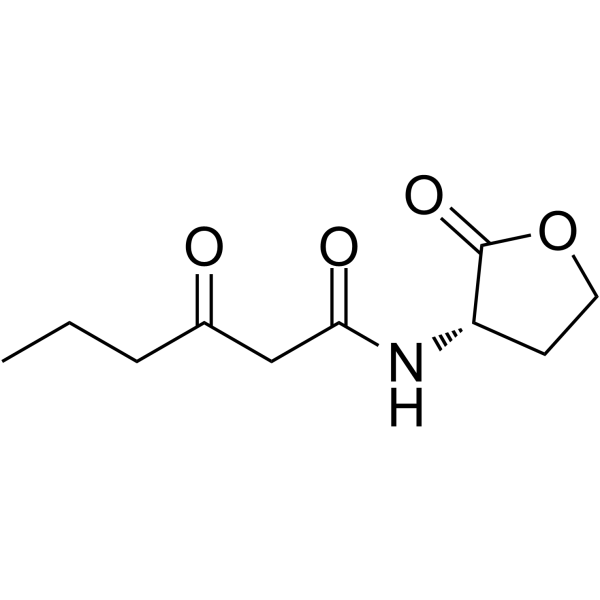
Cat. No.: HY-W008806
CAS No.: 143537-62-6
Synonyms: OHHL; N-(3-Oxohexanoyl)homoserine lactone
Target:  

Bacterial

Research Areas:  

Infection Inflammation/Immunology

N-(3-Oxohexanoyl)-L-homoserine lactone (OHHL; N-(3-Oxohexanoyl)homoserine lactone) is a specific agonist of LuxR-type transcription factor CarR with a Kd of 1.8 μM. N-(3-Oxohexanoyl)-L-homoserine lactone activates CarR by inducing protein multimerization, promoting its binding to target DNA sequences in the carR-carA intergenic region, thereby upregulating the transcription of carbapenem biosynthesis genes. N-(3-Oxohexanoyl)-L-homoserine lactone acts as a quorum sensing signal molecule, enabling bacteria to coordinate the production of carbapenem antibiotics in a cell density-dependent manner. N-(3-Oxohexanoyl)-L-homoserine lactone is used to study bacterial quorum sensing mechanisms, especially the secondary metabolism and virulence factor regulatory pathways of Erwinia carotovora and Yersinia enterocolitica .
loading...
    loading...
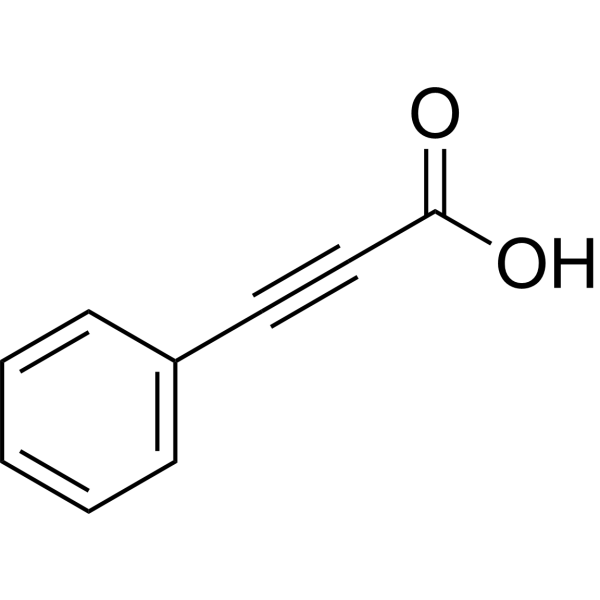
Cat. No.: HY-W007319
CAS No.: 637-44-5
Phenylpropiolic acid is an Antibacterial agent. Phenylpropiolic acid is identified from the intracellular extract of Proteus mirabilis DMTMMR-11. Phenylpropiolic acid disrupts biofilm formation by reducing pathogen adhesion and enhancing biofilm clearance ability. Phenylpropiolic acid inhibits the growth of Yersinia enterocolitica, disrupts its cell membrane integrity, and increases the survival rate of infected Caenorhabditis elegans. Phenylpropiolic acid can be used in studies related to yersiniosis and gastroenteritis .
loading...
    loading...
Cat. No.: HY-P99131
Anti-Mouse CD90.2 Antibody (30H12) is an anti-mouse CD90.2 IgG2b antibody inhibitor derived from host Rat. Anti-Mouse CD90.2 Antibody (30H12) can deplete innate lymphoid cells (ILC) and T cells. Anti-Mouse CD90.2 Antibody (30H12) can be used for the researches of infection, inflammation and immunology, such as Yersinia enterocolitica infection and airway inflammation .
loading...
    loading...
Cat. No.: HY-126461
CAS No.: 521-39-1
Salazinic acid has antibacterial activity against bacteria and fungi. Salazinic acid does not show antibacterial activity against Listeria monocytogenes, Pseudomonas aeruginosa, Yersinia enterocolitica, and Enterococcus faecalis, but it does have antibacterial activity against Pseudomonas aeruginosa and Salmonella typhimurium .
loading...
    loading...
Cat. No.: HY-P12181
CAS No.: 1357447-10-9
Target:  

Bacterial

Research Areas:  

Infection

YopE (69-77) is an H-2Kb-restricted immunodominant protective bacterial epitope that binds with high affinity to mouse H-2Kb and human HLA-A26:01 class I MHC alleles. YopE is a virulence factor derived from Yersinia pseudotuberculosis, Yersinia pestis, and serogroups O9 and O3 of Yersinia enterocolitica. YopE (69-77) can be used in studies related to Yersinia pseudotuberculosis infection .
loading...
    loading...
Cat. No.: HY-W007319R
CAS No.: 637-44-5
Phenylpropiolic acid (Standard) is the analytical standard of Phenylpropiolic acid (HY-W007319). This product is intended for research and analytical applications. Phenylpropiolic acid is an Antibacterial agent. Phenylpropiolic acid is identified from the intracellular extract of Proteus mirabilis DMTMMR-11. Phenylpropiolic acid disrupts biofilm formation by reducing pathogen adhesion and enhancing biofilm clearance ability. Phenylpropiolic acid inhibits the growth of Yersinia enterocolitica, disrupts its cell membrane integrity, and increases the survival rate of infected Caenorhabditis elegans. Phenylpropiolic acid can be used in studies related to yersiniosis and gastroenteritis .
loading...
    loading...
Cat. No.: HY-W008806S
Synonyms: OHHL-d3; N-(3-Oxohexanoyl)homoserine lactone-d3
N-(3-Oxohexanoyl)-L-homoserine lactone-d3 (OHHL-d3) is the deuterated-labeled N-(3-Oxohexanoyl)-L-homoserine lactone (HY-W008806). N-(3-Oxohexanoyl)-L-homoserine lactone (OHHL; N-(3-Oxohexanoyl)homoserine lactone) is a specific agonist of LuxR-type transcription factor CarR with a Kd of 1.8 μM. N-(3-Oxohexanoyl)-L-homoserine lactone activates CarR by inducing protein multimerization, promoting its binding to target DNA sequences in the carR-carA intergenic region, thereby upregulating the transcription of carbapenem biosynthesis genes. N-(3-Oxohexanoyl)-L-homoserine lactone acts as a quorum sensing signal molecule, enabling bacteria to coordinate the production of carbapenem antibiotics in a cell density-dependent manner. N-(3-Oxohexanoyl)-L-homoserine lactone is used to study bacterial quorum sensing mechanisms, especially the secondary metabolism and virulence factor regulatory pathways of Erwinia carotovora and Yersinia enterocolitica .
loading...
    loading...
Cat. No.: HY-W008806S1
Synonyms: OHHL-d2; N-(3-Oxohexanoyl)homoserine lactone-d2
N-(3-Oxohexanoyl)-L-homoserine lactone-d2 (OHHL-d2) is the deuterated-labeled N-(3-Oxohexanoyl)-L-homoserine lactone (HY-W008806). N-(3-Oxohexanoyl)-L-homoserine lactone (OHHL; N-(3-Oxohexanoyl)homoserine lactone) is a specific agonist of LuxR-type transcription factor CarR with a Kd of 1.8 μM. N-(3-Oxohexanoyl)-L-homoserine lactone activates CarR by inducing protein multimerization, promoting its binding to target DNA sequences in the carR-carA intergenic region, thereby upregulating the transcription of carbapenem biosynthesis genes. N-(3-Oxohexanoyl)-L-homoserine lactone acts as a quorum sensing signal molecule, enabling bacteria to coordinate the production of carbapenem antibiotics in a cell density-dependent manner. N-(3-Oxohexanoyl)-L-homoserine lactone is used to study bacterial quorum sensing mechanisms, especially the secondary metabolism and virulence factor regulatory pathways of Erwinia carotovora and Yersinia enterocolitica .
loading...
    loading...

