9 Results for "

acyl-CoA formation

" in MedChemExpress (MCE) Product Catalog:
Products (9)

9 Results for "acyl-CoA formation" in MCE Product Catalog:

Cat. No.: HY-W004784
CAS No.: 2345-51-9
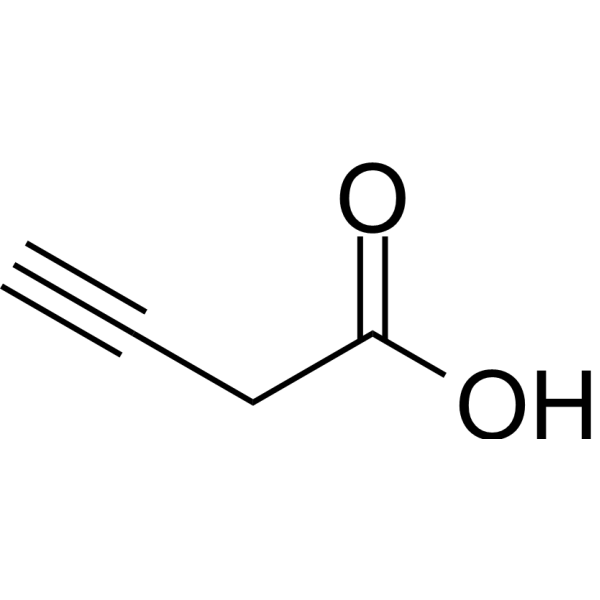
3-Butynoic acid is an inhibitor of acyl CoA dehydrogenase. 3-Butynoic acid is a click chemistry reagent, it contains an Alkyne group and can undergo copper-catalyzed azide-alkyne cycloaddition (CuAAc) with molecules containing Azide groups. 3-Butynoic acid can reduce the formation of propionate and acrylic acid concentration-dependently .
loading...
    loading...
Cat. No.: HY-112487
CAS No.: 78934-83-5
Purity:  99.35%
Target:  

Acyltransferase

Research Areas:  

Metabolic Disease

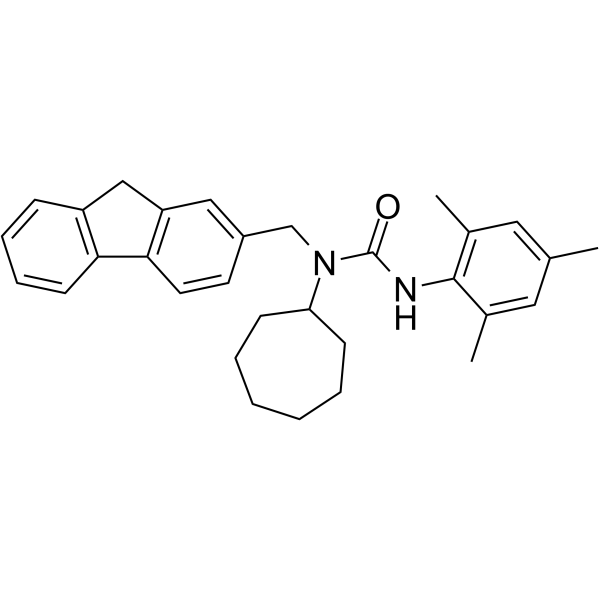
Sandoz 58-035 is a selective acyl-CoA:cholesterol acyltransferase (ACAT) inhibitor. Sandoz 58-035 inhibits this enzyme in intact cells and isolated microsomal fractions. Sandoz 58-035 blocks the esterification of exogenous vesicle-derived cholesterol and the incorporation of oleic acid into cellular cholesterol esters, reducing the formation and accumulation of cholesterol esters. Sandoz 58-035 causes a slight increase in cellular free cholesterol, and at high concentrations, it also causes a slight reduction in overall cellular protein synthesis. Sandoz 58-035 can be used in studies related to cellular cholesterol regulation .
loading...
    loading...
Cat. No.: HY-107396
CAS No.: 138046-43-2
Purity:  99.95%
Target:  

Acyltransferase

Research Areas:  

Cardiovascular Disease

YM-750 is a potent acyl-CoA:cholesterol acyltransferase (ACAT) inhibitor (IC50=0.18 μM). ACAT catalyzes the formation of cholesteryl esters from cholesterol and long-chain fatty-acyl-coenzyme A .
loading...
    loading...
Cat. No.: HY-CE00775
CAS No.: 10478-66-7
Synonyms: o-Hydroxybenzoyl-coenzyme A
Research Areas:  

Metabolic Disease

2-Hydroxybenzoyl-CoA (o-Hydroxybenzoyl-coenzyme A) is a coenzyme A thioester of o-hydroxybenzoic acid and substrate for esterolysis. 2-Hydroxybenzoyl-CoA serves as a substrate for studies of acyl-CoA formation, acyl transfer, and peptide bond formation reactions and enzymes .
loading...
    loading...
Cat. No.: HY-123666
CAS No.: 78991-74-9
Synonyms: Bay o 2752
Target:  

Acyltransferase

Research Areas:  

Cardiovascular Disease

Bay-02752 (Bay o 2752) is a lipid-lowering agent. Bay-02752 inhibits acyl-CoA activity in liver microsomes (IC50 = 0.95 μg/mL). Bay-02752 inhibits intestinal cholesterol absorption in rats. Bay-02752 inhibits gallstone formation in hamsters .
loading...
    loading...
Cat. No.: HY-CE00775A
Synonyms: o-Hydroxybenzoyl-coenzyme A lithium
Research Areas:  

Others

2-Hydroxybenzoyl-CoA (o-Hydroxybenzoyl-coenzyme A) lithium is a coenzyme A thioester of o-hydroxybenzoic acid and substrate for esterolysis. 2-Hydroxybenzoyl-CoA lithium serves as a substrate for studies of acyl-CoA formation, acyl transfer, and peptide bond formation reactions and enzymes .
loading...
    loading...
Cat. No.: HY-107396R
CAS No.: 138046-43-2
YM-750 (Standard) is the analytical standard of YM-750 (HY-107396). This product is intended for research and analytical applications. YM-750 is a potent acyl-CoA:cholesterol acyltransferase (ACAT) inhibitor (IC50=0.18 μM). ACAT catalyzes the formation of cholesteryl esters from cholesterol and long-chain fatty-acyl-coenzyme A .
loading...
    loading...
Cat. No.: HY-W004784R
CAS No.: 2345-51-9
3-Butynoic acid (Standard) is the analytical standard of 3-Butynoic acid (HY-W004784). This product is intended for research and analytical applications. 3-Butynoic acid is an inhibitor of acyl CoA dehydrogenase. 3-Butynoic acid is a click chemistry reagent, it contains an Alkyne group and can undergo copper-catalyzed azide-alkyne cycloaddition (CuAAc) with molecules containing Azide groups. 3-Butynoic acid can reduce the formation of propionate and acrylic acid concentration-dependently .
loading...
    loading...
Cat. No.: HY-121407A
CAS No.: 2180287-51-6
(Rac)-Lateritin is an acyl-CoA:cholesterol acyltransferase (ACAT/SOAT) inhibitor, with IC50 values of 5.7 μM and 5.6 μM in rat liver, respectively. (Rac)-Lateritin exerts time-dependent irreversible enzyme inhibition that persists even after microsomal washing. (Rac)-Lateritin inhibits cholesterol ester formation in macrophages without altering triglyceride synthesis or other steps in oxidized low-density lipoprotein metabolism. (Rac)-Lateritin inhibits the growth of cancer cells, Gram-positive bacteria, and Candida albicans. (Rac)-Lateritin can be used in studies related to atherosclerosis, human solid tumors, mouse lymphocytic leukemia, as well as fungal and bacterial infections .
loading...
    loading...

