
1. Search Result
Search Result
Results for "

adipokine

" in MedChemExpress (MCE) Product Catalog:

9

Inhibitors & Agonists

2

Peptides

6

Natural
Products

Cat. No. Nombre del producto Target Áreas de investigación Chemical Structure
  • HY-N1411
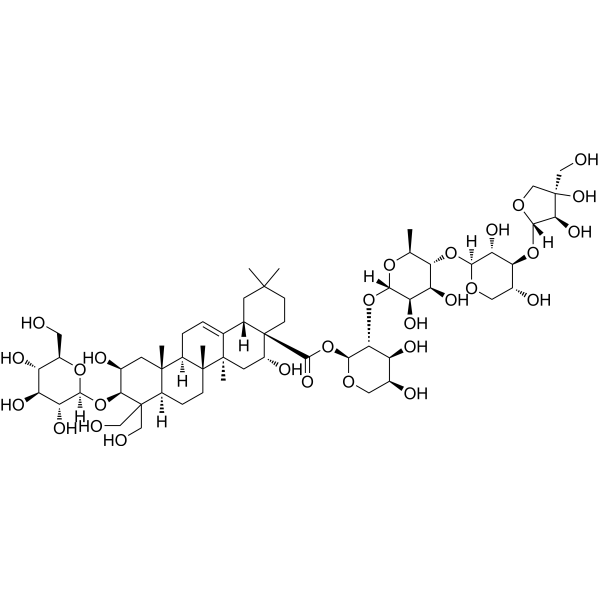
    Platycodin D
    5+ Cited Publications

    AMPK Wnt Metabolic Disease
    Platycodin D is a saponin isolated from Platycodon grandiflorus, acts as an activator of AMPKα, with anti-obesity property. WNT/β-catenin pathway mediates the anti-adipogenic effect of platycodin D .
    Platycodin D
  • HY-128400

    PARP Metabolic Disease Cancer
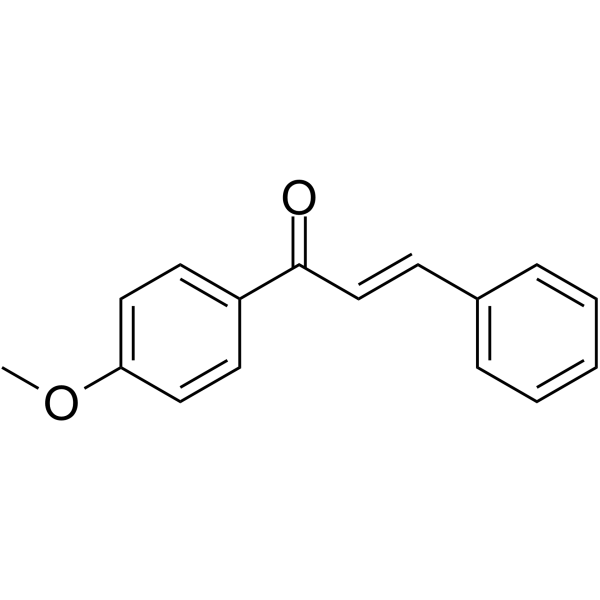
    4'-Methoxychalcone regulates adipocyte differentiation through PPARγ activation. 4'-Methoxychalcone modulates the expression and secretion of various adipokines in adipose tissue that are involved in insulin sensitivity .
    4'-Methoxychalcone
  • HY-P5081

    TGF-β Receptor Collagen Inflammation/Immunology
    Endotrophin (Mus musculus) is an adipokine, a cleavage fragment derived from Collagen VI, whose levels are elevated in adipose tissue and breast tumors of obese mice. Endotrophin (Mus musculus) activates the TGF-β signaling pathway and reduces the expression of hormone-sensitive lipase. Endotrophin (Mus musculus) induces adipogenesis, lipid accumulation, fibrosis, inflammation, angiogenesis, adipose tissue expansion, epithelial-mesenchymal transition, and insulin resistance; it also induces Cisplatin (HY-17394) resistance in cancer cells. Endotrophin (Mus musculus) can be used in research related to metabolic diseases such as obesity and type 2 diabetes, as well as cancers such as breast cancer .
    Endotrophin (Mus musculus)
  • HY-N1411R

    Reference Standards AMPK Wnt Metabolic Disease
    Platycodin D (Standard) is the analytical standard of Platycodin D. This product is intended for research and analytical applications. Platycodin D is a saponin isolated from Platycodon grandiflorus, acts as an activator of AMPKα, with anti-obesity property. WNT/β-catenin pathway mediates the anti-adipogenic effect of platycodin D .
    Platycodin D (Standard)
  • HY-128400R

    PARP Reference Standards Metabolic Disease Cancer
    4'-Methoxychalcone (Standard) is the analytical standard of 4'-Methoxychalcone. This product is intended for research and analytical applications. 4'-Methoxychalcone regulates adipocyte differentiation through PPARγ activation. 4'-Methoxychalcone modulates the expression and secretion of various adipokines in adipose tissue that are involved in insulin sensitivity .
    4'-Methoxychalcone (Standard)
  • HY-182558

    Drug Derivative AMPK IKK NF-κB Metabolic Disease
    Nandinine is an orally active derivative of Berberine (HY-N0716). Nandinine enhances AMPK activity, inhibits the activation of IKKβ/NF-κB, and regulates the phosphorylation of IRS-1. Nandinine reverses the abnormal production of adipokines, promotes insulin-mediated glucose uptake, and alleviates insulin resistance. Nandinine improves glucose tolerance and increases the insulin sensitivity index in mice. Nandinine can be used in studies related to insulin resistance .
    Nandinine
  • HY-P5081A

    TGF-β Receptor Collagen Inflammation/Immunology
    Endotrophin (Mus musculus) TFA is an adipokine, a cleavage fragment derived from Collagen VI, whose levels are elevated in adipose tissue and breast tumors of obese mice. Endotrophin (Mus musculus) TFA activates the TGF-β signaling pathway and reduces the expression of hormone-sensitive lipase. Endotrophin (Mus musculus) TFA induces adipogenesis, lipid accumulation, fibrosis, inflammation, angiogenesis, adipose tissue expansion, epithelial-mesenchymal transition, and insulin resistance; it also induces Cisplatin (HY-17394) resistance in cancer cells. Endotrophin (Mus musculus) TFA can be used in research related to metabolic diseases such as obesity and type 2 diabetes, as well as cancers such as breast cancer .
    Endotrophin (Mus musculus) TFA
  • HY-N7773

    TNF Receptor Interleukin Related Caspase SOD Neurological Disease Metabolic Disease
    Hibiscetin is an orally active anti-inflammatory, antioxidant, antihyperglycemic, hypolipidemic, hepatoprotective and neuroprotective agent. Hibiscetin reduces the levels of TNF-α, IL-1β and IL-6. Hibiscetin inhibits lipid peroxidation, reduces MDA levels, and induces the activities of antioxidant enzymes CAT, GSH and SOD. Hibiscetin lowers blood glucose, reverses reduced insulin levels, regulates adipokine levels, and reduces elevated AST and ALT levels. Hibiscetin alleviates Rotenone (HY-B1756)-induced akinesia and catalepsy, normalizes neurotransmitter levels, and modulates the activities of activated caspase 3 and BDNF. Hibiscetin can be used in the research of type 2 diabetes, Parkinson's disease and Huntington's disease .
    Hibiscetin
  • HY-N16792

    Drug Derivative Others
    Sanggenol F is a natural phenolic compound.
    Sanggenol F

Consulta en línea

Your information is safe with us. * Required Fields.

Saludo


Country or Region *

Nombre del solicitante *


Nombre de la Organizaciòn *

Department *


Direcciòn del E-mail *


Nombre del producto *

Cat. No.


Requested quantity *

Número de teléfono *


Observaciones

Consulta en línea

Inquiry Information

Nombre del producto:
Cat. No.:
Cantidad:
MCE Japan Authorized Agent:

