4 Results for "

ammonia-oxidizing bacteria

" in MedChemExpress (MCE) Product Catalog:
Products (4)

4 Results for "ammonia-oxidizing bacteria" in MCE Product Catalog:

9
9 Cited Publications
Cat. No.: HY-B0273B
CAS No.: 68-35-9
Research Areas:  

Infection

Sulfadiazine 100 µg/mL in methanol is an orally active sulfonamide antibiotic. Sulfadiazine 100 µg/mL in methanol competitively inhibits p-aminobenzoic acid in the folic-acid-metabolism cycle, inhibiting multiplication of most Gram-positive and many Gram-negative bacteria. Sulfadiazine 100 µg/mL in methanol persists in soil long-term, and exerts selective pressure for sulfonamide-resistant microbial populations. Sulfadiazine 100 µg/mL in methanol targets Toxoplasma gondii DHPS enzyme. Sulfadiazine 100 µg/mL in methanol can be used for the research of congenital toxoplasmosis and bacterial infection .
loading...
    loading...
Cat. No.: HY-W019334
CAS No.: 202842-98-6
Synonyms: 3,4-DMPP
Target:  

Bacterial

Research Areas:  

Others

3,4-Dimethylpyrazole phosphate (3,4-DMPP) is a nitrification inhibitor and microbial community regulator, whose activity is dose- and soil pH-dependent. 3,4-Dimethylpyrazole phosphate inhibits ammonia monooxygenase, ammonia-oxidizing bacteria, as well as ammonia-oxidizing archaea and nitrite-oxidizing bacteria. 3,4-Dimethylpyrazole phosphate alters the community composition of prokaryotes, fungi and ammonia-oxidizing bacteria. 3,4-Dimethylpyrazole phosphate reduces nitrate leaching, nitrous oxide emission and soil nitrate accumulation, and enhances nitrogen use efficiency and crop yield in agricultural production. 3,4-Dimethylpyrazole phosphate is applicable to agriculture-related research .
loading...
    loading...
Cat. No.: HY-163269
CAS No.: 2413282-48-9
Target:  

Bacterial

Research Areas:  

Others

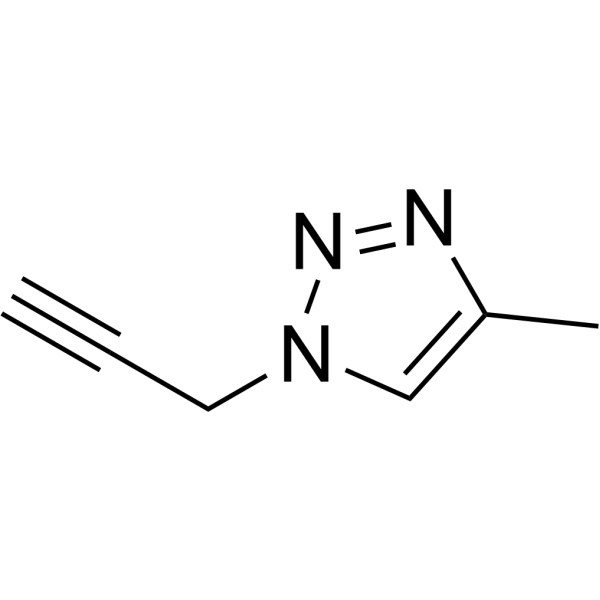
MPT is a novel and highly efficient nitrification inhibitor. MPT inhibits ammoniaoxidizing bacteria and archaea .
loading...
    loading...
Cat. No.: HY-150033
CAS No.: 105018-76-6
Sorgoleone is a photosystem II inhibitor found in sorghum. Sorgoleone binds to the QB niche of the D1 protein, inhibits photosynthetic electron transport, and does not affect photosystem I reactions. Sorgoleone reduces radicle elongation and stunts growth. Sorgoleone inhibits CO2-dependent oxygen evolution, photosynthetic O2 evolution, and mitochondrial respiration. Sorgoleone can be used as a herbicide .
loading...
    loading...

