
7 Results for "

bacterial volatiles

" in MedChemExpress (MCE) Product Catalog:
Products (7)

7 Results for "bacterial volatiles" in MCE Product Catalog:

Cat. No.: HY-W004461
CAS No.: 2949-92-0
Synonyms: MMTS
Research Areas:  

Infection

S-Methyl thiomethanesulfonate (MMTS) is a sulfur-containing volatile organic compound produced by plants and bacteria and is an effective anti-oomycete agent .
loading...
    loading...
Cat. No.: HY-N1780
CAS No.: 2033-89-8
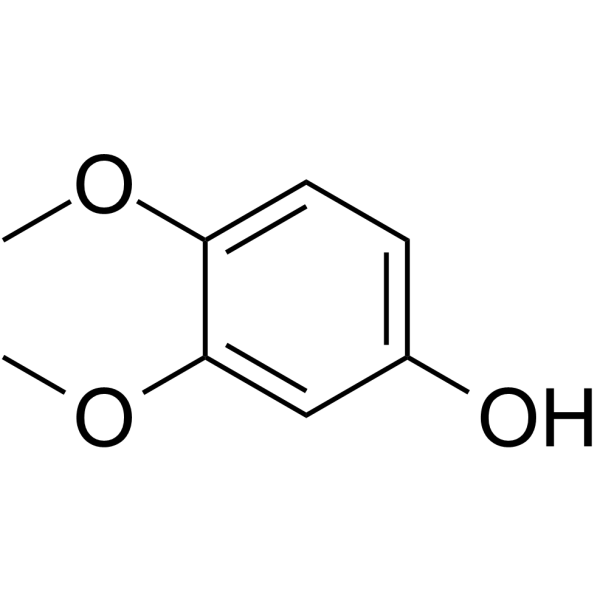
3,4-Dimethoxyphenol is a plant-derived phenylpropanoid compound and can use as a whitening agent in cosmetics. 3,4-Dimethoxyphenol exhibits broad-spectrum antimicrobial activity. 3,4-Dimethoxyphenol has tyrosinase-inhibiting activity. 3,4-Dimethoxyphenol has potent antioxidant effect isolated from the bacterial fermentation broth. 3,4-Dimethoxyphenol can be used for the study of infection .
loading...
    loading...
Cat. No.: HY-N1953
CAS No.: 8000-34-8
Synonyms: Clove leaf oil,rectified
Target:  

Bacterial

Research Areas:  

Infection Inflammation/Immunology

Clove oil (Clove leaf oil,rectified) is a volatile aromatic essential oil with antibacterial, anti-inflammatory and antioxidant activities. Clove oil disrupts the integrity of bacterial cell membranes, releases intracellular nucleic acids and proteins, and inhibits bacterial growth and reproduction. Clove oil scavenges DPPH, ABTS, superoxide anions, hydrogen peroxide and hydroxyl radicals. Clove oil reduces Fe 3+ to Fe 2+, chelates Fe 2+ and iron ions, and inhibits lipid peroxidation in linoleic acid emulsions. Clove oil acts as a natural preservative to reduce the loss of oxidation products. Clove oil can be isolated from the flowers, stems and leaves of Eugenia aromatica and Eugenia caryophyllus, which belong to the Myrtaceae family. Clove oil can be used in studies related to bacterial infection, antioxidation and preservation .
loading...
    loading...
Cat. No.: HY-W087058
CAS No.: 1012-72-2
Target:  

Topoisomerase

Research Areas:  

Infection

1,4-Di-tert-butylbenzene is a volatile compound identified in the hexane extracts of corn cob and green millet. 1,4-Di-tert-butylbenzene shows potent inhibition against receptor proteins of Bacterial type II topoisomerase (4PLB and LpxC) in docking analysis .
loading...
    loading...
Cat. No.: HY-N1780R
CAS No.: 2033-89-8
3,4-Dimethoxyphenol (Standard) is the analytical standard of Lithocholic acid. This product is intended for research and analytical applications. 3,4-Dimethoxyphenol is a plant-derived phenylpropanoid compound and can use as a whitening agent in cosmetics. 3,4-Dimethoxyphenol exhibits broad-spectrum antimicrobial activity. 3,4-Dimethoxyphenol has tyrosinase-inhibiting activity. 3,4-Dimethoxyphenol has potent antioxidant effect isolated from the bacterial fermentation broth. 3,4-Dimethoxyphenol can be used for the study of infection .
loading...
    loading...
Cat. No.: HY-W102349
CAS No.: 1534-08-3
S-Methyl thioacetate is a toxicant with fumigant activity, can be found in emissions from Bacillus oshimensis, Burkholderia gladioli, Burkholderia cepacia, and Pseudomonas oryzihabitans. S-Methyl thioacetate exerts fumigant toxicity against Caenorhabditis elegans and root-knot nematode Meloidogyne incognita. S-Methyl thioacetate functions as a bacterial volatile organic compound. S-Methyl thioacetate can be used for the research of plant-parasitic nematode infection .
loading...
    loading...
Cat. No.: HY-W658295
CAS No.: 1817-89-6
2-Ethoxypentane is an active ingredient that can be extracted from Rubus corchorifolius. 2-Ethoxypentane is a volatile component with antibacterial activity. 2-Ethoxypentane can be studied through bacterial infection .
loading...
    loading...

