8 Results for "

caffeic acid derivative

" in MedChemExpress (MCE) Product Catalog:
Products (8)

8 Results for "caffeic acid derivative" in MCE Product Catalog:

1
1 Cited Publications
Cat. No.: HY-126415
CAS No.: 122021-74-3
Purity:  99.49%
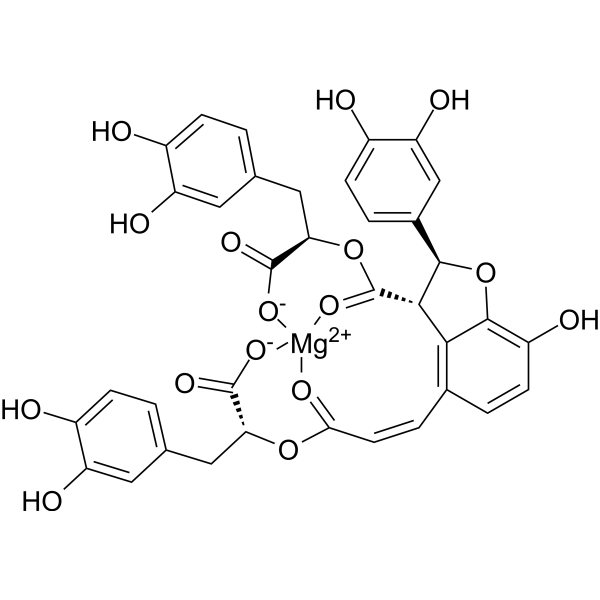
Magnesium Lithospermate B, is a derivative of caffeic acid tetramer and an inhibitor of Na+/K+ ATPase, which can be extracted from Salviae miltiorrhizae. Magnesium Lithospermate B is widely used for the research of cardiovascular diseases, and it can protect against glucose-induced intracellular oxidative damage. Magnesium Lithospermate B also suppresses neuroin?ammation and attenuates neurodegeneration .
loading...
    loading...
Cat. No.: HY-116284
CAS No.: 709-50-2
Purity:  ≥98.0%
Synonyms: Methyl β-D-glucoside
Target:  

Drug Intermediate

Research Areas:  

Others

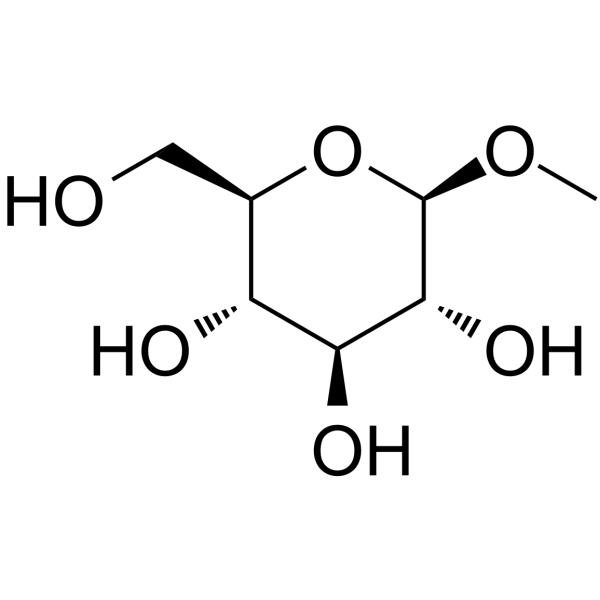
Methyl β-D-glucopyranoside (Methyl β-D-glucoside) is a model glycosyl acceptor for enzymatic glycosylation reactions. Methyl β-D-glucopyranoside participates in glycoside synthesis and can react with acyl donors such as caffeic acid esters under the catalysis of specific enzymes (such as Lipozyme TL IM) to achieve acylation modification. Methyl β-D-glucopyranoside can generate biologically active derivatives (such as 6-O-caffeoyl glucoside). Methyl β-D-glucopyranoside can be used in organic synthesis and biocatalysis research, especially the efficient enzymatic preparation of medicinal glycosides (such as Robustaside B (HY-N2720), 6-O-caffeoyl salidroside) .
loading...
    loading...
Cat. No.: HY-N11229
CAS No.: 22020-28-6
Synonyms: caffeic acid butyl ester
Butyl caffeate (Caffeic acid butyl ester) is a caffeic acid derivative with antioxidant activity and lipophilicity (DPPH IC50 = 14.1 μM). Butyl caffeate protects neuronal PC12 cells against oxidative stress. Butyl caffeate can be used for oxidative stress related and neurodegenerative diseases research .
loading...
    loading...
Cat. No.: HY-N0172S
CAS No.: 1185245-82-2
Synonyms: 3,4-Dihydroxycinnamic acid-13C3
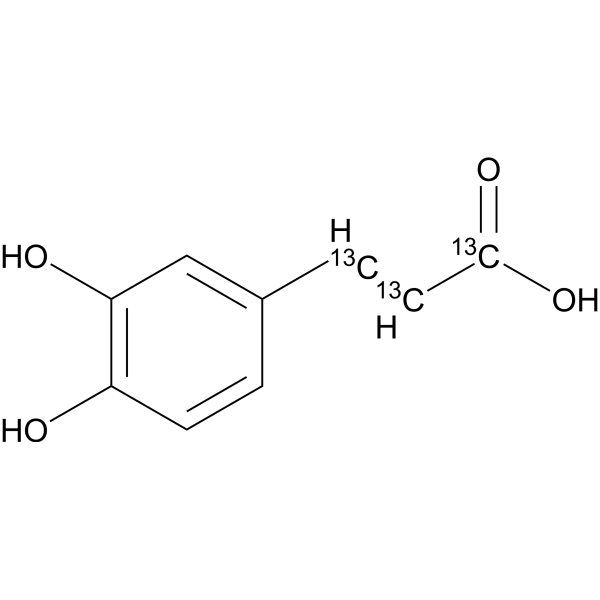
Caffeic acid- 13C3 is an 13C labeled caffeic acid. Caffeic acid is a phytonutrient belonging to the flavonoids. Caffeic acid and its derivatives, are potential antimicrobial agents, chronic infection induced by microbes such as bacteria, fungi, and viruses .
loading...
    loading...
Cat. No.: HY-N17665
CAS No.: 205114-65-4
Cimicifugic acid A is a cytotoxic caffeic acid derivative that can be isolated from the rhizomes of Cimicifuga heracleifolia. Cimicifugic acid A shows cytotoxic activity against cancer cells, and increases expression of cleaved PARP, thereby exhibiting pro-apoptotic activity. Cimicifugic acid A can be used for colon cancer research .
loading...
    loading...
Cat. No.: HY-W095774
CAS No.: 127033-74-3
Target:  

MMP

Research Areas:  

Cancer

(E)-N-(3-Methoxyphenyl) cinnamamide (Compound 5h) is a weakly selective inhibitor of MMP-2 and MMP-9, with weak inhibitory activity against hMMP-2 and hMMP-9, showing IC50 values of 1674.81 nM and 1658.63 nM, respectively, and low selectivity for MMP-1. (E)-N-(3-Methoxyphenyl) cinnamamide is applicable for cancer research .
loading...
    loading...
Cat. No.: HY-N18680
CAS No.: 84082-61-1
Category:  

Extract

Target:  

Others

Melissa officinalis extract is rich in various bioactive compounds, such as citronellol, geraniol, glycosides, caffeic acid derivatives, flavonoids, and triterpenoids. Melissa officinalis extract can be used in research on conditions such as nervous tension, anxiety, insomnia, and menstrual disorders.
loading...
    loading...
Cat. No.: HY-179699
Target:  

Caspase Apoptosis

Research Areas:  

Cancer

Procaspase-3 activator 1 is a potent procaspase-3 activator. Procaspase-3 activator directly activates procaspase-3 through zinc chelation, thereby inducing apoptosis and inhibiting cancer cell proliferation. Procaspase-3 activator 1 can be used for the research of non-small cell lung cancer (NSCLC) and melanoma .
loading...
    loading...

