1. Search Result
Search Result
Results for "

fibrotic disorders

" in MedChemExpress (MCE) Product Catalog:
Cat. No. Product Name Target Research Areas Chemical Structure
  • HY-110279
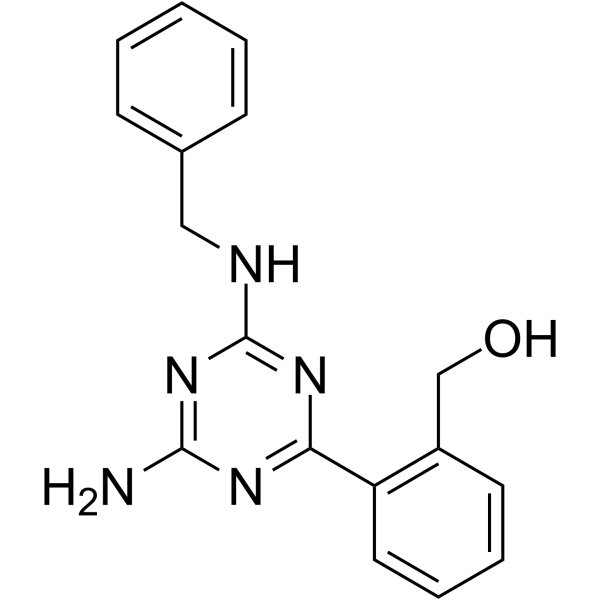
    Ogerin
    2 Publications Verification

    GPR68 Neurological Disease
    Ogerin, a chemical probe, is a selective GPR68 positive aliasing modulator (PAM) (pEC50=6.83) with a moderate antagonistic effect on A2A (Ki=220 nM). Ogerin inhibits the fear conditioning reflex in mice and also inhibits TGF-β-induced myofibroblast differentiation of fibroblasts from multiple organ systems. Ogerin can be used in the studies of fibrotic diseases and neurological disorders .
    Ogerin
  • HY-47888

    Integrin Inflammation/Immunology
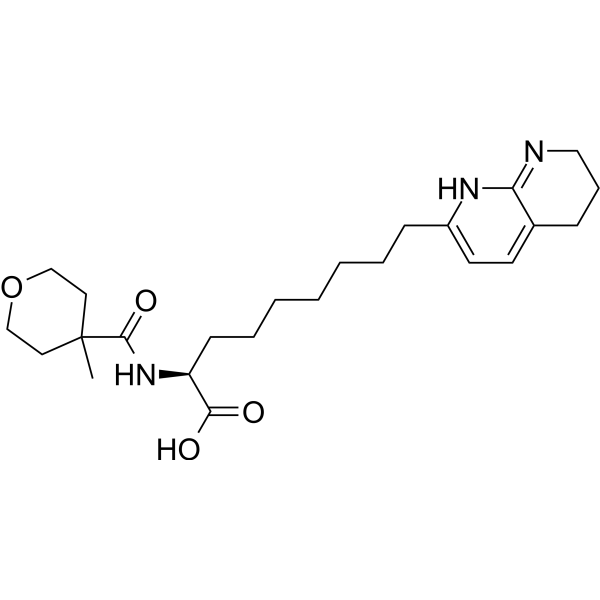
    PLN-1474 (compound 1) is an orally active and selective ανβ1 integrin inhibitor with an IC50 value of <50 nM. PLN-1474 reduces levels of pSMAD3/SMAD3 in liver, hepatic collagen gene expression and hepatic OHP concentration in liver fibrosis mouse model. PLN-1474 can be used for the research of preventing, delaying or researching a fibrotic or cirrhotic disease or disorder.
    PLN-1474
  • HY-167208

    Discoidin Domain Receptor p38 MAPK Inflammation/Immunology Cancer
    SR-302, a chemical probe, is a potent and selectivity DDR/p38 inhibitor, with IC50 values of 0.125, 0.023 and 0.018 μM for p38α, DDR1 and DDR2, respectively. SR-302 can be used for the research of fibrotic disorders, such as renal and pulmonary fibrosis, atherosclerosis, and various forms of cancer .
    SR-302
  • HY-178192

    mTOR Autophagy Neurological Disease Metabolic Disease Inflammation/Immunology Cancer
    mTORC1-IN-3 is a potent and selective mTORC1 inhibitor with an IC50 of 26.38 μM . mTORC1-IN-3 selectively inhibits the phosphorylation of mTORC1 substrates and does not without affect the phosphorylation of mTORC2 substrate. mTORC1-IN-3 can reduce cellular lipid accumulation and induce autophagy. mTORC1-IN-3 can be used for the researches of cancer, immunology, metabolic and neurological disease, such as diabetes and Alzheimer’s disease .
    mTORC1-IN-3
  • HY-176213

    JNK Neurological Disease
    JNK2/3-IN-1 (Compound 56d) is an irreversible covalent inhibitor of c-Jun N-terminal kinases 2/3 (JNK2/3) with IC50 values of 830 and 1909 nM, respectively. JNK2/3-IN-1 is promising for research of neurodegenerative diseases (e.g., Parkinson’s, Alzheimer’s) and fibrotic disorders .
    JNK2/3-IN-1
  • HY-178477

    G protein-coupled Bile Acid Receptor 1 TGF-β Receptor MMP Metabolic Disease Inflammation/Immunology
    LIFR/GPBAR1 modulator 1 is an orally active, potent GPBAR1 agonist (EC50 = 0.2 μM) and LIFR inhibitor (IC50 = 7.9 μM). LIFR/GPBAR1 modulator 1 upregulates leukaemia inhibitory factor (LIF)-mediated mRNA expression of LIFR and GPBAR1 and significantly reduces the expression of pro-fibrosis markers (COL1A1, ASMA, and TGFβ), and reduces TIMP1 expression and increases MMP9 expression. LIFR/GPBAR1 modulator 1 can be used for the study of human fibrotic disorders .
    LIFR/GPBAR1 modulator 1
  • HY-123958

    ROCK β-catenin Collagen Cardiovascular Disease Neurological Disease Inflammation/Immunology
    SB772077B is a ROCK inhibitor. SB772077B has an anti-inflammatory activity and enhances aqueous outflow facility (OF) by inactivating RhoA/ROCK signal pathway. SB772077B significantly reduces the mRNA level of β-catenin and protein level of fibrotic markers, such as vinculin, fibronectin, collagen 1 A and vimentin. SB772077B also has vasodialatory activity and decreases pulmonary and systemic blood pressure. SB772077B can be used for glaucoma research and pulmonary hypertensive disorder research .
    SB772077B
  • HY-183006

    Ligands for Target Protein for PROTAC JNK Others
    JNK1 ligand-1 is a JNK1 ligand that can be used for the synthesis of PROTACs, such as PROTAC JNK1 degrader-1 (HY-182796) .
    JNK1 ligand-1
  • HY-182921

    GPR84 Enterovirus Inflammation/Immunology
    GPR84 antagonist 11 is a highly selective GPR84 antagonist, with a human pA2 of 8.41 and a pKi of 8.16. GPR84 antagonist 11 competitively inhibits the binding of agonists to the orthosteric site of GPR84 and has improved druglike properties, though its metabolic stability still requires optimization. GPR84 antagonist 11 can be used in the research of autoimmune diseases and fibrotic diseases .
    GPR84 antagonist 11
  • HY-185379

    STING Inflammation/Immunology
    STING antagonist-3 is a potent STING antagonist with an IC50 of 2.3 nM against human wild-type STING. STING antagonist-3 inhibits human wild-type STING and the gain-of-function STING mutants N154S and V155M. STING antagonist-3 suppresses IFN‑α2a production in stimulated human whole blood. STING antagonist-3 inhibits IP-10 production in activated human dermal microvascular endothelial cells (HMVEC-d). STING antagonist-3 can be used for the research of autoimmune diseases, autoinflammatory diseases, interferonopathies, and fibrotic disorders .
    STING antagonist-3
  • HY-182014

    LXR Cardiovascular Disease Metabolic Disease
    TLC-2716 is an orally available, gut- and liver-restricted inhibitor against LXRα and LXRβ, with EC50 values of 7 nM and 15 nM, respectively. TLC-2716 represses LXRα/β transcriptional activity, downregulates genes involved in lipogenesis, lipid absorption and lipoprotein metabolism, and preserves peripheral reverse cholesterol transport. TLC-2716 reduces lipid accumulation, suppresses inflammation and fibrotic gene expression, enhances triglyceride-rich lipoprotein clearance, and improves glucose homeostasis and insulin sensitivity. TLC-2716 lowers serum and hepatic triglycerides, plasma cholesterol and other atherogenic lipid profiles in experimental models and humanized liver mice. TLC-2716 can be used for the research of dyslipidemia and related cardiometabolic disorders .
    TLC-2716
  • HY-182306

    VEGFR Cardiovascular Disease
    VEGFR-2 ligand-1, Sorafenib (HY-10201) derivative, is a vascular endothelial growth factor receptor 2 (VEGFR2) ligand. VEGFR-2 ligand-1 binds to the ATP-binding pocket of VEGFR2, forms hydrophobic contacts and hydrogen bonds with key binding-site residues. VEGFR-2 ligand-1 can be used for the research angiogenesis-related pathologies .
    VEGFR-2 ligand-2

Inquiry Online

Your information is safe with us. * Required Fields.

Salutation


Country or Region *

Applicant Name *


Organization Name *

Department *


Email Address *


Product Name *

Cat. No.


Requested quantity *

Phone Number *


Remarks

Inquiry Online

Inquiry Information

Product Name:
Cat. No.:
Quantity:
MCE Japan Authorized Agent:

