7 Results for "

hallucinogenic effects

" in MedChemExpress (MCE) Product Catalog:
Products (7)

7 Results for "hallucinogenic effects" in MCE Product Catalog:

Cat. No.: HY-N2510
CAS No.: 607-91-0
Synonyms: Myristicine
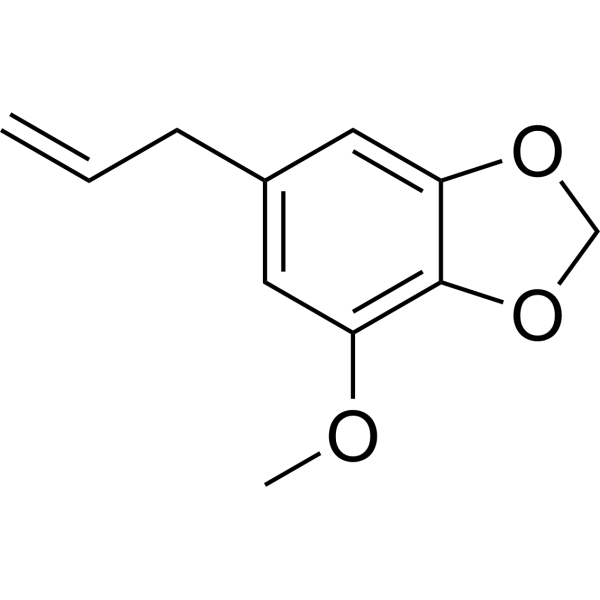
Myristicine is an orally bioavailable serotonin receptor antagonist and weak monoamine oxidase (MAO) inhibitor. Myristicine also exerts anti-cancer effects on gastric cancer cells by inhibiting the EGFR/ERK signaling pathway. Myristicine is the main component of nutmeg essential oil and has anti-cancer, anti-proliferative, antibacterial, anti-inflammatory and apoptosis-inducing effects. Myristicine abuse can produce hallucinogenic effects, organ damage, etc .
loading...
    loading...
Cat. No.: HY-168809
CAS No.: 21420-59-7
Research Areas:  

Neurological Disease

Norbaeocystin is an intermediate/minor metabolite naturally present in the psilocybin biosynthetic pathway of hallucinogenic mushrooms (Psilocybe spp.). Norbaeocystin has weak or no affinity for the serotonin 2A (5-HT2A) receptor and does not induce receptor activation. Norbaeocystin is rapidly metabolized by monoamine oxidase, and thus does not participate in centrally mediated psychedelic effects. Norbaeocystin can be used for studies on biological pathways associated with hallucinogenic effects .
loading...
    loading...
Cat. No.: HY-N2510R
CAS No.: 607-91-0
Synonyms: Myristicine (Standard)
Myristicin (Standard) is the analytical standard of Myristicin. This product is intended for research and analytical applications. Myristicine is an orally bioavailable serotonin receptor antagonist and weak monoamine oxidase (MAO) inhibitor. Myristicine also exerts anti-cancer effects on gastric cancer cells by inhibiting the EGFR/ERK signaling pathway. Myristicine is the main component of nutmeg essential oil and has anti-cancer, anti-proliferative, antibacterial, anti-inflammatory and apoptosis-inducing effects. Myristicine abuse can produce hallucinogenic effects, organ damage, etc .
loading...
    loading...
Cat. No.: HY-135222
CAS No.: 132980-17-7
Synonyms: 5-Methoxy-6-methyl-2-aminoindan hydrochloride
Target:  

5-HT Receptor

Research Areas:  

Neurological Disease

MMAI (5-Methoxy-6-methyl-2-aminoindan) hydrochloride is a selective serotonin releaser that does not produce psychoactive or hallucinogenic effects in the context of drug discrimination in rats. MMAI hydrochloride induces a behavioral syndrome in rats, including hypokinesia with freezing, spinning, Straub tail, flat posture, and reduced sleep time .
loading...
    loading...
Cat. No.: HY-N15291
CAS No.: 611228-04-7
Divinatorin A is a diterpenoid extracted from Salvia divinorum. Divinatorin A has hallucinogenic properties .
loading...
    loading...
Cat. No.: HY-W680886
CAS No.: 152623-93-3
6-APDB is a class of monoamine neurotransmitter releaser and Monoamine Transporter modulator that exerts selective effects on human monoamine transporters and acts as a partial agonist at 5-HT2 family receptors. For NET, 6-APDB has an IC50 of 0.56 μM and a Ki of 18 μM; for SERT, it has an IC50 of 2.3 μM and a Ki of 23 μM; for DAT, it has an IC50 of 33 μM and a Ki of >30 μM, and affinity for rat and mouse TAAR1, with Ki values of 1.0 μM and 0.21 μM, respectively. 6-APDB inhibits norepinephrine and 5-HT reuptake, mediates the release of three types of monoamine neurotransmitters, shows a dose-dependent biphasic locomotor effect in mice, and fully substitutes the discriminative stimulus effect of MDMA. 6-APDB shows no significant cytotoxicity at high concentrations, and possesses empathogenic psychoactivity, potential hallucinogenic effects, and behavioral effects associated with intermittent abuse .
loading...
    loading...
Cat. No.: HY-N20747
CAS No.: 28363-70-4
Synonyms: 4-Hydroxy-N-methyltryptamine; 4-HO-NMT
Norpsilocin (4-hydroxy-N-methyltrypt amine; 4-HO-NMT) is a natural tryptamine alkaloid isolated from the hallucinogenic mushroom Psilocybe cubensis. Norpsilocin activates human 5-HT2 receptors (5-HT2A: EC50 = 8.4 nM; 5-HT2B = 12.8 nM; 5-HT2C = 39.6 nM) and displays binding affinity toward 5-HT1 receptors (5-HT1B: Ki = 212 nM; 5-HT1D = 48.9 nM; 5-HT1E = 81.7 nM). Norpsilocin induces β-arrestin recruitment at the 5-HT1B receptor. Norpsilocin fails to produce psychedelic-like effects in mice, whereas high doses can induce hypothermia in vivo. Norpsilocin acts as an important research tool for exploring the structure–activity relationship of tryptamine hallucinogens and the pharmacology of serotonin receptors .
loading...
    loading...

