12 Results for "

herbicide resistance

" in MedChemExpress (MCE) Product Catalog:
Products (12)

12 Results for "herbicide resistance" in MCE Product Catalog:

Cat. No.: HY-118742
CAS No.: 156963-66-5
Purity:  99.25%
Research Areas:  

Others

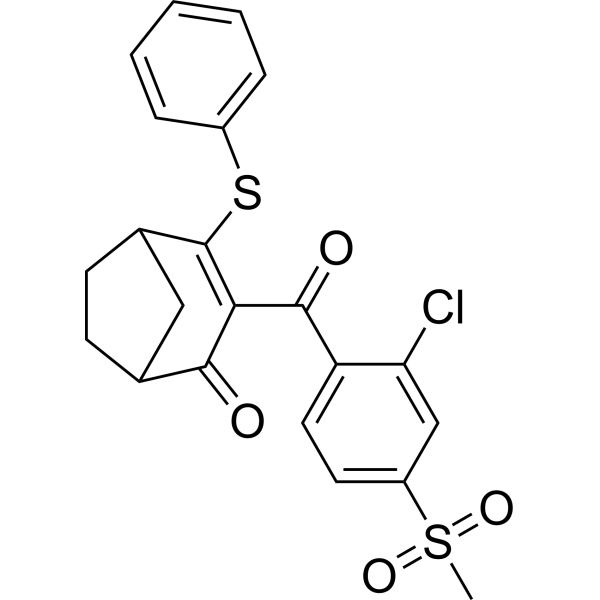
Benzobicyclon is a 4-HPPD inhibitor and herbicide that reacts with water to form a hydrolysate of the active herbicide benzobicycline, causing bleaching and death of weeds. Benzobicyclon is effective against grass, sedge and broadleaf weeds. Benzobicyclon effectively targets sulfonylurea herbicide-resistant biotypes as well as wild-type weeds .
loading...
    loading...
Cat. No.: HY-136633R
CAS No.: 447399-55-5
Research Areas:  

Others

Pyroxasulfone (Standard) is the analytical standard of Pyroxasulfone. This product is intended for research and analytical applications. Pyroxasulfone is a broad-spectrum pyrazole herbicide used primarily for all-season residual weed control in corn and soybeans. Pyroxasulfone is active against a variety of annual grasses and some broad-leaved weeds, and can be absorbed through roots and stems to inhibit early seedling growth of sensitive plants. Pyroxasulfone can be used to study herbicide effects and weed resistance .
loading...
    loading...
Cat. No.: HY-118742R
CAS No.: 156963-66-5
Research Areas:  

Others

Benzobicyclon (Standard) is the analytical standard of Benzobicyclon. This product is intended for research and analytical applications. Benzobicyclon is a 4-HPPD inhibitor and herbicide that reacts with water to form a hydrolysate of the active herbicide benzobicycline, causing bleaching and death of weeds. Benzobicyclon is effective against grass, sedge and broadleaf weeds. Benzobicyclon effectively targets sulfonylurea herbicide-resistant biotypes as well as wild-type weeds .
loading...
    loading...
Cat. No.: HY-129300
CAS No.: 52888-80-9
Target:  

Endogenous Metabolite

Research Areas:  

Others

Prosulfocarb is a herbicide with a rapidly growing use trend. Prosulfocarb is used in winter cereals to help address the problem of increasing biotic resistance of weeds to certain pesticides. Environmental and food effects of prosulfocarb have been observed, and its transfer pattern from target crops to non-target areas has been studied. The volatility effect of prosulfocarb is an important factor explaining the inefficiency of isolated area contamination and marginal protection against residue spread .
loading...
    loading...
Cat. No.: HY-129300R
CAS No.: 52888-80-9
Research Areas:  

Others

Prosulfocarb (Standard) is the analytical standard of Prosulfocarb. This product is intended for research and analytical applications. Prosulfocarb is a herbicide with a rapidly growing use trend. Prosulfocarb is used in winter cereals to help address the problem of increasing biotic resistance of weeds to certain pesticides. Environmental and food effects of prosulfocarb have been observed, and its transfer pattern from target crops to non-target areas has been studied. The volatility effect of prosulfocarb is an important factor explaining the inefficiency of isolated area contamination and marginal protection against residue spread .
loading...
    loading...
Cat. No.: HY-N7176R
CAS No.: 22688-78-4
Synonyms: Kaempferol-3-glucuronide (Standard); Kaempferol-3-O-glucuronide (Standard)
Prosulfocarb (Standard) is the analytical standard of Prosulfocarb. This product is intended for research and analytical applications. Prosulfocarb is a herbicide with a rapidly growing use trend. Prosulfocarb is used in winter cereals to help address the problem of increasing biotic resistance of weeds to certain pesticides. Environmental and food effects of prosulfocarb have been observed, and its transfer pattern from target crops to non-target areas has been studied. The volatility effect of prosulfocarb is an important factor explaining the inefficiency of isolated area contamination and marginal protection against residue spread .
loading...
    loading...
Cat. No.: HY-129300S
Synonyms: S-Benzyl dipropylthiocarbamate-d7
Prosulfocarb-d7 (S-Benzyl dipropylthiocarbamate-d7) is deuterium labeled Prosulfocarb. Prosulfocarb is a herbicide with a rapidly growing use trend. Prosulfocarb is used in winter cereals to help address the problem of increasing biotic resistance of weeds to certain pesticides. Environmental and food effects of prosulfocarb have been observed, and its transfer pattern from target crops to non-target areas has been studied. The volatility effect of prosulfocarb is an important factor explaining the inefficiency of isolated area contamination and marginal protection against residue spread .
loading...
    loading...
Cat. No.: HY-184215
CAS No.: 2920564-49-2
Target:  

Herbicide

Research Areas:  

Others

Z2768276635 is an Arabidopsis thaliana acetohydroxyacid synthase (AHAS) inhibitor with a Ki of 0.12 μM, and a Kd of 0.565 μM.Z2768276635 forms a covalent bond with the Ser653 residue of AtAHAS to inhibit catalytic activity.Z2768276635 can be used for the research of weed herbicide resistance .
loading...
    loading...
Cat. No.: HY-16947
CAS No.: 138164-12-2
Target:  

Herbicide

Research Areas:  

Others

Butroxydim is a cyclohexanedione acetyl-coenzyme A carboxylase (ACCase)-inhibiting herbicide. Butroxydim controls herbicide-resistant Hordeum leporinum populations with resistance to other ACCase-inhibiting herbicides .
loading...
    loading...
Cat. No.: HY-116945
CAS No.: 957-51-7
Target:  

Endogenous Metabolite

Research Areas:  

Others

Diphenamid is a chemical compound that exhibits herbicide activity. Diphenamid acts by inhibiting the enzyme acetyl-CoA carboxylase. Diphenamid has shown resistance as a model for mimicking organic pollutants in wastewater treatment processes, especially in the presence of multiple anions. The degradation of diphenamid is significantly affected by certain inorganic ions, such as chromium (VI) and nitrogen oxides. Diphenamid shows changes in toxicity with longer treatment times, and the results of toxicity tests on selected algae indicate higher toxicity at 240 minutes of treatment .
loading...
    loading...
Cat. No.: HY-185314
CAS No.: 1848207-89-5
Research Areas:  

Others

Metproxybicyclone is a graminaceous herbicide. Metproxybicyclone also acts as an ACCase inhibitor, with an IC50 of 0.19 μM against Lolium multiflorum. Metproxybicyclone inhibits eukaryotic homomeric acetyl-CoA carboxylase, which catalyzes the first key step in fatty acid biosynthesis of graminaceous plants. Metproxybicyclone controls susceptible graminaceous weeds as well as graminaceous weed populations with target-site, non-target-site, and ACCase D2078G target-site resistance mechanisms. Metproxybicyclone is safe to dicotyledonous crops and is suitable for pre-plant burndown applications .
loading...
    loading...
Cat. No.: HY-N16818
CAS No.: 1242672-31-6
9-epi-Blumenol C is a C13-norisoprenoid (carotenoid derivative) compound with allelopathic and antifungal activities, and can regulate plant growth. The IC50 values ??of 9-epi-Blumenol C for watercress roots and hypocotyls are 2780 μM and 2240 μM, respectively, and for perennial ryegrass roots and coleoptiles are 3290 μM and 2950 μM, respectively. 9-epi-Blumenol C exhibits allelopathic activity through a mechanism involving direct inhibition of plant growth and degradation of arbuscular mycorrhizal fungi (AMF) colonization, thereby weakening nutrient uptake and stress resistance in neighboring plants. 9-epi-Blumenol C can be used in herbicide development and research related to plant competition mechanisms. 9-epi-Blumenol C can be obtained from the dried fallen leaves of Metasequoia glyptostroboides (a plant of the cypress family, genus Metasequoia) through extraction with 70% methanol and purification by ethyl acetate extraction .
loading...
    loading...
  • 1

