
7 Results for "

hormone-sensitive cancers

" in MedChemExpress (MCE) Product Catalog:
Products (7)

7 Results for "hormone-sensitive cancers" in MCE Product Catalog:

9
9 Cited Publications
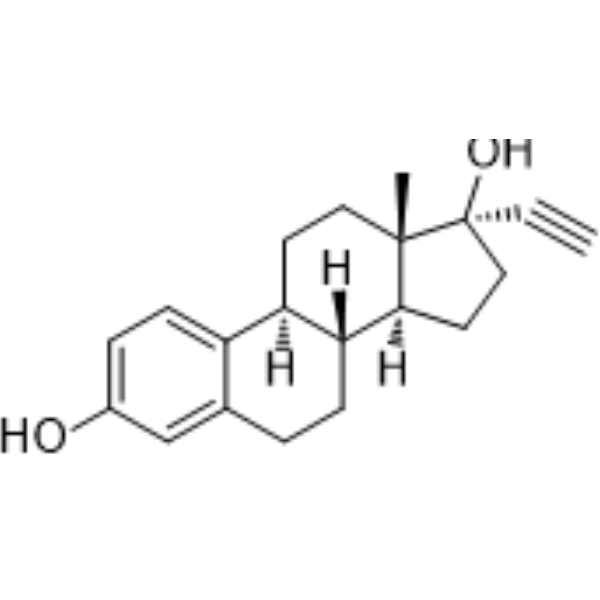
Cat. No.: HY-B0216
CAS No.: 57-63-6
Synonyms: Ethynyl estradiol; 17α-Ethynylestradiol
Ethinylestradiol is an orally active steroidal estrogen. Ethinylestradiol is widely used in research on menopausal symptoms, gynecological conditions, and certain hormone-sensitive cancers .
loading...
    loading...
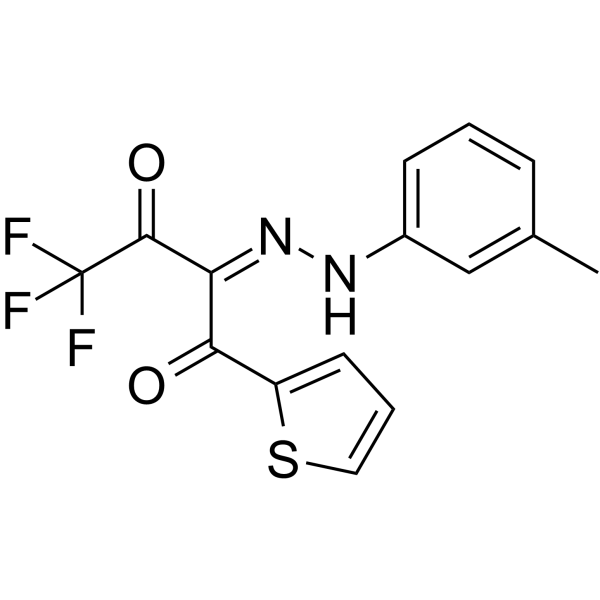
Cat. No.: HY-110390
CAS No.: 263890-70-6
Purity:  99.61%
GR148672X is an inhibitor of carboxylesterase 1 (CES1) and hepatic microsomal triglyceride hydrolase (TGH). GR148672X blocks the catalytic activity of CES1, impairs the functions of triglyceride and cholesteryl ester lipase, reduces triglyceride mobilization and secretion, and decreases apolipoprotein B-100 secretion in primary rat hepatocytes. Under low-glucose conditions, GR148672X inhibits the survival of colorectal cancer cells by reducing free fatty acid availability, inducing toxic triglyceride accumulation, ROS production, mitochondrial damage, ferroptosis and apoptosis. GR148672X can be used in studies related to colorectal cancer and atherosclerosis .
loading...
    loading...
Cat. No.: HY-P6825
CAS No.: 2790413-59-9
Synonyms: PNT2001; LY4181530; PSMA-62
Target:  

PSMA

Research Areas:  

Cancer

PNT2001 (LY4181530) is a high-affinity PSMA-targeted radiopharmaceutical ligand precursor. natLu-PNT2001 has an IC50 of 3.1 nM against PSMA. PNT2001 is applicable for PSMA targeting, radiopharmaceutical ligand delivery, and prostate cancer-related research .
loading...
    loading...
Cat. No.: HY-129593
CAS No.: 135215-95-1
Target:  

GnRH Receptor

Research Areas:  

Endocrinology Cancer

A-75998 is an antagonist of luteinizing hormone-releasing hormone (LHRH). A-75998 can be used in the research of diseases such as hormone-sensitive cancers and endometriosis .
loading...
    loading...
Cat. No.: HY-P5081
CAS No.: 1678414-54-4
Research Areas:  

Inflammation/Immunology

Endotrophin (Mus musculus) is an adipokine, a cleavage fragment derived from Collagen VI, whose levels are elevated in adipose tissue and breast tumors of obese mice. Endotrophin (Mus musculus) activates the TGF-β signaling pathway and reduces the expression of hormone-sensitive lipase. Endotrophin (Mus musculus) induces adipogenesis, lipid accumulation, fibrosis, inflammation, angiogenesis, adipose tissue expansion, epithelial-mesenchymal transition, and insulin resistance; it also induces Cisplatin (HY-17394) resistance in cancer cells. Endotrophin (Mus musculus) can be used in research related to metabolic diseases such as obesity and type 2 diabetes, as well as cancers such as breast cancer .
loading...
    loading...
Cat. No.: HY-N16404
CAS No.: 2416222-17-6
Asperindole A is an indole-diterpene alkaloid. Asperindole A can be isolated from fungus Aspergillus sp. KMM 4676. Asperindole A induces Apoptosis. Asperindole A exerts cytotoxic activity against hormone-resistant and hormone-sensitive prostate cancer cells .
loading...
    loading...
Cat. No.: HY-P5081A
Research Areas:  

Inflammation/Immunology

Endotrophin (Mus musculus) TFA is an adipokine, a cleavage fragment derived from Collagen VI, whose levels are elevated in adipose tissue and breast tumors of obese mice. Endotrophin (Mus musculus) TFA activates the TGF-β signaling pathway and reduces the expression of hormone-sensitive lipase. Endotrophin (Mus musculus) TFA induces adipogenesis, lipid accumulation, fibrosis, inflammation, angiogenesis, adipose tissue expansion, epithelial-mesenchymal transition, and insulin resistance; it also induces Cisplatin (HY-17394) resistance in cancer cells. Endotrophin (Mus musculus) TFA can be used in research related to metabolic diseases such as obesity and type 2 diabetes, as well as cancers such as breast cancer .
loading...
    loading...

