
8 Results for "

ischemic myocardial tissue

" in MedChemExpress (MCE) Product Catalog:
Products (8)

8 Results for "ischemic myocardial tissue" in MCE Product Catalog:

1
1 Cited Publications
Cat. No.: HY-W016409
CAS No.: 3943-89-3
Synonyms: Protocatechuic acid ethyl ester
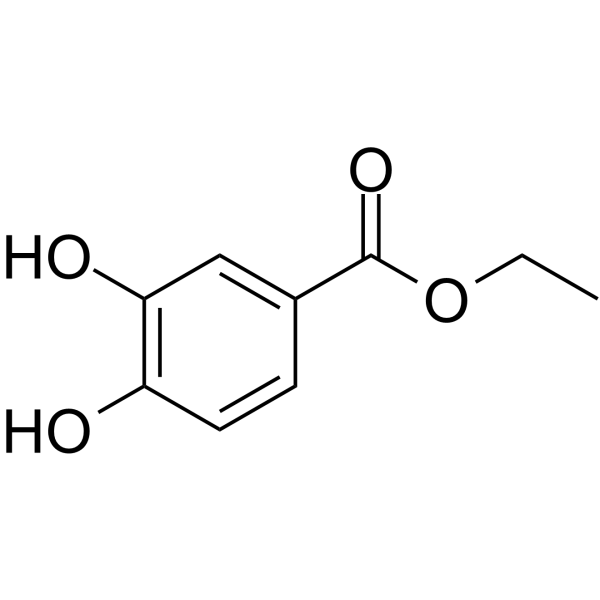
Ethyl 3,4-dihydroxybenzoate (Protocatechuic acid ethyl ester) is an orally effective, blood-brain barrier-permeable, competitive prolyl hydroxylase (PHD) inhibitor that inhibits the hydroxylation modification of hypoxia-inducible factor (HIF) by PHD. Ethyl 3,4-dihydroxybenzoate stabilizes HIF-1α by inhibiting PHD, activates downstream pathways to induce autophagy and apoptosis of tumor cells, and regulates inflammatory responses, inhibits the NF-κB pathway, improves vascular permeability, and promotes osteoblast differentiation. Ethyl 3,4-dihydroxybenzoate has anti-tumor, anti-hypoxic injury, and bone metabolism regulation effects. It can also be used in the research of cardiovascular protection (such as reducing myocardial ischemic damage), bone tissue engineering (promoting osteogenesis/inhibiting osteoclast differentiation), and prevention and treatment of high-altitude cerebral edema .
loading...
    loading...
Cat. No.: HY-108865
CAS No.: 105857-23-6
Synonyms: Actilyse; Activase
Target:  

Ser/Thr Protease

Research Areas:  

Cardiovascular Disease Cancer

Alteplase (Actilyse; Activase), a tissue plasminogen activator prepared by recombination, is a thrombolytic agent that play important roles in acute ischemic stroke, pulmonary embolism, acute myocardial infarction, and occluded catheters .
The product size below only indicate the effective content of Alteplase. The ratio of Alteplase effective content : total content = 1:46-1:50. The actual ratio depends on the batch.)
loading...
    loading...
Cat. No.: HY-172687
Target:  

Liposome

Research Areas:  

Cardiovascular Disease

DSPE-PEG2000-CSTSMLKAC is a PEG compound which composed of DSPE and a peptide (CSTSMLKAC). DSPE-PEG2000-CSTSMLKAC can be used for drug delivery DSPE-PEG2000-CSTSMLKAC enables targeted delivery of associated nanoliposomes to ischemic myocardial cells .
loading...
    loading...
Cat. No.: HY-120148A
CAS No.: 194542-56-8
Purity:  ≥99.0%
SM19712 is an orally active, selective endothelin converting enzyme (ECE) inhibitor. SM19712 inhibits conversion of big ET-1 to ET-1. SM19712 attenuates colonic angiogenesis, tissue injury, inflammation, without altering colon shortening or myeloperoxidase levels in mice. SM19712 can be used for the research of inflammatory bowel disease (colitis), ischemic acute renal failure, acute myocardial infarction, and myocardial ischemia/reperfusion injury .
loading...
    loading...
Cat. No.: HY-120148
CAS No.: 194542-49-9
SM19712 free acid is an orally active, selective endothelin converting enzyme (ECE) inhibitor. SM19712 free acid inhibits conversion of big ET-1 to ET-1. SM19712 free acid attenuates colonic angiogenesis, tissue injury, inflammation, without altering colon shortening or myeloperoxidase levels in mice. SM19712 free acid can be used for the research of inflammatory bowel disease (colitis), ischemic acute renal failure, acute myocardial infarction, and myocardial ischemia/reperfusion injury .
loading...
    loading...
Cat. No.: HY-W016409R
CAS No.: 3943-89-3
Synonyms: Protocatechuic acid ethyl ester (Standard)
Ethyl 3,4-dihydroxybenzoate (Standard) (Protocatechuic acid ethyl ester (Standard)) is the analytical standard of Ethyl 3,4-dihydroxybenzoate (HY-W016409). This product is intended for research and analytical applications. Ethyl 3,4-dihydroxybenzoate (Protocatechuic acid ethyl ester) is an orally effective, blood-brain barrier-permeable, competitive prolyl hydroxylase (PHD) inhibitor that inhibits the hydroxylation modification of hypoxia-inducible factor (HIF) by PHD. Ethyl 3,4-dihydroxybenzoate stabilizes HIF-1α by inhibiting PHD, activates downstream pathways to induce autophagy and apoptosis of tumor cells, and regulates inflammatory responses, inhibits the NF-κB pathway, improves vascular permeability, and promotes osteoblast differentiation. Ethyl 3,4-dihydroxybenzoate has anti-tumor, anti-hypoxic injury, and bone metabolism regulation effects. It can also be used in the research of cardiovascular protection (such as reducing myocardial ischemic damage), bone tissue engineering (promoting osteogenesis/inhibiting osteoclast differentiation), and prevention and treatment of high-altitude cerebral edema .
loading...
    loading...
Cat. No.: HY-W778057
CAS No.: 1330195-40-8
Synonyms: Protocatechuic acid ethyl ester-13C3
Ethyl 3,4-Dihydroxybenzoate- 13C3 (Protocatechuic acid ethyl ester- 13C3) is the 13C-labeled Ethyl 3,4-dihydroxybenzoate (HY-W016409). Ethyl 3,4-dihydroxybenzoate (Protocatechuic acid ethyl ester) is an orally effective, blood-brain barrier-permeable, competitive prolyl hydroxylase (PHD) inhibitor that inhibits the hydroxylation modification of hypoxia-inducible factor (HIF) by PHD. Ethyl 3,4-dihydroxybenzoate stabilizes HIF-1α by inhibiting PHD, activates downstream pathways to induce autophagy and apoptosis of tumor cells, and regulates inflammatory responses, inhibits the NF-κB pathway, improves vascular permeability, and promotes osteoblast differentiation. Ethyl 3,4-dihydroxybenzoate has anti-tumor, anti-hypoxic injury, and bone metabolism regulation effects. It can also be used in the research of cardiovascular protection (such as reducing myocardial ischemic damage), bone tissue engineering (promoting osteogenesis/inhibiting osteoclast differentiation), and prevention and treatment of high-altitude cerebral edema .
loading...
    loading...
Cat. No.: HY-184103
CAS No.: 378230-75-2
Synonyms: Ethylenedicysteine deoxyglucose
ECDG is a small-molecule compound dependent on α-ketoglutarate/Fe 2+ that participates in the biosynthesis of echinocandins. ECDG is involved in the targeted transport of glucose, and can be used for PET imaging after labeling with radioactive atoms. ECDG increases blood glucose levels in rats, undergoes cellular uptake mediated by D-glucose, localizes in ischemic viable myocardial tissue, and accumulates in the synovial space of rheumatoid arthritis. ECDG can be used in research related to candidiasis, glucose metabolism disorders, fungal infections, myocardial ischemia and rheumatoid arthritis .
loading...
    loading...

