7 Results for "

living-mice

" in MedChemExpress (MCE) Product Catalog:
Products (7)

7 Results for "living-mice" in MCE Product Catalog:

Cat. No.: HY-P4154
CAS No.: 2276787-79-0
Synonyms: ALM-488
Target:  

Fluorescent Dye

Research Areas:  

Neurological Disease Cancer

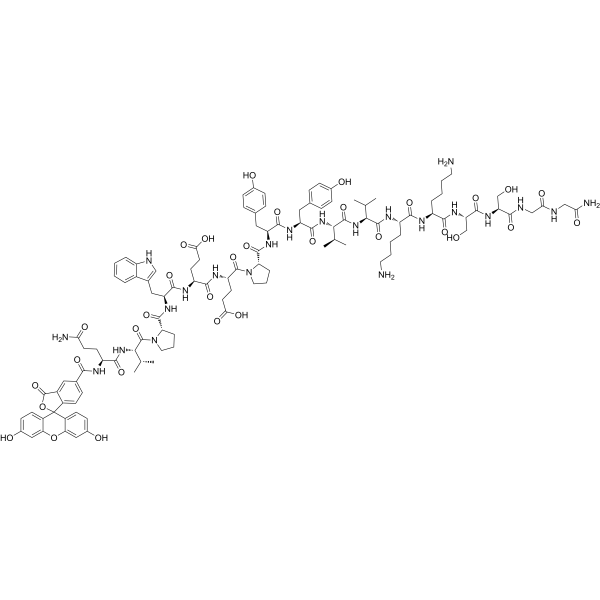
Bevonescein (ALM-488) is a fluorescein-conjugated peptide that facilitates the targeted delivery of a fluorescent moiety (5-FAM (HY-66022)) to nerves after intravenous (IV) administration. Bevonescein binds nerve-associated connective tissue, labels peripheral nerves under real-time fluorescence imaging (FL) in living mice and human ex vivo nerve tissue. Bevonescein is a peptide-linked tracer which fluorescently labeled both intact and degenerated nerves (Ex/Em = 480/530 nm) .
loading...
    loading...
Cat. No.: HY-D1065
CAS No.: 1392488-04-8
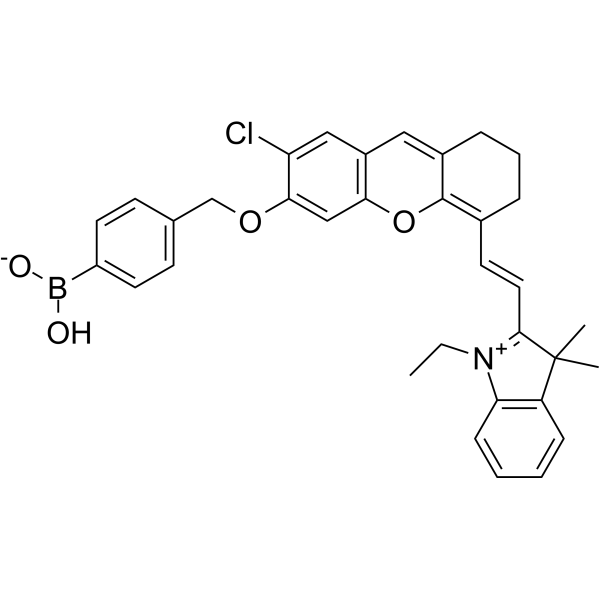
NIR-H2O2 is a cell-permeable near-infrared (NIR) fluorescent turn-on sensor. NIR-H2O2 has both absorption and emission in the NIR region. NIR-H2O2 responds to H2O2 with a large turn-on NIR fluorescence signal upon excitation in the NIR region. NIR-H2O2 is capable of imaging endogenously produced H2O2 in living cells and mice .
loading...
    loading...
Cat. No.: HY-151704
CAS No.: 1622335-41-4
Purity:  99.17%
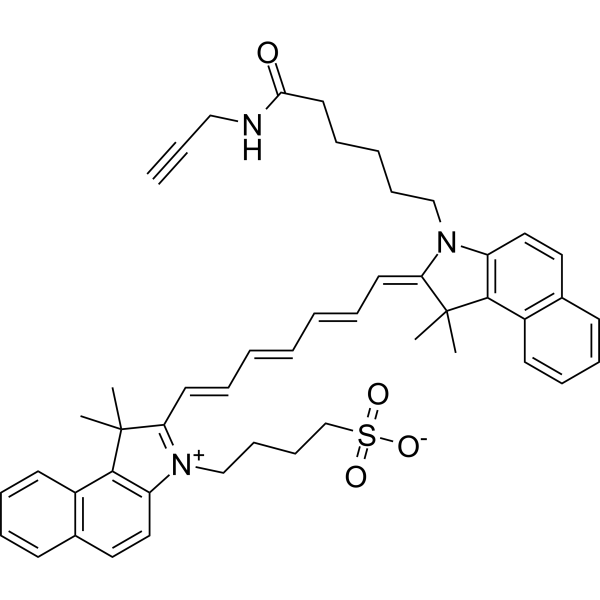
ICG-alkyne is a short-wave infrared (SWIR)-emitting cyanine fluorescent probe based on alkyne-derivatized indocyanine green. ICG-alkyne can undergo click chemistry reaction to conjugate with antibody molecules via binding to the azide groups introduced into antibodies. ICG-alkyne enables SWIR fluorescent molecular imaging of breast tumors in living mice. ICG-alkyne can be used in breast cancer-related research .
loading...
    loading...
Cat. No.: HY-D1066
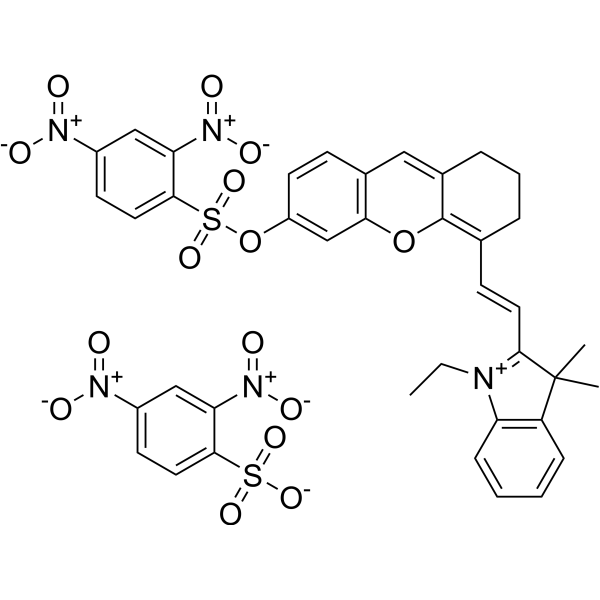
NIR-Thiol dinitrobenzenesulfonate has both absorption and emission in the NIR region. NIR-Thiol dinitrobenzenesulfonate responds to thiol with a large turn-on NIR fluorescence signal upon excitation in the NIR region. NIR-Thiol dinitrobenzenesulfonate is capable of imaging endogenously produced thiol in living cells and mice .
loading...
    loading...
Cat. No.: HY-D3214
CAS No.: 1895099-34-9
NIR-Cu (Ⅱ) is a near-infrared fluorescent Cu 2+ probe. NIR-Cu (Ⅱ) enables fluorescence imaging of Cu 2+ in living mice. NIR-Cu (Ⅱ) reduces self-absorption and exhibits minimal photobleaching, thus supporting in vivo imaging applications .
loading...
    loading...
Cat. No.: HY-D3442
CAS No.: 3121565-89-4
ALDH2 probe 5 is a ALDH2 isoform-selective fluorescent probe with an emission wavelength centered at 494 nm. ALDH2 probe 5 is a turn-on fluorescent substrate for ALDH2; in its unreacted aldehyde form, twisted intramolecular charge transfer (TICT) occurs, resulting in fluorescence quenching. After ALDH2 probe 5 is catalytically oxidized to carboxylate by ALDH2, TICT is inhibited and fluorescence is significantly enhanced. ALDH2 probe 5 enables highly sensitive quantitative imaging of ALDH2 activity in recombinant enzymes, live cells, blood, tissue homogenates, and the brains of living mice. ALDH2 probe 5 can be used for studies related to neuroinflammation .
loading...
    loading...
Cat. No.: HY-D3370
CAS No.: 3114128-41-2
Target:  

Fluorescent Dye iGluR

Research Areas:  

Others

CL-NC is a chemiluminescent probe used for in vivo imaging of N-methyl-D-aspartate receptors (NMDARs), and its detection mechanism relies on bioorthogonal activation achieved via a tetrazine-triggered click-to-release reaction. The isonitrile group of CL-NC undergoes a click reaction with tetrazine, followed by hydrolysis and β-elimination to release a phenoxide anion, which induces the departure of adamantane and generates chemiluminescence. CL-NC has a maximum absorption wavelength of approximately 425 nm, a maximum fluorescence emission wavelength of approximately 670 nm, and a maximum chemiluminescence emission wavelength of 710 nm. When used in combination with Tz-IFDL (HY-D3369), an NMDAR ligand conjugated with tetrazine, CL-NC enables targeted imaging of NMDARs in living cells, as well as in the brain and spinal cord of living mice .
loading...
    loading...

