6 Results for "

nuclear pore proteins

" in MedChemExpress (MCE) Product Catalog:
Products (6)

6 Results for "nuclear pore proteins" in MCE Product Catalog:

Cat. No.: HY-170430
CAS No.: 3055558-98-7
Research Areas:  

Cancer

HGC652 is a molecular glue degrader targeting TRIM21 with a TRIM21-dependent nuclear membrane disruption effect. HGC652 binds to the PRY-SPRY domain of TRIM21 with high affinity (Ka=0.061 μM), mediates the interaction between TRIM21 and NUP98, and redirects E3 ligase activity. By triggering the polyubiquitination and proteasomal degradation of nucleoporins (such as NUP155 and GLE1), HGC652 disrupts nuclear membrane integrity, alters nuclear morphology, induces genomic instability, and thereby induces cancer cell death .
loading...
    loading...
Cat. No.: HY-119264
CAS No.: 903499-49-0
PRLX-93936 is a molecular Glues that binds to and reprograms the TRIM21 ubiquitin ligase to degrade nuclear pore complexes. PRLX-93936 binds to TRIM21, forms a ternary complex with TRIM21 and NUP98, and mediates the ubiquitination and proteasomal degradation of NUP98 and other nuclear pore complex proteins. PRLX-93936 induces the loss of short-lived cytoplasmic mRNA transcripts, triggers cancer cell apoptosis (Apoptosis), and inhibits the activated Ras pathway. PRLX-93936 inhibits HIF-1 under hypoxic conditions (IC50 = 0.09 μM in cell-based reporter gene assay). PRLX-93936 suppresses tumor growth in mouse models and improves survival rates in mouse models of multiple myeloma. PRLX-93936 is applicable to research related to pancreatic cancer and multiple myeloma .
loading...
    loading...
Cat. No.: HY-169325
Research Areas:  

Cancer

(S)-ACE‑OH is the active metabolite of Acepromazine (HY-B1506), acting as a molecular glue degrader. (S)-ACE-OH induces functional interaction between TRIM21 and NUP98, promoting protein ubiquitination and degradation of TRIM21 at the nuclear pore complex. (S)-ACE-OH triggers nucleocytoplasmic transport disorder and exerts interferon-potentiated cytotoxic effects on certain cancer cells. (S)-ACE-OH can be used in cancer-related research .
loading...
    loading...
Cat. No.: HY-119264A
CAS No.: 1094210-96-4
Purity:  99.83%
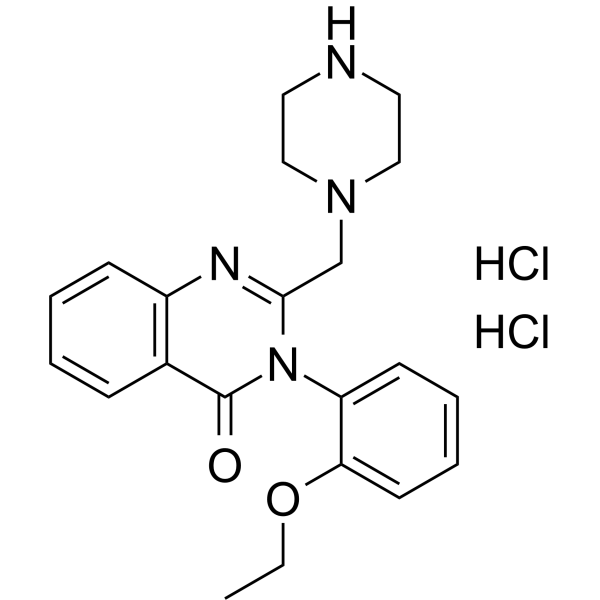
PRLX-93936 dihydrochloride is a molecular Glues that binds to and reprograms the TRIM21 ubiquitin ligase to degrade nuclear pore complexes. PRLX-93936 dihydrochloride binds to TRIM21, forms a ternary complex with TRIM21 and NUP98, and mediates the ubiquitination and proteasomal degradation of NUP98 and other nuclear pore complex proteins. PRLX-93936 dihydrochloride induces the loss of short-lived cytoplasmic mRNA transcripts, triggers cancer cell apoptosis (Apoptosis), and inhibits the activated Ras pathway. PRLX-93936 dihydrochloride inhibits HIF-1 under hypoxic conditions (IC50 = 0.09 μM in cell-based reporter gene assay). PRLX-93936 dihydrochloride suppresses tumor growth in mouse models and improves survival rates in mouse models of multiple myeloma. PRLX-93936 dihydrochloride is applicable to research related to pancreatic cancer and multiple myeloma .
loading...
    loading...
Cat. No.: HY-P1730
Target:  

Inhibitory Antibodies

Research Areas:  

Cancer

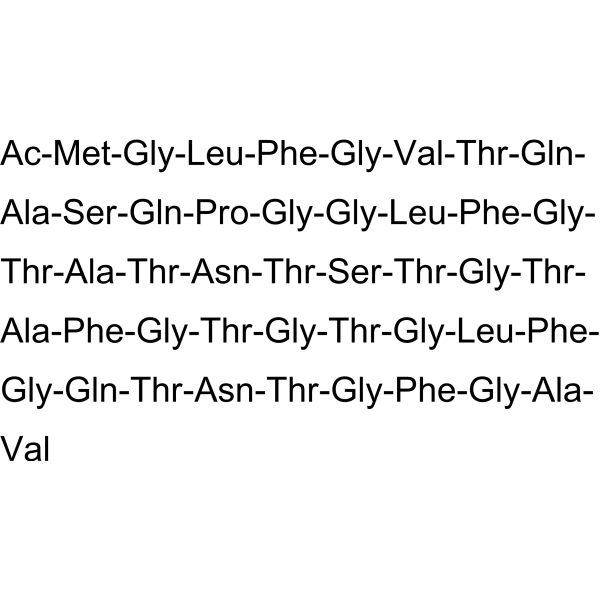
Nuclear pore complex protein Nup98 (315-360) is the 315-360 fragment part of the nuclear pore complex (NPC) protein .
loading...
    loading...
Cat. No.: HY-186250
CAS No.: 3055559-33-3
Research Areas:  

Cancer

TRIM21 ligand-1 is a TRIM21 ligand. TRIM21 ligand-1 mediates the degradation of nuclear pore complex proteins GLE1 and NUP155. TRIM21 ligand-1 induces the disassembly of nuclear pore complexes, which in turn leads to cell death. TRIM21 ligand-1 can be used in cancer research .
loading...
    loading...

