



PRLX-93936 dihydrochloride

Based on 1 Customer Validation
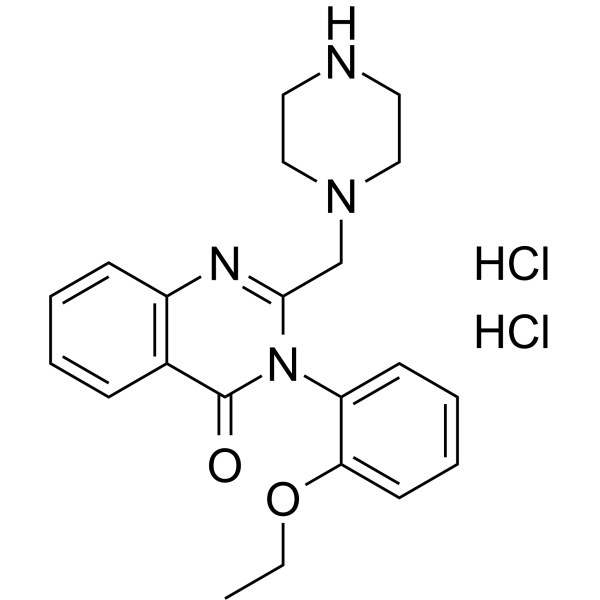
PRLX-93936 dihydrochloride is a molecular Glues that binds to and reprograms the TRIM21 ubiquitin ligase to degrade nuclear pore complexes. PRLX-93936 dihydrochloride binds to TRIM21, forms a ternary complex with TRIM21 and NUP98, and mediates the ubiquitination and proteasomal degradation of NUP98 and other nuclear pore complex proteins. PRLX-93936 dihydrochloride induces the loss of short-lived cytoplasmic mRNA transcripts, triggers cancer cell apoptosis (Apoptosis), and inhibits the activated Ras pathway. PRLX-93936 dihydrochloride inhibits HIF-1 under hypoxic conditions (IC50 = 0.09 μM in cell-based reporter gene assay). PRLX-93936 dihydrochloride suppresses tumor growth in mouse models and improves survival rates in mouse models of multiple myeloma. PRLX-93936 dihydrochloride is applicable to research related to pancreatic cancer and multiple myeloma.
For research use only. We do not sell to patients.
- Purity : 99.83%
- CAS No.: 1094210-96-4
- Formula: C21H26Cl2N4O2
- Molecular Weight:437.36
-
Storage:
4°C, sealed storage, away from moisture
* In solvent : -80°C, 6 months; -20°C, 1 month (sealed storage, away from moisture)

To place orders, for customer services and technical support, please contact: MedChemExpress USA
Tel: 609-228-6898 E-mail: [email protected] [email protected]


-
 Biological Activity
-
Chemical Information
-
Solvent & Solubility
- Purity & Documentation
- References
-
 Help & FAQs




Biological Activity
Description
In Vitro
PRLX-93936 (72 h) dihydrochloride selectively inhibits the viability of human cancer cell lines, with the strongest activity observed in pancreatic and head and neck cancer cell lines, and reduces the survival rate of human cancer cell lines with high TRIM21 expression[1].
PRLX-93936 (500 nM; 30 min-10 h) dihydrochloride induces TRIM21-dependent degradation of nuclear pore complex proteins and MCL1 in PANC-1 human pancreatic cancer cells[1].
PRLX-93936 (500 nM; 30 min) dihydrochloride induces TRIM21-dependent ubiquitination of nuclear pore complex proteins in human pancreatic cancer cell line PANC-1 pretreated with MG132 (HY-13259)[1].
PRLX-93936 (cells are pretreated with 1 μM MG132 for 30 min, followed by treatment with 500 nM PRLX-93936 for 30 min or 2 h, and co-treated with 100 nM biotin for 30 min) dihydrochloride induces the translocation of TRIM21 to the nuclear pore complex in human pancreatic cancer cell line PANC-1. Treatment with 500 nM PRLX-93936 dihydrochloride for 30 min or 2 h results in close proximity between TRIM21 and nucleoporins such as NUP98[1].
PRLX-93936 (2 h) dihydrochloride acts as a molecular glue that induces a direct, dose-dependent interaction between TRIM21 and NUP98 in HEK293T cells[1].
PRLX-93936 (for 5 days) dihydrochloride potently reduces the viability of cholangiopancreatic organoids with high TRIM21 expression, and induces TRIM21-dependent degradation of nuclear pore complex proteins.
PRLX-93936 (1-10 μM) dihydrochloride reduces HIF-1α protein accumulation under hypoxic conditions[3].
MedChemExpress (MCE) has not independently confirmed the accuracy of these methods. They are for reference only.
In Vivo
MedChemExpress (MCE) has not independently confirmed the accuracy of these methods. They are for reference only.
-
Animal Model:NOD.Cg-Prkdcscid Il2rgtm1Wjl/SzJ (female, 6 weeks old, subcutaneous xenograft with 5×10⁶ PANC-1 cells/HS766T cells/PANC-1 cells)[1]
-
Dosage:50, 100 mg/kg
-
Administration:i.p.; daily; 21 days/i.p.; two daily doses
-
Result:Reduced average tumor volume.
Depleted several nucleoporins (NUP98, NUP96, NUP35) in tumor tissue, confirming on-target degradation of nuclear pore complex components in vivo.


Chemical Information
-
CAS No. 1094210-96-4
-
Appearance Solid
-
Molecular Weight 437.36
-
Formula C21H26Cl2N4O2
-
Color White to off-white
-
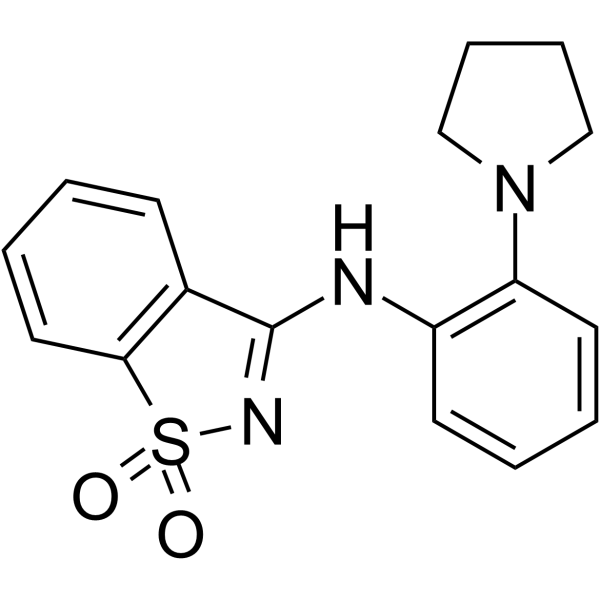
SMILES
O=C1N(C(CN2CCNCC2)=NC3=C1C=CC=C3)C4=CC=CC=C4OCC.Cl.Cl
-
Shipping
Room temperature in continental US; may vary elsewhere.
-
Storage
4°C, sealed storage, away from moisture
* In solvent : -80°C, 6 months; -20°C, 1 month (sealed storage, away from moisture)


Solvent & Solubility
In Vitro:
DMSO : 125 mg/mL (285.81 mM; Need ultrasonic; Hygroscopic DMSO has a significant impact on the solubility of product, please use newly opened DMSO)
Please refer to the solubility information to select the appropriate solvent. Once prepared, please aliquot and store the solution to prevent product inactivation from repeated freeze-thaw cycles.
Storage method and period of stock solution: -80°C, 6 months; -20°C, 1 month (sealed storage, away from moisture). When stored at -80°C, please use it within 6 months. When stored at -20°C, please use it within 1 month.
Please refer to the solubility information to select the appropriate solvent. Once prepared, please aliquot and store the solution to prevent product inactivation from repeated freeze-thaw cycles.
Storage method and period of stock solution: -80°C, 6 months; -20°C, 1 month (sealed storage, away from moisture). When stored at -80°C, please use it within 6 months. When stored at -20°C, please use it within 1 month.
Concentration (start) × Volume (start) = Concentration (final) × Volume (final)


Purity & Documentation
-
Data Sheet (279 KB)
-
SDS (393 KB)
- English - EN (393 KB)
- Français - FR (393 KB)
- Deutsch - DE (393 KB)
- Norwegian - NO (393 KB)
- Español - ES (393 KB)
- Swedish - SV (393 KB)
- Italian - IT (393 KB)
- Korean - KR (393 KB)
- Portuguese - PT (393 KB)
-
Handling Instructions (2659 KB)
References
[1]. Yuan L, et al. Defining the Antitumor Mechanism of Action of a Clinical-stage Compound as a Selective Degrader of the Nuclear Pore Complex. Cancer Discov. 2025;15(12):2505-2529. [Content Brief]
[3]. Huang W, et al. Synthesis and evaluation of quinazolin-4-ones as hypoxia-inducible factor-1α inhibitors. Bioorg Med Chem Lett. 2011 Sep 15;21(18):5239-43. [Content Brief]


Complete Stock Solution Preparation Table
Please refer to the solubility information to select the appropriate solvent. Once prepared, please aliquot and store the solution to prevent product inactivation from repeated freeze-thaw cycles.
Storage method and period of stock solution: -80°C, 6 months; -20°C, 1 month (sealed storage, away from moisture). When stored at -80°C, please use it within 6 months. When stored at -20°C, please use it within 1 month.
| Optional Solvent | Concentration Solvent Mass | 1 mg | 5 mg | 10 mg | 25 mg |
|---|---|---|---|---|---|
| DMSO | 1 mM | 2.2864 mL | 11.4322 mL | 22.8645 mL | 57.1612 mL |
| 5 mM | 0.4573 mL | 2.2864 mL | 4.5729 mL | 11.4322 mL | |
| 10 mM | 0.2286 mL | 1.1432 mL | 2.2864 mL | 5.7161 mL | |
| 15 mM | 0.1524 mL | 0.7621 mL | 1.5243 mL | 3.8107 mL | |
| 20 mM | 0.1143 mL | 0.5716 mL | 1.1432 mL | 2.8581 mL | |
| 25 mM | 0.0915 mL | 0.4573 mL | 0.9146 mL | 2.2864 mL | |
| 30 mM | 0.0762 mL | 0.3811 mL | 0.7621 mL | 1.9054 mL | |
| 40 mM | 0.0572 mL | 0.2858 mL | 0.5716 mL | 1.4290 mL | |
| 50 mM | 0.0457 mL | 0.2286 mL | 0.4573 mL | 1.1432 mL | |
| 60 mM | 0.0381 mL | 0.1905 mL | 0.3811 mL | 0.9527 mL | |
| 80 mM | 0.0286 mL | 0.1429 mL | 0.2858 mL | 0.7145 mL | |
| 100 mM | 0.0229 mL | 0.1143 mL | 0.2286 mL | 0.5716 mL |


PRLX-93936 dihydrochloride Related Classifications
HY-119264A Related Classifications
 Powered by Bioz