1. Search Result
Search Result
Results for "

phospholipid classes

" in MedChemExpress (MCE) Product Catalog:

12

Inhibitors & Agonists

1

Screening Libraries

1

Fluorescent Dyes

5

Biochemical Assay Reagents

1

Natural
Products

2

Click Chemistry

3

Oligonucleotides

1

GMP Molecules

Cat. No. Product Name Target Research Areas Chemical Structure
  • HY-129084
    Propargylcholine bromide
    1 Publications Verification

    Biochemical Assay Reagents Others
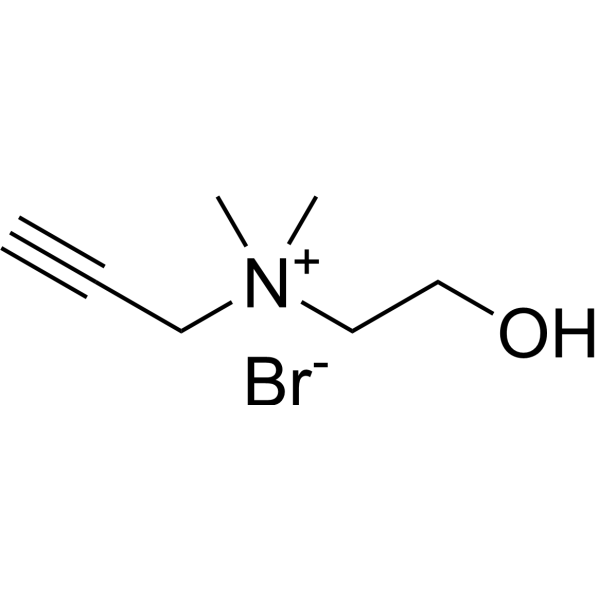
    Propargylcholine bromide is a choline analogue containing terminal propargyl that can be incorporated into all classes of Choline-containing phospholipids such as phosphatidylcholine and sphingomyelin, labeling Choline-containing phospholipids. Propargylcholine bromide-labeled phospholipid molecules can be visualized in cells with high sensitivity and spatial resolution. Propargylcholine bromide can be used as a molecular tool to study the biochemical and metabolic processes of Choline-containing phospholipids in cells . Propargylcholine (bromide) is a click chemistry reagent, it contains an Alkyne group and can undergo copper-catalyzed azide-alkyne cycloaddition (CuAAc) with molecules containing Azide groups.
    Propargylcholine bromide
  • HY-148123

    Biochemical Assay Reagents Neurological Disease
    Glycerophospholipids and cephalins are a class of phospholipid compounds and important components of neural membranes. Glycerophospholipids and cephalins are hydrolysis substrates of phospholipase (such as PLA2, PLC, and PLD). After complete hydrolysis, they produce 1 mol of glycerol, phosphate, ethanolamine, and 2 mol of fatty acids, respectively. Glycerophospholipids and cephalins can maintain membrane structure, fluidity, and ion permeability, and serve as precursors of second messengers such as arachidonic acid and diacylglycerol. Glycerophospholipids and cephalins can regulate signal transduction, cell apoptosis, and membrane transport, and are used in the study of neurodegenerative diseases (such as Alzheimer's disease) .
    Glycerophospholipids, cephalins
  • HY-142988

    1S-2M-PC

    Liposome Others
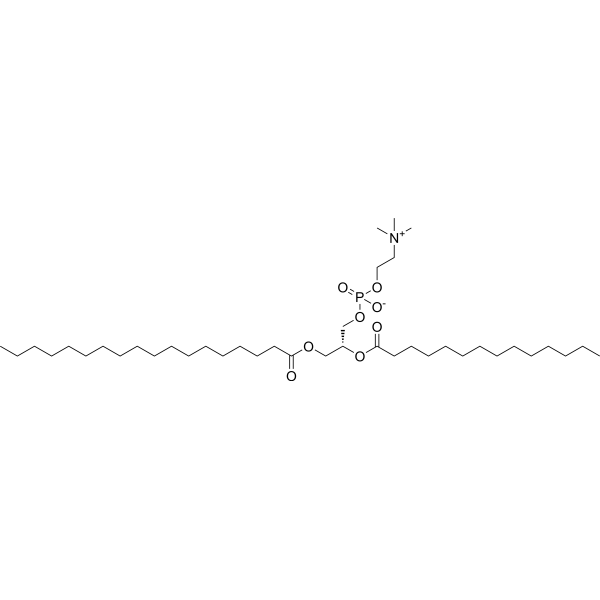
    1-Stearoyl-2-myristoyl-sn-glycero-3-PC (1S-2M-PC) belongs to the class of asymmetric phospholipids. 1-Stearoyl-2-myristoyl-sn-glycero-3-PC is abundant in biological membranes .
    1-Stearoyl-2-myristoyl-sn-glycero-3-PC
  • HY-P2817

    PLCs

    Phospholipase Infection Metabolic Disease
    Phospholipase C (PLCs) is a class of phospholipases. Phospholipase C participates in cellular signaling and regulation by virtue of its ability to hydrolyze membrane phospholipids into di-acyl-glycerol (DAG) and inositol triphosphate (IP3), which further causes the activation of other signaling pathways involved in various processes, including immune response .
    Phospholipase C
  • HY-112005GL

    Dioleoylphosphatidylethanolamine (GMP Like); 1,2-Dioleoyl-sn-glycero-3-phosphoethanolamine (GMP Like)

    Liposome Endogenous Metabolite Inflammation/Immunology
    DOPE (GMP Like) is the GMP Like class DOPE (HY-112005), and can be used as pharmaceutical excipients. GMP small molecules works appropriately as an auxiliary reagent for cell therapy manufacture. DOPE is a neutral helper lipid for cationic liposome and combines with cationic phospholipids to improve transfection efficiency of naked siRNA .
    DOPE (GMP Like)
  • HY-154857

    Scavenger Receptor Class B type I (SR-BI) Cancer
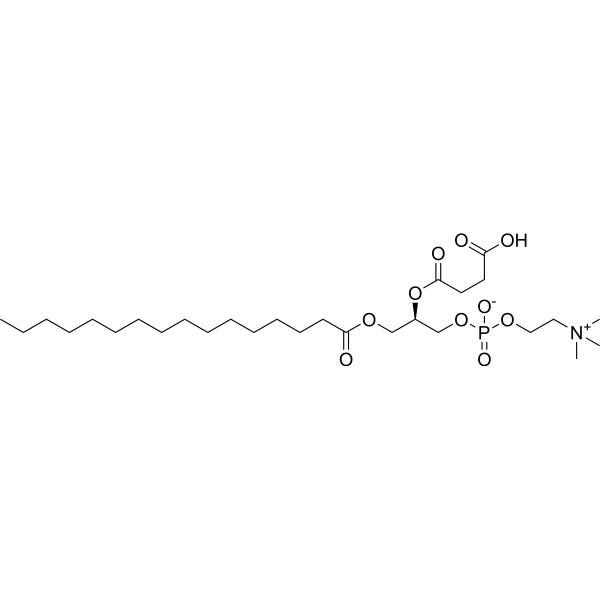
    1-Palmitoyl-2-succinyl-sn-glycerophosphorylcholine is a glycerophosphorylcholine, consisting of glycerol phosphate, choline and palmitic acid. It accumulates in vivo at sites of oxidative stress. 1-Palmitoyl-2-succinyl-sn-glycerophosphorylcholine may be a ligand of scavenger receptors class B, while oxidized phospholipids oxPC(CD36) are potent ligands of scavenger receptors class B (CD36 and SR-BI). Oxidized phospholipids (oxPLs) also play an important role in tumor apoptosis, may be elevated in malignant biliary strictures .
    1-Palmitoyl-2-succinyl-sn-glycerophosphorylcholine
  • HY-19594

    WIN 13146

    Parasite Infection
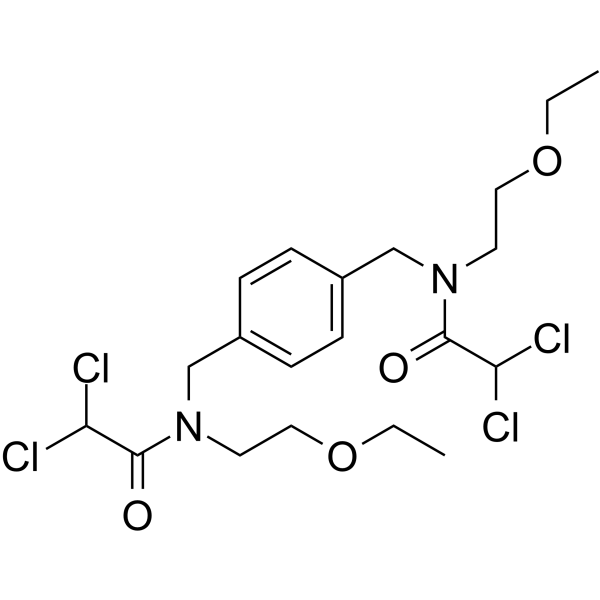
    Teclozan (WIN 13146) is an antiprotozoal agent, class in benzylamine derivatives. Teclozan intervenes in the phospholipid metabolism preventes the formation of arachidonic acid. Teclozan acts in the intestinal lumen being effective in Anti-G. intestinalis. Teclozan can be used for the research of protozoan infections .
    Teclozan
  • HY-147207C

    Liposome Others
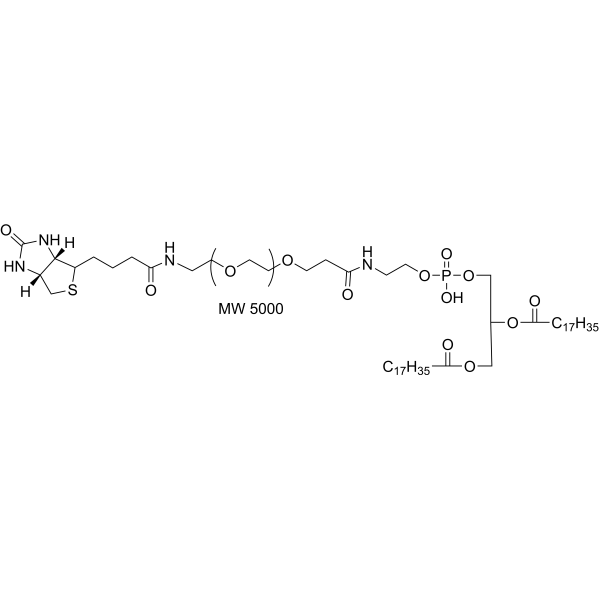
    Phospholipid-PEG5000-Biotin is a phospholipid PEG derivative, can be used for modify liposome and cells surface, and pancreatic islets for cell transplantation. Phospholipid is a class of lipid containing a hydrophilic “head” and two hydrophobic “tails”; PEG is a hydrophilic and water-soluble polymer with low toxicity; Biotin is an enzyme co-factor, can be used for labeling protein .
    Phospholipid-PEG5000-Biotin
  • HY-147207A

    Liposome Others
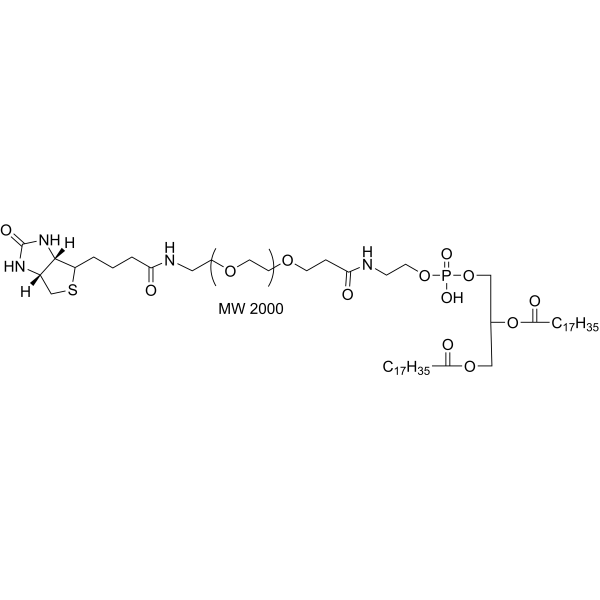
    Phospholipid-PEG2000-Biotin is a Biotin labeled phospholipid PEG derivative, can be used for modify liposome and cells surface, and pancreatic islets for cell transplantation. Phospholipid is a class of lipid containing a hydrophilic "head" and two hydrophobic "tails" ; PEG is a hydrophilic and water-soluble polymer with low toxicity; Biotin is an enzyme co-factor, can be used for labeling protein .
    Phospholipid-PEG2000-Biotin
  • HY-157641A

    Biochemical Assay Reagents Others
    (2S)-18:1 Lyso PC is the (2S)-enantiomer of lysophosphatidylcholine (Lyso PC). LysoPC is a class of phospholipids, which are essential components of cell membranes.
    (2S)-18:1 Lyso PC
  • HY-19594R

    WIN 13146 (Standard)

    Reference Standards Parasite Infection
    Teclozan (Standard) is the analytical standard of Teclozan. This product is intended for research and analytical applications. Teclozan (WIN 13146) is an antiprotozoal agent, class in benzylamine derivatives. Teclozan intervenes in the phospholipid metabolism preventes the formation of arachidonic acid. Teclozan acts in the intestinal lumen being effective in Anti-G. intestinalis. Teclozan can be used for the research of protozoan infections .
    Teclozan (Standard)
  • HY-W895360

    Biochemical Assay Reagents Others
    pacFA is a bifunctional fatty acid with both photocrosslinking and click chemistry properties. pacFA can be metabolically incorporated into phospholipids by cells, enabling in-situ capture, identification and imaging of protein-lipid interactions in live cells and living organisms via ultraviolet crosslinking and click reactions .
    pacFA

Inquiry Online

Your information is safe with us. * Required Fields.

Salutation


Country or Region *

Applicant Name *


Organization Name *

Department *


Email Address *


Product Name *

Cat. No.


Requested quantity *

Phone Number *


Remarks

Inquiry Online

Inquiry Information

Product Name:
Cat. No.:
Quantity:
MCE Japan Authorized Agent:

