5 Results for "

plant protoplasts

" in MedChemExpress (MCE) Product Catalog:
Products (5)

5 Results for "plant protoplasts" in MCE Product Catalog:

Cat. No.: HY-B2220A
CAS No.: 9012-54-8
Research Areas:  

Others

Cellulase R-10 from Trichoderma Vride is an enzyme mixture that includes cellulase, hemicellulase, pectinase and protease, etc. Cellulase R-10 from Trichoderma Vride can act on the 1,4-β-D-glucosidic bonds in cellulose, catalyzing the hydrolysis of cellulose molecules and generating cellulose oligosaccharides, cellulose di-saccharides and glucose. Cellulase R-10 from Trichoderma Vride can be used in combination with lyase R-10 to break down the cell walls of plants, preparing protoplasts. Cellulase R-10 from Trichoderma Vride is widely applied in plant cell hybridization research .
loading...
    loading...
Cat. No.: HY-N1033
CAS No.: 140631-27-2
Research Areas:  

Infection

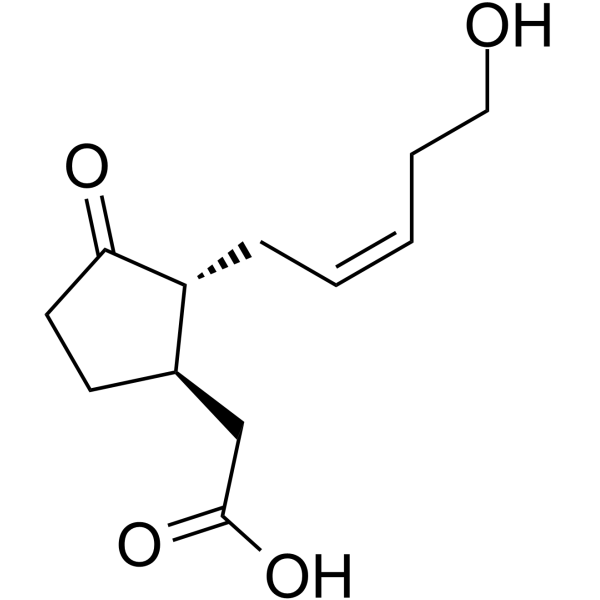
12-Hydroxyjasmonic acid is a metabolite of Jasmonic acid (HY-122464A) and an inducer of defense responses. 12-Hydroxyjasmonic acid can be isolated from potato leaflets. During the response of sugar beet plants to Cercospora beticola infection, 12-Hydroxyjasmonic acid is released through deglycosylation of its glucoside form and participates in the Jasmonic acid-mediated defense signaling pathway. 12-Hydroxyjasmonic acid mediates changes in source-sink relationships during pathogen infection, prioritizing the activation of defense processes over growth processes. 12-Hydroxyjasmonic acid serves as a substrate for salicylic acid Glycosyltransferases in tobacco and rice. 12-Hydroxyjasmonic acid can induce leaflet closure in Samanea saman. 12-Hydroxyjasmonic acid acts as a potato tuber-inducing substance. 12-Hydroxyjasmonic acid does not induce protoplast shrinkage in extensor motor cells of Samanea saman. 12-Hydroxyjasmonic acid can be used in studies related to brown spot disease .
loading...
    loading...
Cat. No.: HY-172190
MS Medium is a basic medium for plant tissue culture. MS Medium has a high concentration of inorganic salts and is suitable for plant protoplast, cell and tissue culture .
loading...
    loading...
Cat. No.: HY-DY2041
Target:  

Fluorescent Dye

Research Areas:  

Infection

Callose Staining Solution (Aniline Blue, Bright-Field Method) is a fluorescent dye used for detecting callose in plant tissues, green algal cell walls, plant cells, and protoplasts. Callose Staining Solution (Aniline Blue, Bright-Field Method) specifically binds to callose, a β-(1,3)-D-glucan polymer, and exhibits blue-green fluorescence under alkaline conditions with reduced background staining and non-toxicity to living cells. Callose Staining Solution (Aniline Blue, Bright-Field Method) is suitable for observation under UV or epifluorescence microscopy (Ex/Em = 365-370/397-509 nm). Callose Staining Solution (Aniline Blue, Bright-Field Method) can be used in studies related to the visualization of callose deposition in plants .
loading...
    loading...
Cat. No.: HY-179188
DPD Medium is mainly used for tissue culture and protoplast culture of woody plants, especially trees.
loading...
    loading...

