16 Results for "

quinone derivatives.

" in MedChemExpress (MCE) Product Catalog:
Products (16)

16 Results for "quinone derivatives." in MCE Product Catalog:

1
1 Cited Publications
Cat. No.: HY-128895
CAS No.: 1800405-30-4
Purity:  99.94%
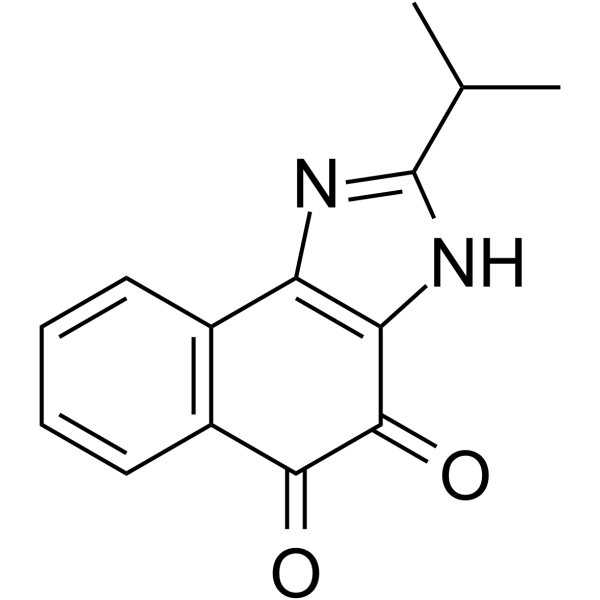
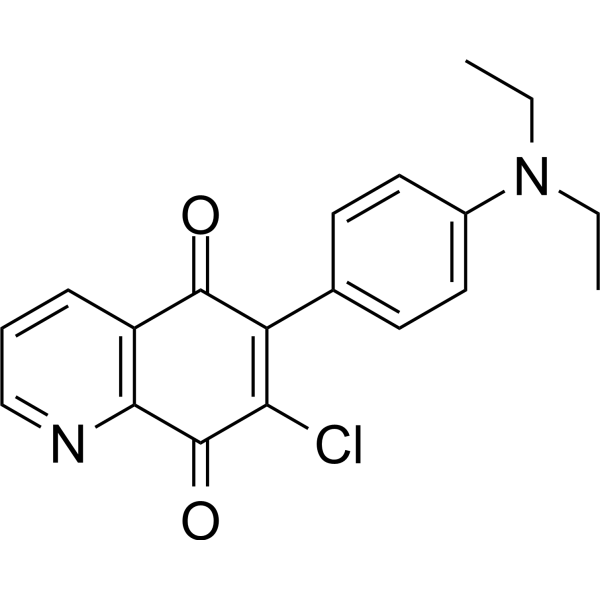
KL1333, a derivative of β-lapachone, is an orally available NAD+ modulator. KL1333 reacts with NAD(P)H:quinone oxidoreductase 1 (NQO1) as a substrate, resulting in increases in intracellular NAD+ levels via NADH oxidation. KL1333 improves energy metabolism and mitochondrial dysfunction in MELAS fibroblasts. KL1333 protects against Cisplatin-induced ototoxicity in mouse cochlear cultures .
loading...
    loading...
1
1 Cited Publications
Cat. No.: HY-160831
CAS No.: 74447-88-4
Synonyms: PQQ-TME
Target:  

α-synuclein

Research Areas:  

Neurological Disease

PQQ-trimethylester (PQQ-TME) is a synthetic compound that is a trimethylester derivative of pyrroloquinoline quinone (PQQ). PQQ-trimethylester has twice the blood-brain barrier permeability of PQQ (HY-100196) in vitro. In addition, PQQ-trimethylester shows strong inhibitory activity against α-synuclein, amyloid β1-42 (Aβ1-42) and prion protein fibrillation. PQQ-trimethylester can be used in the study of neurodegenerative diseases .
loading...
    loading...
1
1 Cited Publications
Cat. No.: HY-W176199
CAS No.: 3421-08-7
DPPD-Q is a quinone derivative of p-phenylenediamine antioxidants and an analog of DTPD-Q (HY-163650). DPPD-Q is identified as a major sewage treatment plant effluent .
loading...
    loading...
1
1 Cited Publications
Cat. No.: HY-W007671
CAS No.: 1080-06-4
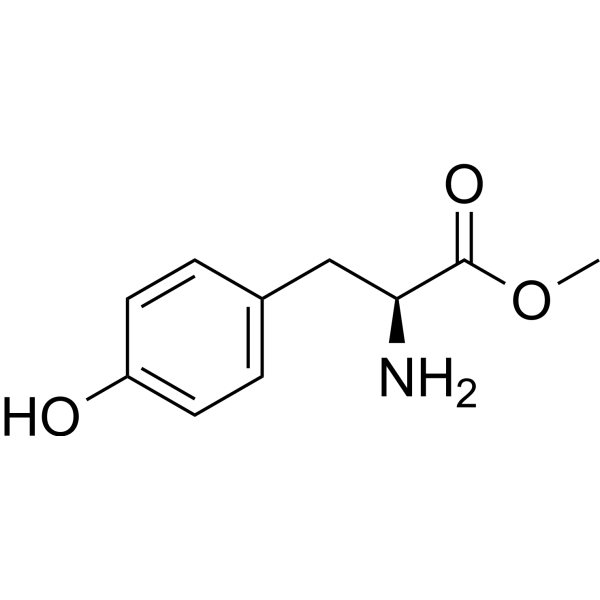
H-Tyr-OMe is an amino acid derivative and also a coordinating ligand for Cu II ions. H-Tyr-OMe can serve as a surface functionalization reagent for carbon dots, and is used to prepare fluorescent probes for biothiol sensing. H-Tyr-OMe is oxidized to quinone under the catalysis of Tyrosinase via its phenolic hydroxyl group, which quenches the fluorescence of carbon dots. H-Tyr-OMe contains potential coordination sites, including carboxyl, amino and phenolic hydroxyl groups .
loading...
    loading...
1
1 Cited Publications
Cat. No.: HY-W012228
CAS No.: 3417-91-2
Research Areas:  

Others

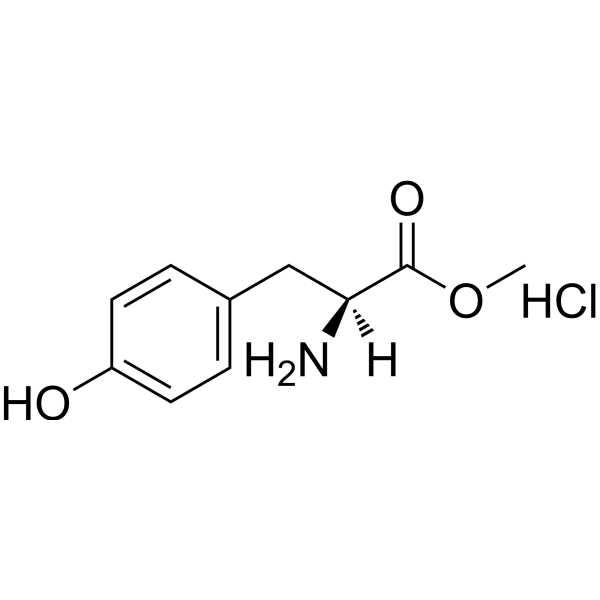
H-Tyr-OMe.HCl is an amino acid derivative and also a coordinating ligand for Cu II ions. H-Tyr-OMe.HCl can serve as a surface functionalization reagent for carbon dots, and is used to prepare fluorescent probes for biothiol sensing. H-Tyr-OMe.HCl is oxidized to quinone under the catalysis of Tyrosinase via its phenolic hydroxyl group, which quenches the fluorescence of carbon dots. H-Tyr-OMe.HCl contains potential coordination sites, including carboxyl, amino and phenolic hydroxyl groups .
loading...
    loading...
Cat. No.: HY-125999
CAS No.: 1147883-03-1
Purity:  99.53%
Research Areas:  

Neurological Disease

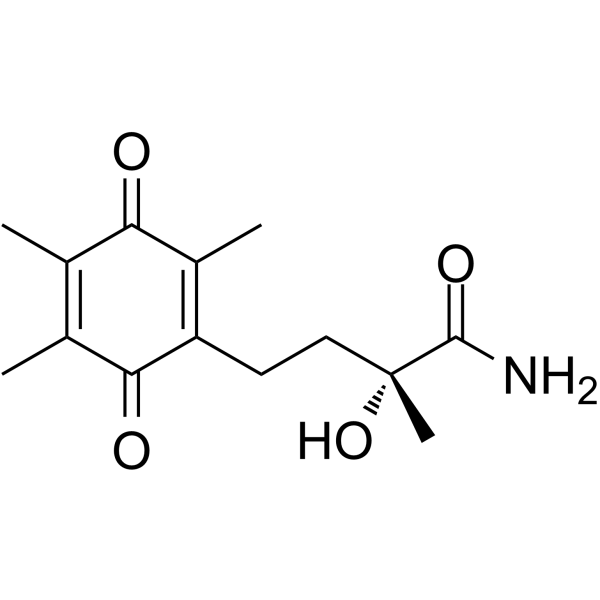
EPI-589, a quinone derivative, is a safe and well tolerated oxidoreductase enzyme inhibitor and a free radical scavenger, with blood-brain barrier permeable and orally available. EPI-589 is a redox-active neuroprotectant that effectively delays the symptoms of motor neuron disease in wobbler mice. EPI-589 can be used in amyotrophic lateral sclerosis (ALS) research .
loading...
    loading...
Cat. No.: HY-131722
CAS No.: 389614-94-2
Purity:  98.75%
Target:  

Phospholipase

Research Areas:  

Cardiovascular Disease

EA4, a derivative of quinone, is an inhibitor for both rPLA and cPLA. EA4 can inhibit rPLA2 with a Ki value of 130 μM. EA4 can be used for the research of hemostasis, thrombosis, and erythropoiesis .
loading...
    loading...
Cat. No.: HY-176151
CAS No.: 3121970-31-5
Synonyms: HPPD-quinone
Research Areas:  

Others

HPPD-Q (HPPD-quinone) is a substituted p-phenylenediamine quinone and derivative of 6-PPD-Q.
loading...
    loading...
Cat. No.: HY-CE01425
Synonyms: 6-Hydroxydopa quinone-coenzyme A
Research Areas:  

Metabolic Disease

6-Hydroxydopa-quinone-CoA (6-Hydroxydopa quinone-coenzyme A) is a coenzyme A derivative .
loading...
    loading...
Cat. No.: HY-169493
CAS No.: 2952779-34-7
Target:  

Drug Derivative

Research Areas:  

Metabolic Disease

OPPD-Q is a p-phenylenediamine-quinone (PPD-Q) and an oxidized derivative of the aromatic amine antioxidant OPPD.
loading...
    loading...
Cat. No.: HY-N11789
CAS No.: 100205-29-6
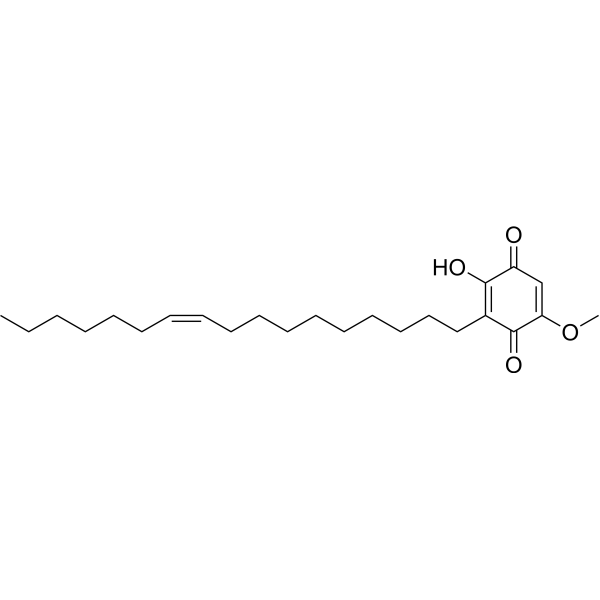
3-Hydroxyirisquinone is a quinone derivative, which can isolated from the seeds of Iris bungei Maxim .
loading...
    loading...
Cat. No.: HY-W007671R
CAS No.: 1080-06-4
H-Tyr-OMe (Standard) is the analytical standard of H-Tyr-OMe (HY-W007671). This product is intended for research and analytical applications. H-Tyr-OMe is an amino acid derivative and also a coordinating ligand for Cu II ions. H-Tyr-OMe can serve as a surface functionalization reagent for carbon dots, and is used to prepare fluorescent probes for biothiol sensing. H-Tyr-OMe is oxidized to quinone under the catalysis of Tyrosinase via its phenolic hydroxyl group, which quenches the fluorescence of carbon dots. H-Tyr-OMe contains potential coordination sites, including carboxyl, amino and phenolic hydroxyl groups .
loading...
    loading...
Cat. No.: HY-184058
CAS No.: 1653-85-6
Synonyms: CCPD-quinone
Target:  

Urease Bacterial

Research Areas:  

Infection

CCPD-Q (CCPD-Quinone) is a quinone derivative of phenylenediamine-based tire wear compounds, as well as a Urease inhibitor against Helicobacter pylori, with an IC50 value of 41.50 μM. CCPD-Q can be used in studies related to Helicobacter pylori infection .
loading...
    loading...
Cat. No.: HY-N20681
CAS No.: 168146-21-2
Evofolin A is a conjugated benzophenone derivative and monocyclic polyketide that exists in the heartwood of Phellodendron chinense var. glabriusculum, the herb Sida acuta, and the filamentous fungus Aspergillus oryzae. Evofolin A acts as an inducer of quinone reductase activity in cultured hepatoma cells .
loading...
    loading...
Cat. No.: HY-189057
Anethole trithione derivative-1 is a derivative of Anethole trithione (HY-B1223), and also a regulator of sulfide:quinone oxidoreductase (SQR) and uncoupling protein 2 (UCP2), with mitochondrial uncoupling-inducing activity and neuroprotective activity. Anethole trithione derivative-1 mediates mitochondrial uncoupling via SQR-dependent reverse electron transport of complex I, ROS-dependent UCP2 activation, and reduction of mitochondrial membrane potential. Anethole trithione derivative-1 reduces brain damage and improves function in mouse models of ischemic and hemorrhagic stroke. Anethole trithione derivative-1 can be used in stroke research .
loading...
    loading...
Cat. No.: HY-L021M
20,566 compounds

From the discovery of traditional Chinese medicine to modern antibiotics, natural products have played an important role in the drug development process. A review of all FDA-approved drugs shows that natural products and natural product-like compounds account for more than one-third of all approved drugs. Nearly half of that came from mammals, a quarter from microbes, and a quarter from plants. Over time, the proportion of microbial natural products and natural product derivatives in approved drugs has increased. Natural products have natural advantages in drug development and can be used as lead compounds in drug discovery for drug identification and mechanism research.

MCE provides a unique collection of 20,566 natural compounds and natural product-like compounds that contain saccharides and glycosides, phenylpropanoids, quinones, flavonoids, terpenoids and glycosides, steroids, alkaloid, phenols, acids and aldehydes. Natural product and natural product-like compounds library is a useful tool for drug discovery that can be used for high-throughput screening (HTS) and high-content screening (HCS).

  • 1

