7 Results for "

rat aorta smooth muscle

" in MedChemExpress (MCE) Product Catalog:
Products (7)

7 Results for "rat aorta smooth muscle" in MCE Product Catalog:

1
1 Cited Publications
Cat. No.: HY-10419A
CAS No.: 81496-19-7
Research Areas:  

Cardiovascular Disease

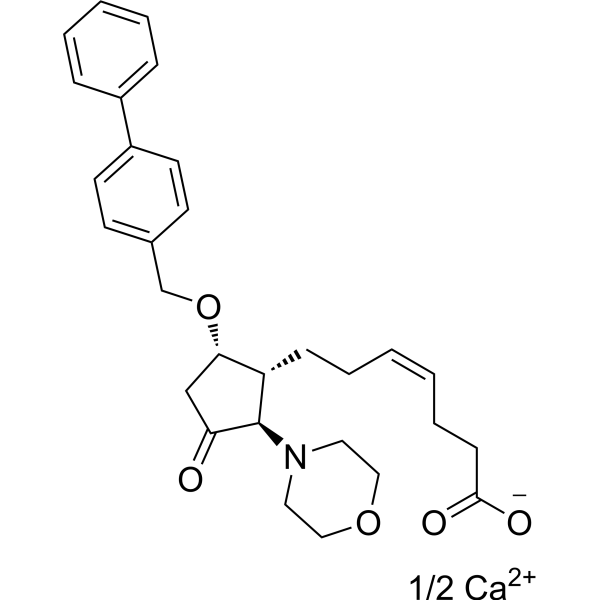
AH23848 hemicalcium salt is an orally active, selective competitive blocker of the thromboxane A2 receptor, with an IC50 value of 50 nM. AH23848 hemicalcium salt shows no activity against other prostaglandin, serotonin (5-HT) or adenosine diphosphate (ADP) receptors. AH23848 hemicalcium salt can be used in the research of occlusive vascular diseases .
loading...
    loading...
Cat. No.: HY-142117
CAS No.: 149091-92-9
Research Areas:  

Others

Adenophostin A is an IP3 receptor (inositol 1,4,5-trisphosphate receptors) modulator and Ca 2+ releaser, with an IC50 of 1.3 nM, an EC50 of 1.4 nM, and a Ki of 0.18 nM in rats, and an IC50 of 0.95 nM in humans. Adenophostin A activates IP3 receptors, stimulates Ca 2+ release from intracellular stores and microsomes, inhibits the binding of [ 3H]IP3 to plasma membrane receptors, and activates chloride channels. Adenophostin A resists phosphorylation and dephosphorylation by IP3 metabolic enzymes to maintain its activity, and increases cytoplasmic [Ca 2+] levels via calcium mobilization from the endoplasmic reticulum of vascular smooth muscle cells. Adenophostin A is applicable to research related to hemorrhagic shock .
loading...
    loading...
Cat. No.: HY-10419
CAS No.: 81443-73-4
Research Areas:  

Cardiovascular Disease

AH23848 (compound 6) is a competitive blocker of the thromboxane A2 receptor and an orally effective agent, with an IC50 value of 50 nM against human targets and a long duration of action.
loading...
    loading...
Cat. No.: HY-135283
CAS No.: 212481-66-8
Synonyms: A-216546
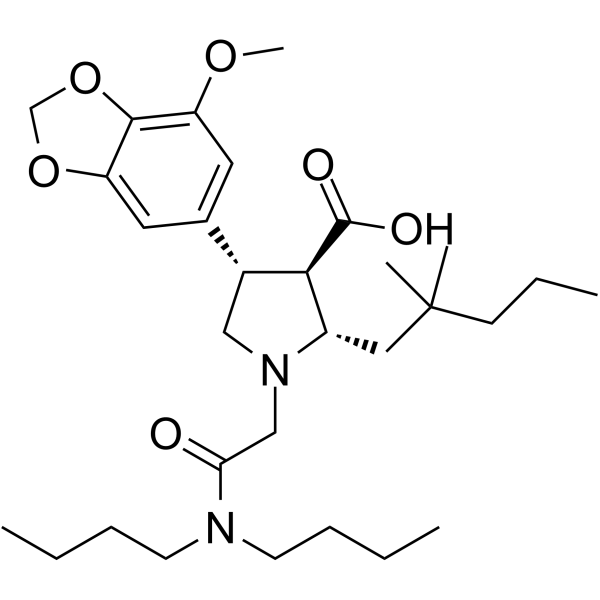
ABT-546 (A-216546) is an orally active ETA receptor antagonist, with Ki values of 0.46 nM and 13000 nM for human ETA and ETB receptors, respectively, and exhibits >25000-fold selectivity over the ETB receptor. ABT-546 effectively inhibits ET-1 (HY-P0202)-induced phosphoinositide hydrolysis (IC50 = 0.59 nM) and arachidonic acid release (IC50 = 3.03 nM), and antagonizes ET-1-induced contraction in isolated vascular rings. ABT-546 crosses the placental barrier but shows extremely low fetal exposure, with a favorable safety profile. ABT-546 inhibits ET-1-induced pressor response and downregulates the NLRP3/ROS/GSDMD-mediated pyroptosis pathway. ABT-546 can be used for research on abdominal aortic aneurysm .
loading...
    loading...
Cat. No.: HY-19138
CAS No.: 135809-60-8
Target:  

Potassium Channel

Research Areas:  

Cardiovascular Disease

SR 47063 is an ATP-sensitive potassium channel (KATP) agonist. SR 47063 selectively activates KATP channels in vascular smooth muscle cells (IC50: 8.1 nM in human saphenous vein, 3.86 nM in rat aorta). SR 47063 promotes potassium efflux and cellular hyperpolarization to induce vasorelaxation. SR 4706 is promising for research of hypertension and related cardiovascular disorders .
loading...
    loading...
Cat. No.: HY-183907
CAS No.: 89943-82-8
Target:  

Calcium Channel

Research Areas:  

Cardiovascular Disease

Cicletanine is a voltage-dependent Ca 2+ channel inhibitor. Cicletanine inhibits α-adrenoceptor-mediated Ca 2+ release pathway, and shows vasodilatory effects on isolated vascular smooth muscle. Cicletanine directly stimulates lysosomal and cytoplasmic cholesteryl ester hydrolase activity. Cicletanine can be used for the research of hypertension .
loading...
    loading...
Cat. No.: HY-19309
CAS No.: 223756-43-2
Synonyms: A-216546 hydrochloride
ABT-546 (A-216546) hydrochloride is an orally active ETA receptor antagonist, with Ki values of 0.46 nM and 13000 nM for human ETA and ETB receptors, respectively, and exhibits >25000-fold selectivity over the ETB receptor. ABT-546 hydrochloride effectively inhibits ET-1 (HY-P0202)-induced phosphoinositide hydrolysis (IC50 = 0.59 nM) and arachidonic acid release (IC50 = 3.03 nM), and antagonizes ET-1-induced contraction in isolated vascular rings. ABT-546 hydrochloride crosses the placental barrier but shows extremely low fetal exposure, with a favorable safety profile. ABT-546 hydrochloride inhibits ET-1-induced pressor response and downregulates the NLRP3/ROS/GSDMD-mediated pyroptosis pathway. ABT-546 hydrochloride can be used for research on abdominal aortic aneurysm .
loading...
    loading...

